
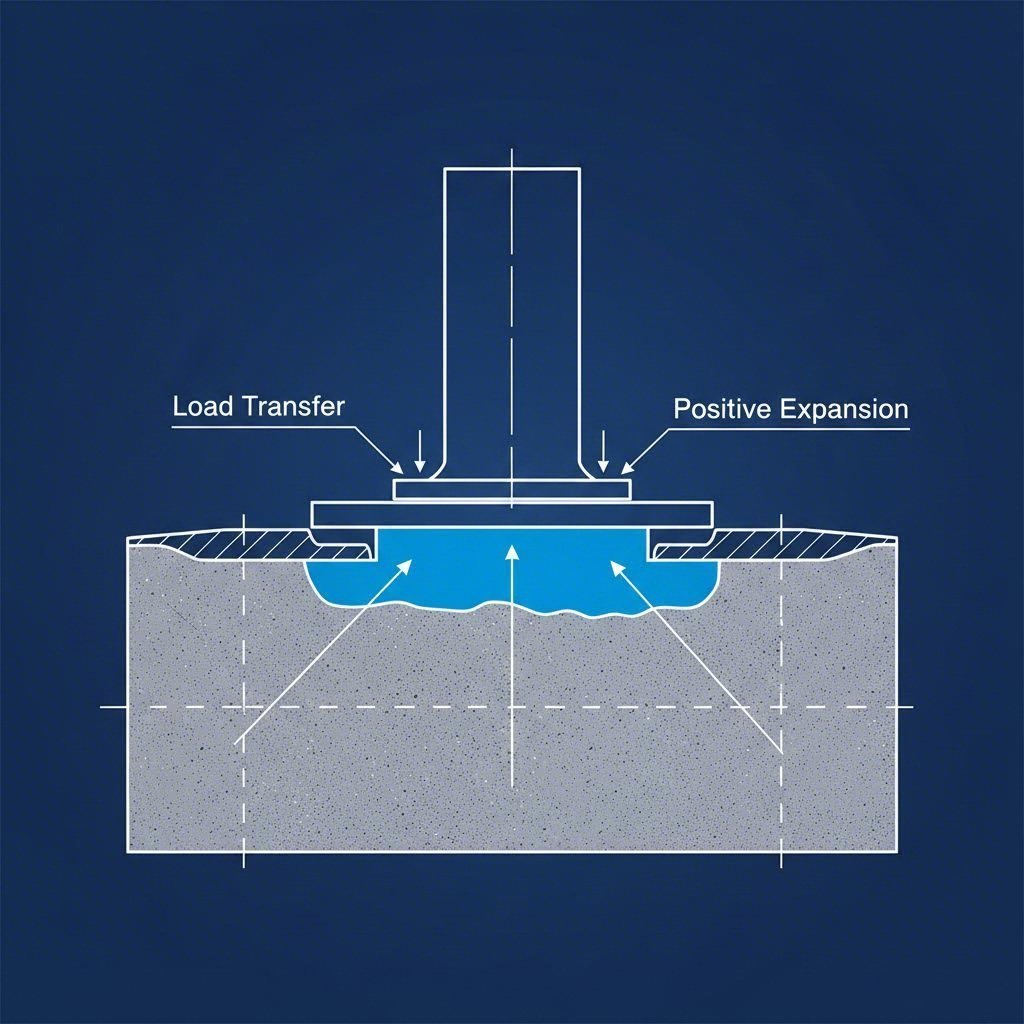
Non-shrink grout is a specialized hydraulic cement designed to expand slightly as it cures, counteracting the natural shrinkage that occurs in standard concrete. This unique property makes it the industry standard for load-bearing applications where a tight, permanent seal is critical, such as anchoring bolts, setting heavy machinery bases, and filling voids under structural columns. Unlike standard patch mortar, non-shrink grout is typically flowable or fluid, meaning it pours like pancake batter to self-level in tight spaces.
Critical Warning: Do not use non-shrink grout for vertical surface repairs (like wall cracks) unless you use formwork to hold it in place. For vertical patching, use a polymer-modified concrete patch mortar instead.
What Is Non-Shrink Grout and How Does It Work?
Standard concrete and mortar shrink as they dry—often by 0.05% to 0.10%. While this seems negligible for a sidewalk slab, it is catastrophic for structural connections. If you pour standard mortar under a steel column base plate, it will shrink away from the plate as it hardens, creating a gap. This gap prevents the load from transferring effectively to the foundation, leading to instability and potential structural failure.
Non-shrink grout solves this engineering challenge through positive expansion. It contains additives (often proprietary blends involving gypsum, aluminates, or metallic aggregates) that cause the material to expand slightly in volume while in its plastic or hardening state. This expansion locks the material tightly against the surrounding surfaces, ensuring 100% effective bearing area for load transfer.
The Three Consistencies
Unlike standard concrete which has a fixed “slump,” most non-shrink grouts are engineered to be mixed at varying water ratios to achieve different consistencies without sacrificing strength:
- Plastic: Trowelable consistency, similar to stiff modeling clay or putty. Used for packing small voids or sloped areas.
- Flowable: Pourable consistency, similar to heavy pancake batter. Ideal for general grouting where the material needs to flow under gravity but doesn’t need to travel long distances.
- Fluid: Runny consistency, similar to heavy cream. Critical for pumping or pouring into areas with tight clearances (e.g., under large machine base plates) where the grout must self-level completely.
Critical Decision: Non-Shrink Grout vs. Concrete Patching Mortar
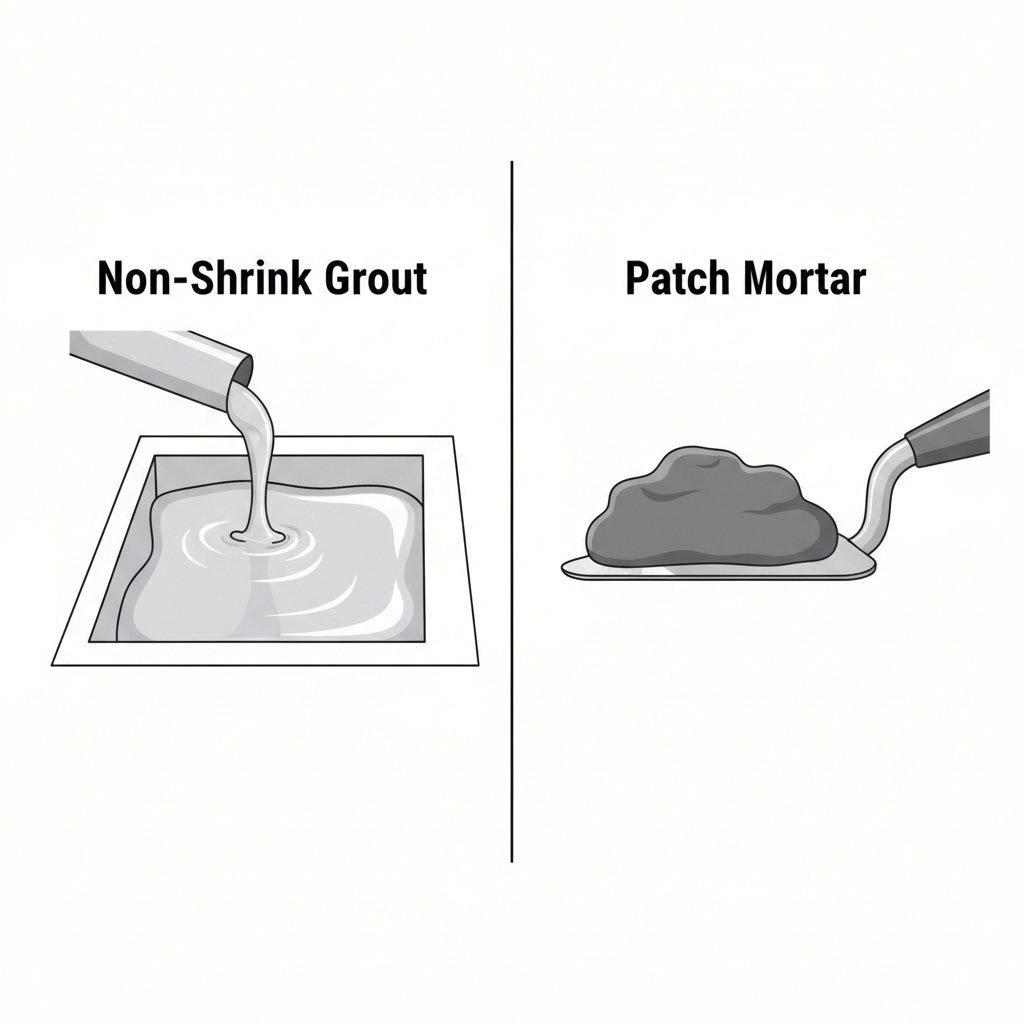
The most common mistake DIYers and even some pros make is grabbing a bag of “grout” to fix a crack in a wall, or using “patching mortar” to set an anchor bolt. These materials have opposite rheologies (flow behaviors) and purposes.
Concrete Patching Mortar is thixotropic (sticky). It stands up on a trowel and defies gravity, making it perfect for shaping corners, filling vertical cracks, or overhead repairs. It does not expand.
Non-Shrink Grout is generally flowable. If you try to patch a vertical wall crack with it, it will simply run out onto the floor. It is designed to fill confined spaces, not to be shaped.
| Feature | Non-Shrink Grout | Concrete Patching Mortar |
|---|---|---|
| Primary Characteristic | Expands to fill voids tightly | Stick/Stiff to restore shape |
| Consistency | Fluid / Pourable (Self-leveling) | Stiff / Moldable (Thixotropic) |
| Best Use Case | Anchoring bolts, base plates, filling holes in floors | Vertical cracks, chipped steps, wall repairs |
| Application | Pouring or Pumping (requires forms for vertical) | Troweling and Sculpting |
| Compressive Strength | Extremely High (8,000 – 13,000+ PSI) | Moderate to High (3,000 – 6,000 PSI) |
Top Product Comparison & Technical Specs
Choosing the right product depends on your specific constraints: time, application depth, and required strength. Below is a breakdown of market leaders found in professional supply channels.
1. SikaGrout-428 FS (High Precision / Industrial)
A powerhouse for industrial applications, this product uses ViscoCrete technology to achieve high fluidity with low water demand. It is designed for critical timelines where strength cannot be compromised.
- Set Time: Rapid. Initial set in ~30 minutes; final set in 45–60 minutes.
- Strength: Exceptional. Can reach 13,000 PSI at 28 days (Plastic consistency).
- Best For: Precision grouting of heavy machinery, wind turbine bases, and jobs requiring rapid turnover.
2. Quikrete FastSet Non-Shrink Grout (General Purpose / DIY Friendly)
Widely available at home centers, this is the go-to for general construction and residential repairs. It balances performance with ease of use.
- Set Time: ~30 minutes (walk-on time in hours).
- Strength: Reaches ~8,000 PSI at 28 days (Plastic consistency).
- Best For: Anchoring railings, setting steel columns in residential builds, and floor repairs.
3. Hubei Qiandao QD-85 (Specialized Structural Applications)
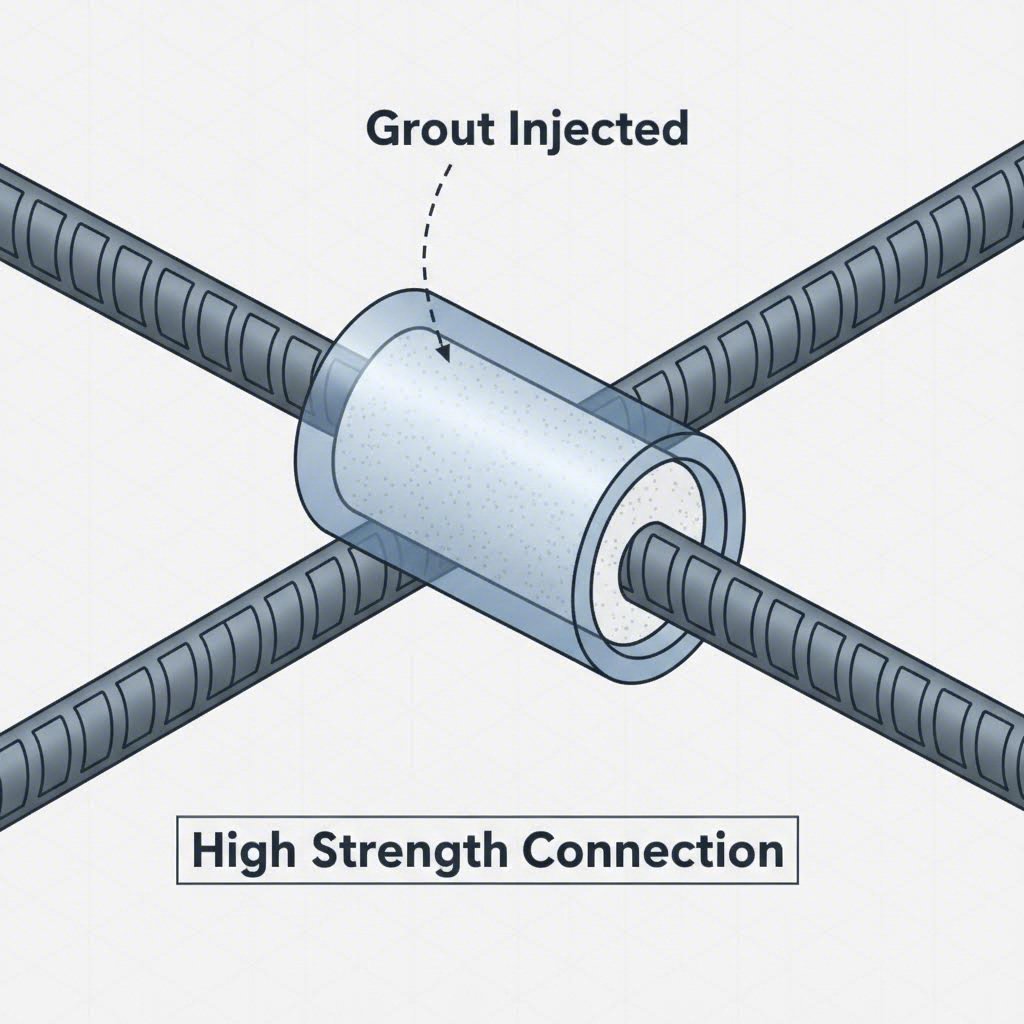
For construction professionals handling large-scale infrastructure or precast projects, Hubei Qiandao New Materials Co., Ltd. offers specialized solutions like the QD-85 Structural Grout. While general hardware store brands work for light duty, QD-85 is engineered specifically for rebar connection sleeves and prefabricated building components. It ensures superior fluidity for easy pumping into sleeve connections and delivers high early strength to accelerate construction schedules.
4. Sakrete Precision Construction Grout
Known for versatility, this grout is non-metallic and non-staining, making it a safe choice where aesthetics matter (won’t rust).
- Application Depth: 1 inch to 4 inches (neat).
- Yield: Approximately 0.45 cubic feet per 50lb bag.
- Best For: General construction grouting where a clean, concrete-like appearance is needed.
Step-by-Step Application Guide
Proper application is the difference between a permanent bond and a crumbled failure. Follow these steps for a standard base-plate or void-filling application.
Phase 1: Preparation (The SSD Rule)
The most critical step is bringing the concrete substrate to a Saturated Surface Dry (SSD) condition. Concrete is like a sponge; if you pour wet grout onto dry concrete, the dry concrete will suck the water out of the grout instantly. This “flash drying” stops the cure and causes cracks/debonding.
- Chip away loose concrete to sound material.
- Clean the surface thoroughly (vacuum dust, remove grease).
- Soak the area with water for 24 hours prior to grouting.
- Immediately before pouring, remove standing water so the surface is damp but not glistening. This is SSD.
Phase 2: Mixing
Do not use a hand trowel to mix non-shrink grout; you need a mechanical mixer to activate the plasticizers.
- Use a 1/2″ heavy-duty drill with a mixing paddle (400–600 RPM).
- Add only the recommended water amount. For SikaGrout-428 FS fluid consistency, this might be around 8 pints per bag, but always check the bag. Warning: Adding extra water weakens the grout drastically.
- Add powder to water (not water to powder) to prevent clumps.
- Mix for 3–5 minutes until uniform.
Phase 3: Placement & Curing
- Pour continuously: Pour from one side only to push air out the opposite side. This prevents trapped air pockets (voids) under the plate.
- Agitate slightly: Use a rod or strap to pump the material back and forth if needed to ensure flow, but rely mostly on the head pressure (gravity) of the pour.
- Cure immediately: Once the grout dulls (begins to set), cover it with wet burlap or plastic sheeting for 3 days. Non-shrink grout generates significant heat and can crack if allowed to dry out too fast.
Troubleshooting & FAQ
1. Can I use non-shrink grout to fill a crack in my driveway?
Yes, but only if the crack is wide enough (typically 1/4 inch or wider) and you can dam the ends. Because it is fluid, it will flow deep into the crack and seal it better than patch mortar. However, for hairline cracks, it is too thick to penetrate; use a specialized epoxy injection or concrete crack sealant instead.
2. Why did my grout crack after 24 hours?
Cracking is usually caused by two errors: too much water in the mix (which increases shrinkage despite the additives) or lack of curing (water evaporating too fast in sun/wind). Always adhere strictly to the water ratios on the bag and wet cure the finished surface.
3. Can I feather edge non-shrink grout?
No. Most non-shrink grouts contain sand aggregates that require a minimum depth, usually 1/4 inch to 1/2 inch. If you try to feather it out to zero thickness like a skim coat, the edges will flake off. For feather-edge repairs, use a vinyl patching compound.