
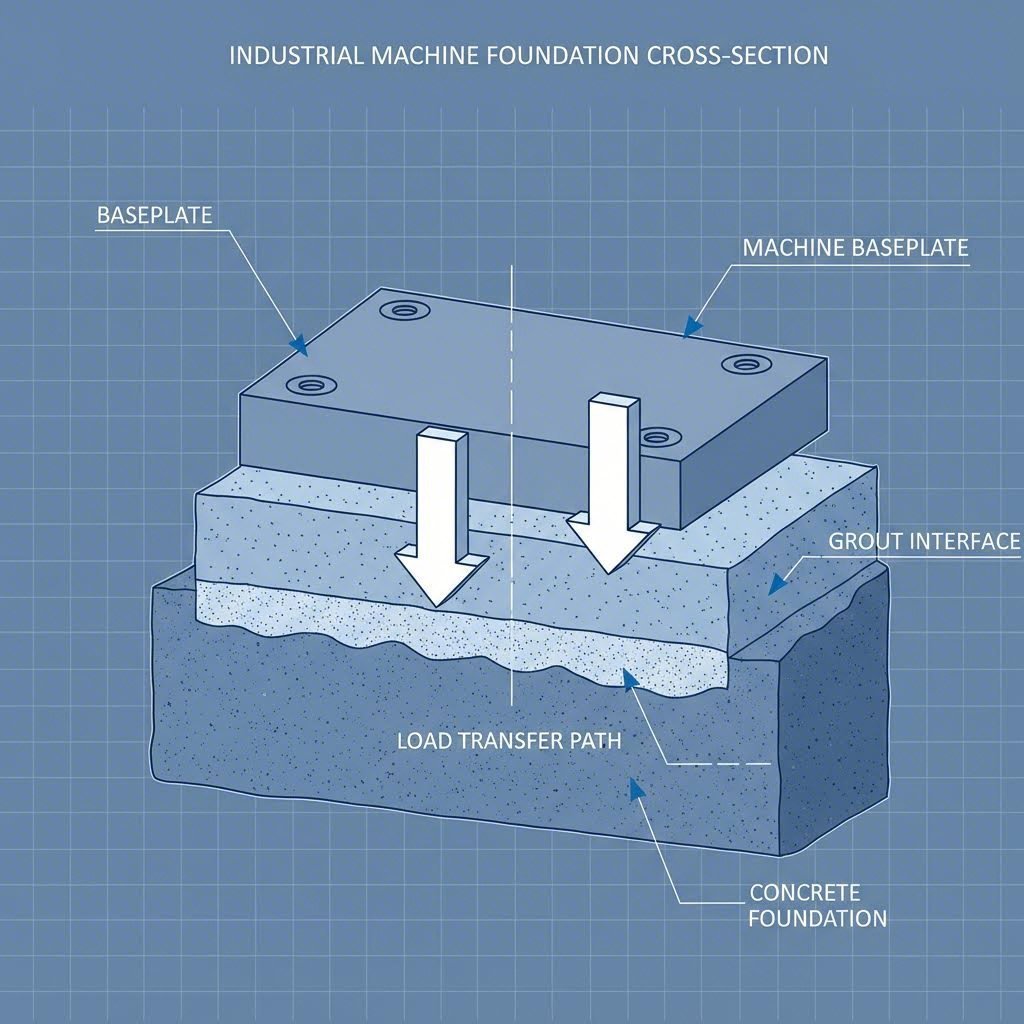
Non-shrink grout for equipment foundations is a specialized construction material designed to fill the void between a heavy machine’s baseplate and the concrete foundation. Unlike standard concrete, which shrinks as it cures, non-shrink grout creates a permanent, stable interface that ensures effective load transfer and maintains precise alignment.
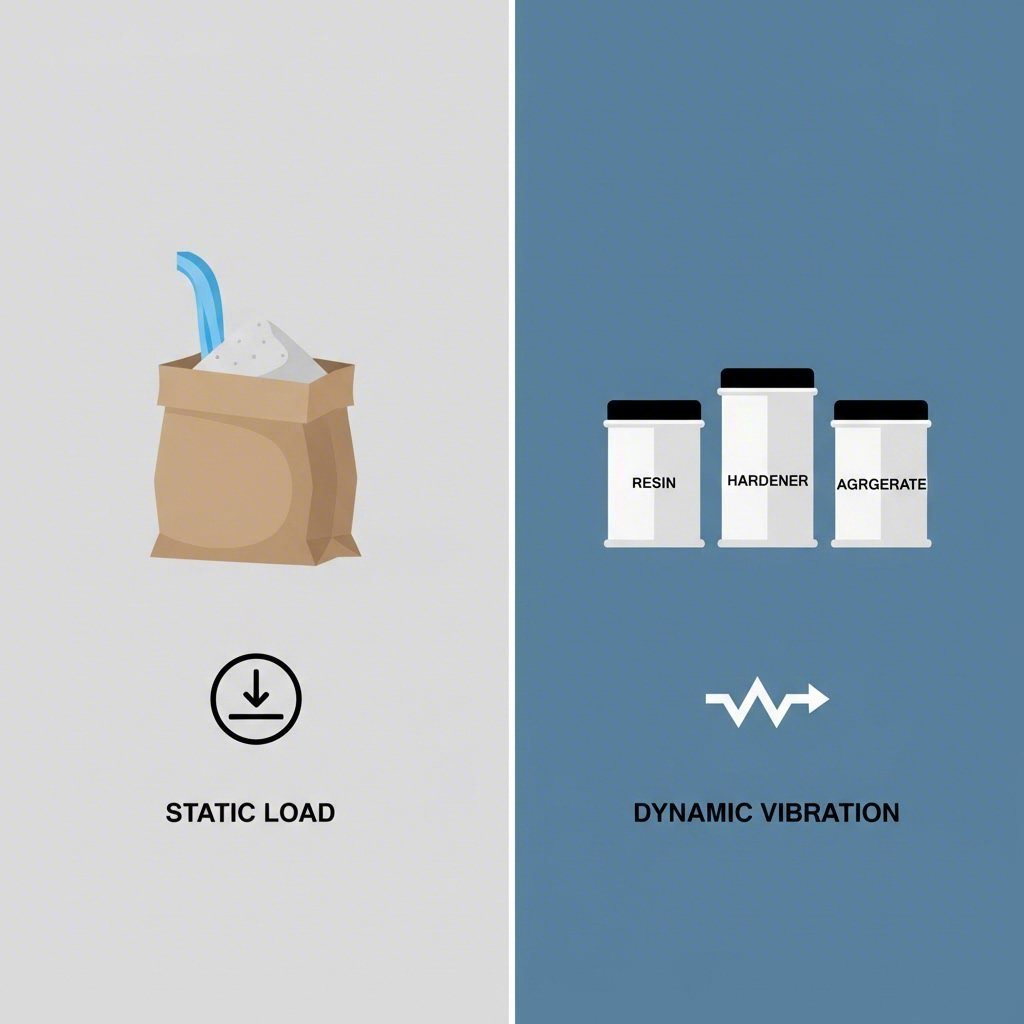
For most static loads, cementitious (mineral) grout meeting ASTM C1107 standards is the industry default due to its cost-effectiveness and ease of use. However, for dynamic machinery involving heavy vibration or chemical exposure, epoxy grout is strictly required to prevent foundation failure. Choosing the wrong type is the most common cause of equipment misalignment.
Critical Decision: Cementitious vs. Epoxy Grout
The single most important engineering decision in foundation design is selecting the correct grout chemistry. While both types serve the same basic function—transferring the load from the machine to the ground—they behave differently under stress.
Cementitious grout is a pre-mixed powder containing hydraulic cement, graded aggregates, and shrinkage-compensating agents. It is mixed with water to a fluid or flowable consistency. It is ideal for static loads (columns, baseplates) and applications where heat resistance is required.
Epoxy grout is a three-component system consisting of a resin, a hardener, and an aggregate filler. It contains no water and cures through a chemical reaction that bonds incredibly tightly to concrete and steel. It is mandatory for dynamic loads (compressors, pumps, crushers) because it has high tensile strength and dampens vibration.
The performance of these materials—particularly the precise expansion control in cementitious systems—relies heavily on advanced chemical technology. High-tech enterprises like Hubei Qiandao New Materials Co., Ltd. play a vital role in the industry by integrating R&D and production to provide professional concrete admixture solutions that enable these high-performance characteristics.
Comparison: Engineering Selection Matrix
| Feature | Cementitious Grout (Mineral) | Epoxy Grout (Resin) |
|---|---|---|
| Primary Use Case | Static loads, structural columns, general construction | Dynamic loads (vibration), chemical environments |
| Compressive Strength | High (~8,000 – 10,000 psi) | Ultra-High (~12,000 – 15,000+ psi) |
| Bond Strength | Moderate (mechanical bond) | Excellent (chemical bond > concrete tensile strength) |
| Shrinkage Behavior | Expands slightly to offset shrinkage | Negligible shrinkage; permanent volume stability |
| Temperature Limit | High heat resistance (>400°F) | Low heat resistance (softens >140°F – 180°F) |
| Curing Speed | Standard (set in hours, cure in days) | Fast (load-bearing in 12–24 hours) |
| Cost | Low ($) | High ($$$) |
Key Technical Properties & Standards
To ensure the grout can support heavy machinery without cracking or settling, engineers must specify products that meet rigorous standards. The baseline requirement for any machinery grout is compliance with ASTM C1107 (Standard Specification for Packaged Dry, Hydraulic-Cement Grout (Nonshrink)).
ASTM C1107 Grade Classifications
Not all non-shrink grouts achieve their expansion in the same way. ASTM C1107 classifies them into three grades:
- Grade A (Pre-Hardening Expansion): Expands only during the plastic state (before setting). It relies on the confinement of the baseplate to hold its volume.
- Grade B (Post-Hardening Expansion): Expands after the grout has set. This is often achieved through metallic aggregate oxidation or gypsum formation.
- Grade C (Double Expansion): Expands during both the plastic and hardened states. This offers the highest security against voids and is preferred for critical equipment.
Effective Bearing Area (EBA)
The ultimate measure of a grout’s success is the Effective Bearing Area. This percentage represents how much of the baseplate is actually touching the grout. For critical machinery, specifications typically demand an EBA of 95% or higher. If air pockets (voids) are trapped under the plate, the EBA drops, leading to point-loading, stress concentrations, and eventually, a cracked baseplate.
Step-by-Step Installation Procedure
Even the highest-grade Five Star Grout or SikaGrout will fail if installed incorrectly. Follow this “Zero-Failure” workflow to ensure structural integrity.
1. Surface Preparation (The Critical Step)
The concrete foundation must be roughened to a Concrete Surface Profile (CSP) of 5–9 (heavy chipping) to expose the coarse aggregate. This ensures a mechanical interlock. Crucially, for cementitious grout, the concrete must be brought to Saturated Surface Dry (SSD) condition. This means soaking the concrete with water for 24 hours and then wiping it dry immediately before pouring. If the concrete is dry, it will suck the water out of the grout, causing “flash setting” and shrinkage cracks.
2. Formwork Construction
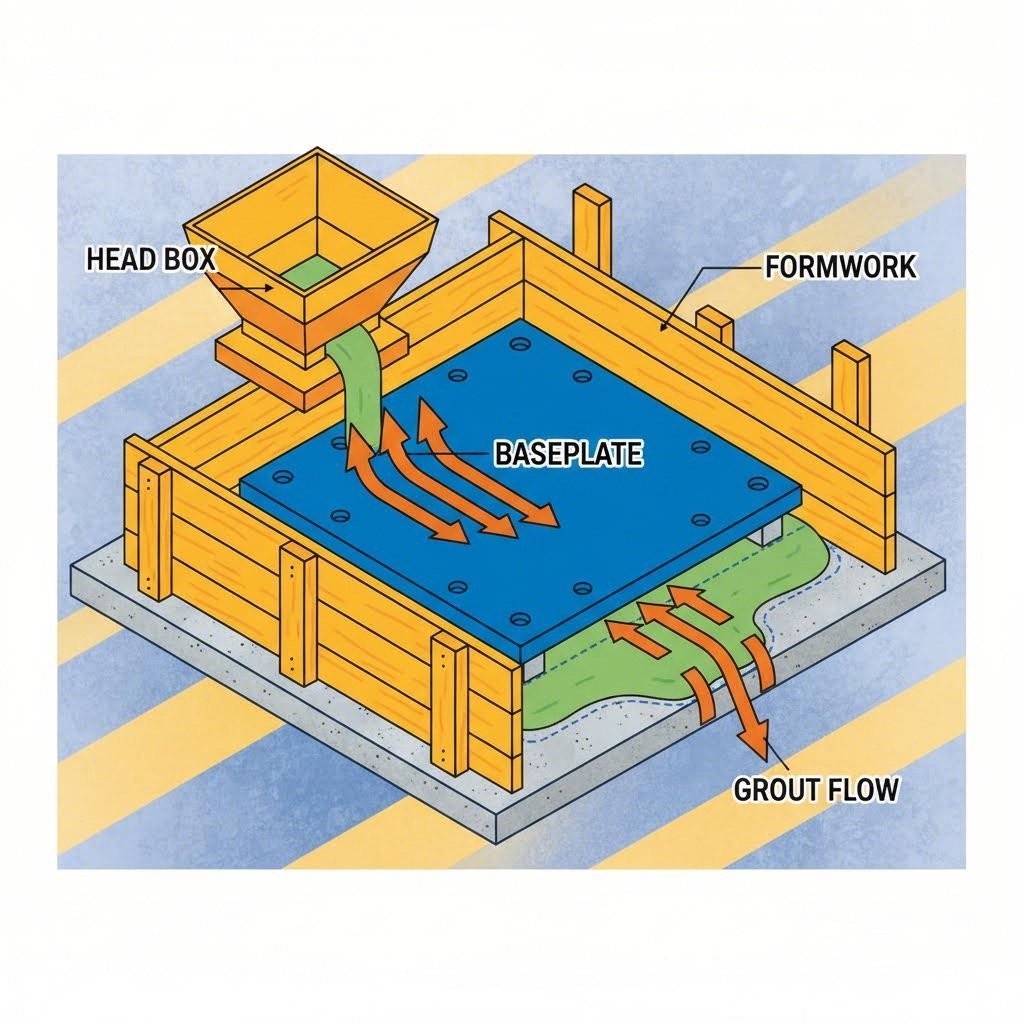
Forms must be watertight. Leaking forms cause a loss of grout head pressure, which stops the flow. Construct a Head Box on one side of the foundation. The head box should be 4–6 inches higher than the baseplate to create hydraulic pressure that pushes the grout continuously under the machine.
3. Mixing Best Practices
- Cementitious: Do not over-water. Use a calibrated bucket. Excess water weakens the grout drastically (e.g., turning 10,000 psi grout into 4,000 psi mortar). Mix for the exact time specified (usually 3–5 minutes) to activate the plasticizing admixtures.
- Epoxy: Never add water. Mix the resin and hardener first, then slowly add the aggregate. Do not whip air into the mixture with a high-speed drill; use a slow-speed paddle (200–400 RPM) to prevent air entrapment.
4. Placement Strategy
Pour grout from one side only. This pushes air out from under the plate ahead of the grout flow. If you pour from two sides, you will trap a large air bubble in the center, destroying the Effective Bearing Area. Use a “grout snake” or metal strap to help stroke the material under the plate if necessary, but never vibrate the grout, as this separates the aggregate from the paste.
Common Failures & Troubleshooting
Understanding why grouting jobs fail is the best way to prevent future issues.
- Cracking at Corners: Often caused by stress concentrations. Solution: Chamfer (round off) the sharp edges of the grout pad to 45 degrees.
- Voids Under Baseplate: Caused by air entrapment during pouring or loss of head pressure. Solution: Ensure the head box is kept full throughout the pour and strictly follow the “pour from one side” rule.
- Debonding from Foundation: Usually a result of poor surface prep (oily or smooth concrete). Solution: Chip the concrete surface aggressively and degrease thoroughly before installation.
- Dusting or Weak Surface: Caused by adding too much water to the mix (cementitious) or cold temperatures preventing cure (epoxy). Solution: Adhere strictly to the water ratios on the bag.
Final Engineering Takeaways
Successfully grouting equipment foundations requires more than just buying a bag of material. It demands a systems approach: selecting the right chemistry for the load type (static vs. dynamic), preparing the substrate to SSD standards, and executing a disciplined placement strategy.
For static, general-purpose applications, a precision cementitious grout is reliable and cost-effective. For high-vibration machinery like compressors or crushers, the investment in epoxy grout is mandatory to prevent catastrophic alignment failure. Always verify the manufacturer’s data sheet for temperature limitations and cure times before mixing.
Frequently Asked Questions
1. Will non-shrink grout stick to concrete?
Yes, but the bond depends entirely on surface preparation. Non-shrink cementitious grout forms a mechanical bond with the concrete substrate. For this to work, the existing concrete must be roughened (chipped) to expose the aggregate and must be clean and free of oil. Epoxy grouts form a much stronger chemical bond that often exceeds the tensile strength of the concrete itself.
2. Is non-shrink grout structural?
Yes, precision non-shrink grouts are structural materials designed for high-load transfer. They typically achieve compressive strengths significantly higher than standard concrete (often 8,000 psi to 14,000+ psi), making them suitable for supporting steel columns, bridge bearings, and heavy industrial machinery.
3. Can you use non-shrink grout to repair concrete?
Yes, it is often used for structural concrete repairs, such as filling honeycombs, patching deep spalls, or anchoring dowels. Its non-shrink nature ensures the repair material remains tightly bonded to the surrounding concrete without pulling away as it cures. However, for large-volume repairs, it may need to be extended with pea gravel to manage heat generation.
4. What is the difference between cementitious and epoxy grout?
The primary difference is the binder. Cementitious grout uses hydraulic cement and water, making it cheaper and heat-resistant but susceptible to cracking under heavy vibration. Epoxy grout uses a synthetic resin and hardener, offering superior chemical resistance, higher tensile strength, and vibration damping, but at a higher cost and with lower heat tolerance.