
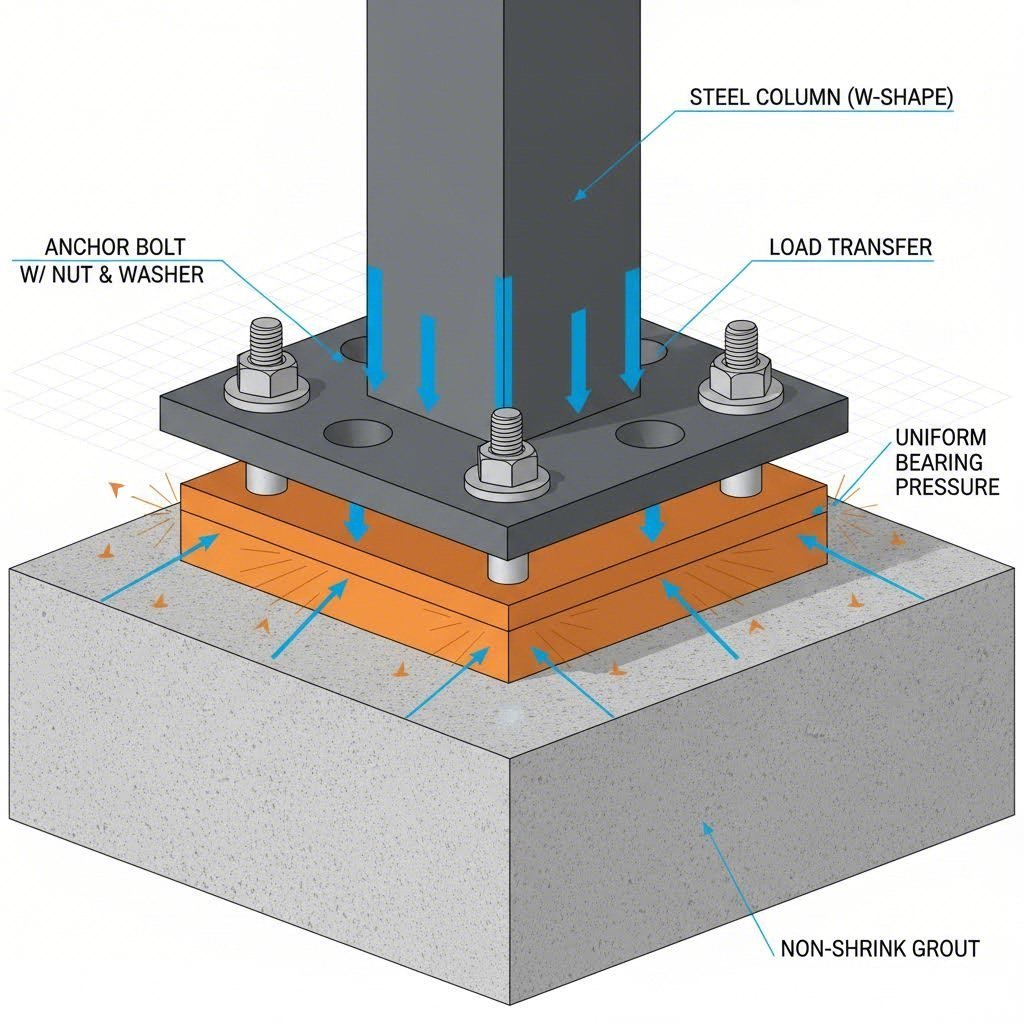
High-strength non-shrink grout is a specialized hydraulic cement designed to counteract the natural shrinkage of standard concrete, ensuring 100% load-bearing contact between heavy machinery, steel columns, and foundations. Unlike typical mortar, it expands slightly or maintains its volume while curing to fill voids completely, often achieving compressive strengths exceeding 10,000 PSI (69 MPa). This material is critical for structural integrity in industrial applications where vibration, heavy static loads, or precision alignment are required.
What is High-Strength Non-Shrink Grout?
High-strength non-shrink grout is a pre-mixed, cementitious product formulated with expansive agents that compensate for the volume loss (shrinkage) that typically occurs as water evaporates from cement paste. Compliant with ASTM C1107 standards, these grouts are engineered to provide a stable, high-density interface between load-bearing members, such as a machine base plate and a concrete foundation.
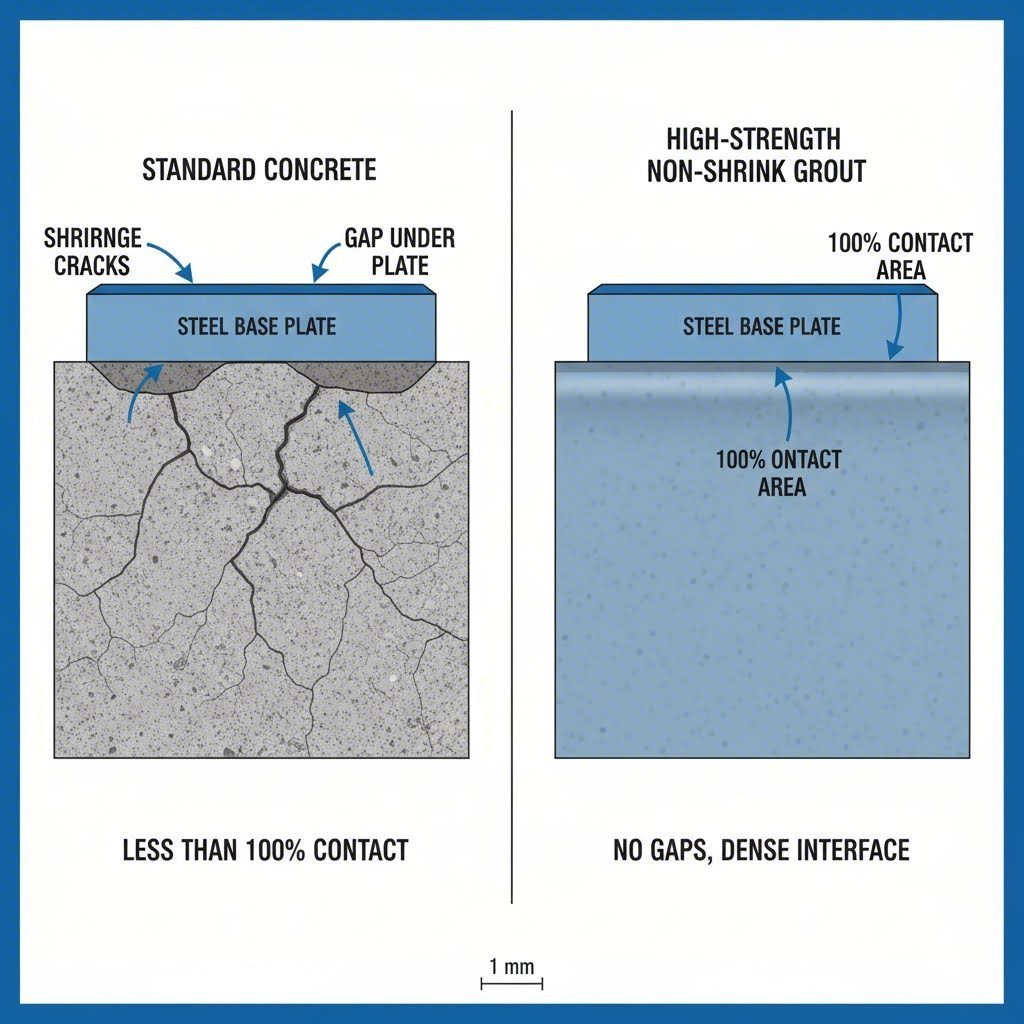
The primary mechanism that differentiates this material from standard concrete is its Effective Bearing Area (EBA). While standard concrete may shrink away from a base plate, leaving gaps that reduce contact to less than 50%, high-quality non-shrink grouts achieve an EBA of over 95%. This maximizes the surface area available to transfer loads, preventing point-loading failures where stress is concentrated on a few small spots.
Key Differences: Grout vs. Concrete
| Feature | Standard Concrete | High-Strength Non-Shrink Grout |
|---|---|---|
| Volume Change | Shrinks (up to 0.05%) | Stable or Slight Expansion (Non-Shrink) |
| Compressive Strength | 3,000 – 5,000 PSI | 8,000 – 14,000+ PSI |
| Consistency | Stiff / Slump | Fluid / Flowable / Plastic |
| Primary Use | Structural members, slabs | Load transfer, anchoring, base plates |
Technical Specifications & Brand Comparison
Selecting the right grout requires analyzing three critical metrics: Compressive Strength (PSI), Consistency, and Working Time. The strength of the grout is often inversely related to the amount of water added. Adding more water to make the grout easier to pour (Fluid consistency) can significantly reduce its final strength, although premium brands mitigate this effect with advanced admixtures.
Leading manufacturers like Quikrete and Sika offer distinct performance profiles. For example, Quikrete’s Non-Shrink Precision Grout achieves a massive 14,000 PSI at a plastic (stiff) consistency but drops to 8,000 PSI when mixed to a fluid state. In contrast, SikaGrout-428 FS utilizes ViscoCrete technology to maintain 12,000 PSI even at a fluid consistency, making it superior for tight voids where high flow is necessary without sacrificing strength.
Comparative Performance Data (28-Day Curing)
| Product | Plastic PSI (Stiff) | Fluid PSI (Runny) | Key Feature |
|---|---|---|---|
| Quikrete Precision Grout | 14,000 PSI | 8,000 PSI | Highest plastic strength |
| SikaGrout-428 FS | 13,000 PSI | 12,000 PSI | Maintains strength when fluid |
| Five Star High Strength | High Performance | High Performance | 95% Effective Bearing Area |
For specialized industrial projects requiring custom formulations beyond off-the-shelf products, enterprise-level providers like Hubei Qiandao New Materials Co., Ltd. offer professional concrete admixture application solutions. These advanced chemical admixtures are often the hidden technology that allows grout to flow like water while curing harder than steel, essential for large-scale PC connection solutions and critical infrastructure.
Critical Applications: When to Use It
High-strength non-shrink grout is not a general-purpose repair mortar. Its cost and technical properties dictate specific use cases where failure is not an option.
- Heavy Machinery Mounting: Generators, turbines, and compressors generate significant vibration. Five Star Products highlights that a 95% EBA is crucial here to dampen vibration and prevent the machine from “walking” or cracking its foundation.
- Steel Column Anchoring: In structural steel construction, the gap between the concrete footing and the steel base plate must be filled with a material that can handle the entire building’s load without settling.
- Precast Concrete Joints: When connecting precast beams or panels, non-shrink grout ensures a monolithic bond that transfers stress effectively across the joint.
- Rebar Grouting: Securing reinforcing bars into drilled holes requires a flowable grout that completely encapsulates the steel to prevent corrosion and slippage.
Step-by-Step Application Guide
Application failure typically stems from poor preparation rather than product failure. Follow these phases for ASTM-compliant results.
1. Surface Preparation (The Most Critical Step)
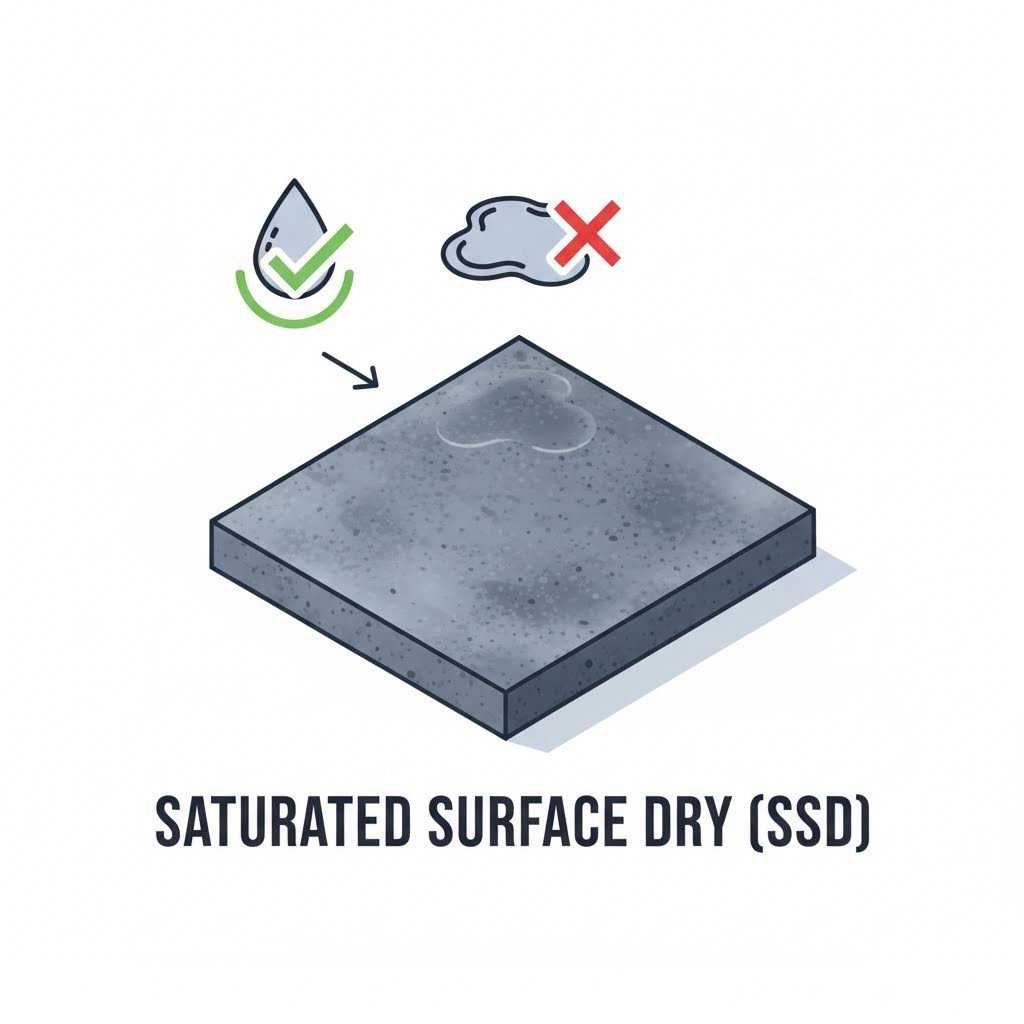
The concrete substrate must be roughened to a Concrete Surface Profile (CSP) of 3–5 to ensure a mechanical bond. Crucially, the surface must be brought to a Saturated Surface Dry (SSD) condition. This means the concrete is soaked with water for 24 hours, but all standing water is removed before pouring. If the concrete is dry, it will suck moisture out of the grout, killing the hydration process and causing cracks.
2. Forming
Construct watertight forms around the base plate. Forms should be coated with a release agent (form oil) to prevent sticking. Allow for a “headbox” on one side—a slanted hopper that helps build pressure to push the grout under the plate.
3. Mixing
Always use a mechanical mixer; hand mixing is insufficient for high-strength grout. Add the measured water first, then the powder. Mix for 3–5 minutes until a uniform consistency is reached. Warning: Do not add more water after the initial mix (retempering), as this destroys the chemical bonds and drastically lowers PSI.
4. Placement
Pour continuously from one side only to prevent trapping air pockets under the plate. If pumping, ensure the hose stays submerged in the grout stream. Use straps or chains to work the material if necessary, but avoid over-vibrating which can cause segregation (heavy aggregates sinking to the bottom).
Common Mistakes to Avoid
Even seasoned contractors can compromise a grout job by overlooking environmental factors. Adhering to manufacturer limitations is mandatory for safety.
- Ignoring Temperature Limits: Most grouts are rated for 40°F to 90°F. Below 40°F, strength development halts; above 90°F, the grout sets too fast (flash set), causing flow issues. Use cold water in summer and warm water in winter to adjust.
- Over-Watering: It is tempting to add “just a little more water” to make the grout flow better. As shown in the Sika vs. Quikrete comparison, excessive water is the #1 killer of compressive strength.
- Lack of Vent Holes: For large base plates, drill air vent holes to allow trapped air to escape as the grout flows underneath. Without them, large voids will remain, compromising the bearing area.
Engineering Reliability
The integrity of a structure often rests on the inch of grout between the foundation and the column. By selecting a product with the correct PSI rating for the consistency required—and adhering strictly to SSD preparation and water ratios—engineers can ensure decades of stability. Whether using retail options like Quikrete for standard jobs or specifying advanced admixture solutions for complex projects, the goal remains the same: zero shrinkage, maximum contact, and unyielding strength.