
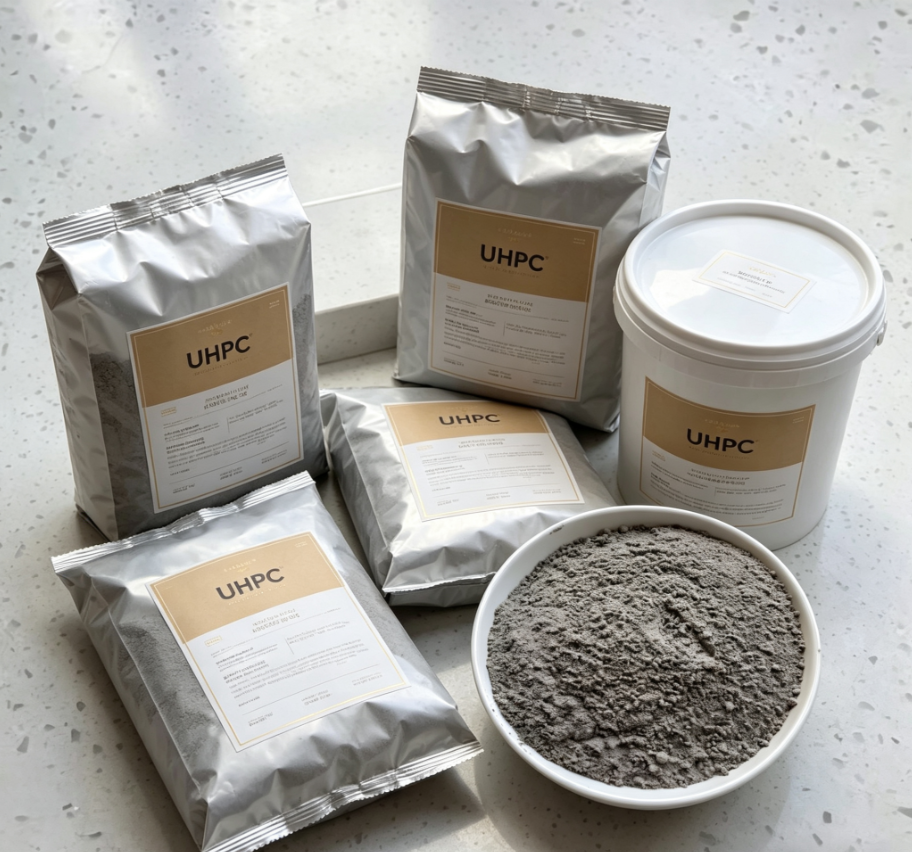
If you are involved in modern infrastructure, architecture, or civil engineering, you have likely heard the buzz surrounding Ultra-High Performance Concrete (UHPC). But when you are looking at the significantly higher upfront cost compared to traditional NSC (Normal Strength Concrete), the question isn’t just about strength—it’s about time.
How long will it actually last?
In this guide, you will discover the scientific reality behind the lifespan of UHPC, why it outperforms traditional materials by a century, and the empirical data that justifies its use in the world’s most demanding environments.
1. Defining the Century-Plus Standard
While standard concrete is often designed with a service life of 30 to 50 years, UHPC is engineered for a 75 to 100-year minimum, with many experts projecting lifespans exceeding 150 years in optimal conditions.
You aren’t just looking at a “stronger” version of cement. You are looking at a material with a disconnected pore structure. In traditional concrete, water and chlorides travel through capillary networks, reaching the steel reinforcement and causing “concrete cancer” (carbonation and rust). In UHPC, those pathways are virtually non-existent.
The Durability Comparison
| Feature | Normal Strength Concrete (NSC) | UHPC |
| Compressive Strength | 20 – 50 MPa | 120 – 200+ MPa |
| Water Absorption | 5% – 10% | < 0.1% |
| Chloride Permeability | Moderate to High | Very Low (Negligible) |
| Design Life | 40 – 50 Years | 100 – 150+ Years |
2. Why Does UHPC Last So Long? The Science of Impermeability
To understand why you won’t be replacing a UHPC structure in your lifetime, you have to look at the packing density. UHPC uses a precise combination of fine sands, silica fume, and chemical admixtures to eliminate the voids found in regular concrete.
Freeze-Thaw Resistance
If you work in regions with harsh winters, you know that the freeze-thaw cycle is the primary killer of infrastructure. Water enters pores, freezes, expands, and cracks the concrete.
- The Fact: In ASTM C666 testing, UHPC typically maintains a Relative Dynamic Modulus of 100% even after 800+ cycles. Traditional concrete often fails or degrades significantly before 300 cycles.
Corrosion Protection
For bridge decks and marine environments, chloride penetration is the enemy. UHPC acts as an impenetrable shield.
- The Fact: Chloride diffusion coefficients for UHPC are measured at levels roughly 10 to 50 times lower than high-performance conventional concrete. This means your steel reinforcement remains pristine for decades longer.
3. Real-World Evidence: Tracking Performance Over Decades
You don’t have to rely solely on lab simulations. Since the first UHPC bridges were installed in the late 1990s (such as the Bourgin-Jallieu bridge in France or the Mars Hill Bridge in Iowa), inspections have shown almost zero carbonation and no significant structural degradation.
The “First Generation” Observation
Field evaluations of UHPC components after 20 years of service in heavy-salt environments show that the material performs as if it were brand new. While traditional bridge decks often require patching or overlays within 15–20 years, UHPC installations from the early 2000s show no signs of needing maintenance.
4. Factors That Influence the Actual Lifespan
While the material is revolutionary, its lifespan in your specific project depends on three critical factors:
- Fiber Choice: Most UHPC uses high-strength steel fibers. In extremely corrosive environments, if the surface fibers oxidize, it is usually purely aesthetic. However, for maximum longevity, stainless steel or non-metallic fibers are sometimes used.
- Curing Process: Proper thermal curing can accelerate the hydration process, ensuring the “matrix” reaches its peak density early on.
- Joint Integrity: In many projects, UHPC is used as a “joint” between precast elements. The lifespan of the bridge then depends on how well you’ve designed that interface.
5. The Financial Reality: Life-Cycle Cost Analysis (LCCA)
You might find the initial price tag of UHPC intimidating. However, when you calculate the Life-Cycle Cost, the narrative shifts.
- Zero Maintenance: Imagine not having to shut down a highway for resurfacing every 15 years.
- Reduced Section Size: Because UHPC is so strong, you use less material (thinner beams, slimmer columns), reducing transport and foundation costs.
- Extended Replacement Cycle: Replacing a bridge once every 100 years instead of twice is a massive win for municipal budgets and environmental sustainability.
FAQ: Your Questions Answered
Q: Does UHPC crack?
A: UHPC is designed for “micro-cracking.” Unlike traditional concrete which develops large, destructive cracks, UHPC distributes stress through millions of tiny cracks (often invisible to the eye) held together by fibers. This maintains the structural integrity and prevents water ingress.
Q: Is the lifespan affected by UV exposure?
A: No. Unlike polymers or certain composites, UHPC is a mineral-based material and is highly resistant to UV degradation.
Q: Can UHPC be repaired if it is damaged?
A: Yes, though it is rarely needed. UHPC bonds exceptionally well to existing UHPC or even old NSC, making repairs permanent and high-strength.
Conclusion: A Legacy Material
When you choose UHPC, you are choosing to build for the next century. The combination of extreme density, chemical resistance, and mechanical toughness makes it the most durable construction material currently available on the market. While the 20th century was the era of building fast, the 21st century is the era of building to last.
Ready to specify UHPC for your next project?
[Download our Technical Specification Sheet] or [Contact our Engineering Team] to see how UHPC can extend the life of your infrastructure.
Call to Action (CAT)
Don’t let maintenance costs drain your future budget. If you are designing a project meant to stand the test of time, it’s time to move beyond 20th-century materials.
[Get a Quote for Your UHPC Project Today] | [Request a Sample Kit]