
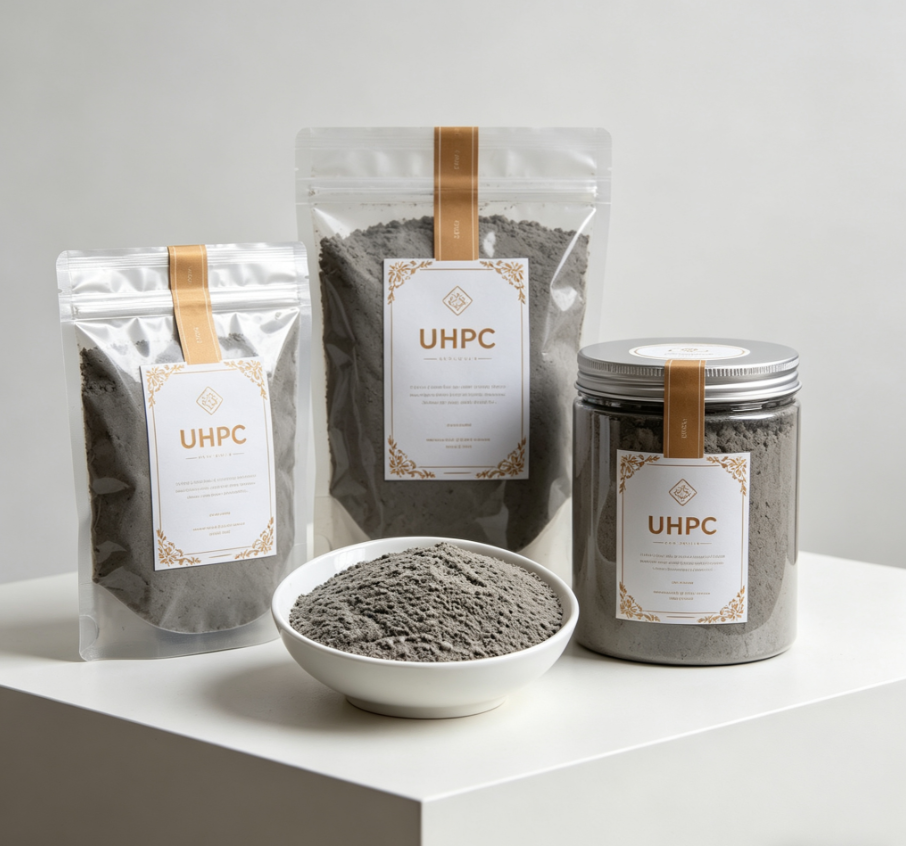
If you have spent any time researching the future of infrastructure, bridge repair, or architectural design, you have undoubtedly encountered the term Ultra-High Performance Concrete (UHPC). But you should understand that UHPC is not simply “stronger concrete.” It is a fundamental shift in material science—a cementitious composite that behaves more like high-strength steel or a ductile polymer than the traditional stone-like concrete you have used in the past.
In this comprehensive guide, you will learn the exact chemical and physical properties that define UHPC, the empirical data that proves its superiority, and the practical reasons why it is rapidly becoming the gold standard for global infrastructure.
1. Defining the Standard: Beyond 150 MPa
To understand UHPC, you must look at the threshold of performance. According to the Federal Highway Administration (FHWA) and international standards like NF P18-710, a material is only classified as UHPC if it meets specific, extreme benchmarks.
The Power of Compression
While the “high-strength” concrete used in skyscrapers typically reaches 50 to 80 MPa, UHPC exists in a different tier.
- The Fact: UHPC is defined by a compressive strength of at least 150 MPa (21,700 psi).
- The Peak: Many commercial mixes, such as those used in nuclear containment or seismic zones, can exceed 200 MPa (29,000 psi).
The Ductility Revolution
Traditional concrete is brittle; when it fails, it shatters. UHPC is ductile. Because it is infused with a high volume of steel or organic micro-fibers, it can undergo significant deformation and “strain-hardening” before failing. This means that unlike standard concrete, UHPC can carry tensile (pulling) loads even after it begins to micro-crack.
2. The Anatomy of UHPC: Why It Performs Differently
You might wonder how a cement-based material can achieve such extreme density. The secret lies in the Particle Packing Theory.
The “Void-Free” Matrix
Traditional concrete uses large rocks (coarse aggregates) which create large gaps and weak points. UHPC eliminates coarse aggregate entirely. Instead, it uses a precisely graded mix of:
- Fine Sands: Carefully selected for grain size.
- Silica Fume: Ultra-fine particles that fill the microscopic voids between cement grains.
- Quartz Flour: To further increase the density.
- High-Range Water Reducers (HRWR): Allowing the mix to flow with a water-to-cement ratio as low as 0.15 to 0.20.
[Image: A cross-section comparison showing the porous structure of standard concrete versus the solid, glass-like density of UHPC]
The Fiber Skeleton
The true “magic” of UHPC comes from the fiber reinforcement. Typically, 2% to 3% of the volume consists of high-strength steel micro-fibers. These fibers act as millions of tiny internal bridges. When a load is applied, the fibers transfer the stress across the matrix, preventing a single crack from becoming a structural failure.
3. Durability: The 100-Year Guarantee
If you are concerned about the “life expectancy” of your project, UHPC is the ultimate insurance policy. Its longevity is a result of its impermeability.
Chloride and Water Resistance
Water and salts are the enemies of infrastructure. In traditional concrete, these elements migrate through pores to rust the rebar.
- The Fact: In ASTM C1202 (Chloride Permeability) tests, UHPC scores “Negligible” (less than 100 Coulombs).
- Freeze-Thaw Resilience: Because there is effectively no water inside the matrix, UHPC is immune to the freeze-thaw cycles that destroy roads in cold climates. In ASTM C666 tests, UHPC maintains 100% of its integrity after 600 cycles, whereas standard concrete often fails at 200.
| Performance Metric | Standard Concrete | UHPC |
| Compressive Strength | 30 – 50 MPa | 150 – 200+ MPa |
| Tensile Strength | ~3 MPa (Brittle) | 7 – 15 MPa (Ductile) |
| Water Absorption | 5% – 10% | < 0.1% |
| Design Life | 40 – 50 Years | 100 – 150 Years |
4. Practical Applications: Where You Should Use It
Because of its higher initial cost, you should view UHPC as a surgical tool—it is used where traditional materials fail.
- Bridge Field Joints: This is the most common use. By using UHPC to “glue” precast bridge sections together, you create a joint that is actually stronger than the sections themselves, eliminating the #1 cause of bridge maintenance.
- Thin-Section Architecture: Because UHPC is so strong, you can design elements that are 30% to 50% thinner than standard concrete. This allows for stunning, lightweight facades and slim pedestrian bridges.
- Retrofitting and Repair: UHPC has an incredible bond strength to old concrete. You can use a thin layer (overlay) of UHPC to “armor” an aging bridge deck, extending its life by decades without adding significant weight.
[Image: A slim, elegant UHPC pedestrian bridge showing the material’s ability to span long distances with minimal thickness]
5. Economic Reality: Cost vs. Value
You will hear that UHPC is “expensive.” On a per-cubic-yard basis, this is true. UHPC can cost 10 to 20 times more than standard concrete. However, your Life-Cycle Cost Analysis (LCCA) will show a different story.
- Material Reduction: You use less of it because the sections are thinner.
- Speed of Construction: UHPC joints allow for rapid precast assembly, reducing highway closure times.
- Zero Maintenance: Imagine a bridge deck that does not need a single repair for 75 years. The savings in labor and traffic disruption often make UHPC the cheaper option over the long term.
FAQ: Frequently Asked Questions
Q: Can I mix UHPC in a standard concrete truck?
A: It is difficult. UHPC requires high-shear mixing to break up the fine powders. While specialized additives have made “truck-mixing” possible in some cases, it generally requires high-energy pan mixers to ensure the fibers are properly dispersed.
Q: Does UHPC rust if it has steel fibers?
A: Only on the surface. Because the matrix is so dense, oxygen and moisture cannot penetrate into the concrete. The fibers on the very surface may show minor oxidation (rust spots), but the internal structural fibers remain pristine for a century.
Q: Is it harder to work with than regular concrete?
A: It is different. UHPC is often self-placing (it flows like thick syrup), so you do not need to vibrate it. However, the timing of the pour and the thermal management of the curing process require specialized training.
Conclusion: The Future Is Dense
Ultra-High Performance Concrete is no longer an “experimental” material. From the 100+ UHPC bridges in the United States to the high-tech facades in Europe, it has proven itself as the most durable construction material available to you.
When you choose UHPC, you are moving away from the “disposable infrastructure” mindset of the 20th century and moving toward a future of resilience, elegance, and extreme longevity.
Call to Action (CAT)
Are You Ready to Build for the Next Century?
If your next project requires extreme durability, seismic resilience, or innovative architectural forms, UHPC is your answer. Don’t settle for materials that will require repairs in 20 years.
[Download our UHPC Technical Specification Guide] | [Request a Life-Cycle Cost Comparison]
[Contact our Engineering Team to Optimize Your Design] | Because strength is nothing without durability.