
What is the main difference between Aliphatic and Sulfamate water reducers?
The primary difference between Aliphatic and Sulfamate water reducers lies in their chemical composition, water-reducing efficiency, and slump retention capabilities. Aliphatic water reducers are carbonyl-pyrosulfite synthetic polymers with a typical water reduction rate of 20% to 25%, offering rapid early strength development and exceptional cost-efficiency. In contrast, Sulfamate water reducers are synthesized from p-aminobenzene sulfonate, phenol, and formaldehyde, achieving a higher water reduction rate of 25% to 30% along with excellent slump retention and minimal concrete bleeding.
In the modern construction landscape of 2026, while third-generation Polycarboxylate Ethers (PCE) dominate high-end engineering, Aliphatic and Sulfamate superplasticizers remain indispensable, cost-effective workhorses for specific high-performance applications, precast elements, and regional infrastructure projects.
What is an Aliphatic water reducer and how does it work?
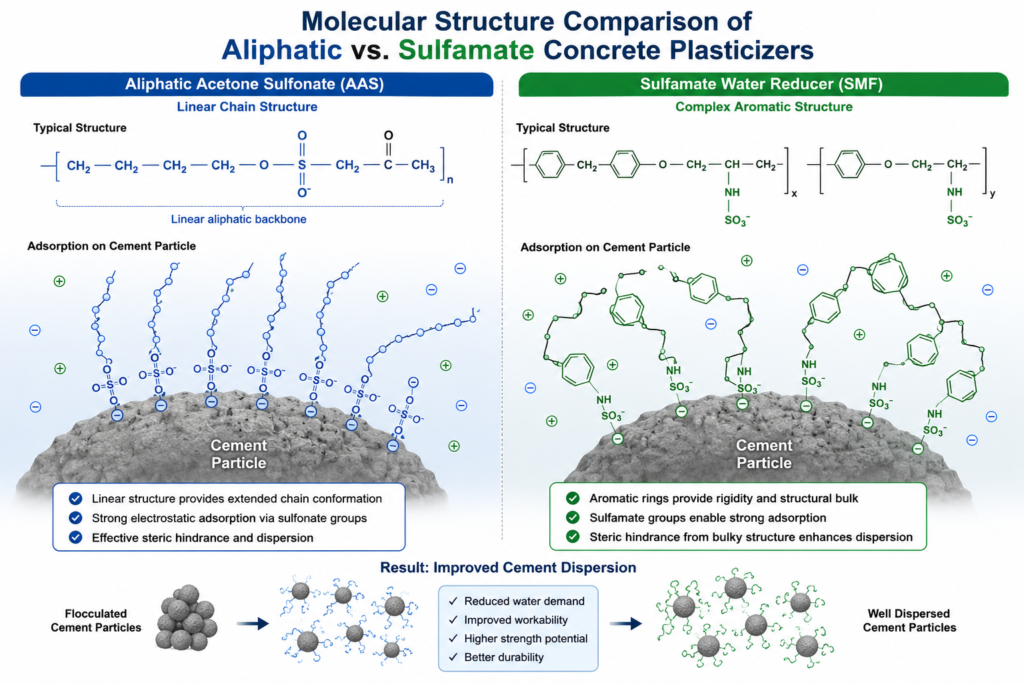
An Aliphatic water reducer is a second-generation high-range water-reducing admixture (HRWRA) manufactured through the condensation reaction of acetone, formaldehyde, and a sulfonating agent (typically sodium pyrosulfite).
What is the chemical mechanism of Aliphatic admixtures?
Aliphatic water reducers work primarily through electrostatic repulsion. When added to a concrete mix, the highly negatively charged sulfonic acid groups (-SO3-) and carbonyl groups (-CO-) adsorb onto the surface of positively charged cement particles. This creates a uniform negative charge on the cement surfaces, causing them to repel each other. As a result, the flocculated cement structures break apart, releasing the trapped mixing water and significantly improving concrete fluidity.
What are the key advantages of Aliphatic superplasticizers?
- High Early Strength: They drastically accelerate the early hydration of cement, making them highly favored for fast-turnaround projects.
- Excellent Cost-to-Performance Ratio: Compared to PCE, Aliphatic admixtures offer a highly economical solution for achieving substantial water reduction.
- Low Retardation Effect: Unlike some traditional admixtures, they do not significantly delay the initial setting time of concrete.
- No Air-Entrainment: They do not naturally introduce unwanted air microbubbles, maintaining high concrete density.
What is a Sulfamate water reducer and why is it unique?
A Sulfamate water reducer is an advanced amino-sulfonate-based high-range chemical admixture. It is synthesized via the co-condensation of p-aminobenzene sulfonate, phenolic compounds, and formaldehyde under high temperatures.
How does Sulfamate achieve superior slump retention?
Similar to Aliphatic variants, Sulfamate water reducers utilize electrostatic repulsion to disperse cement grains. However, the unique aromatic rings and amino-sulfonate chains create a more stable adsorption layer on the cement particles. This stable layer reduces the rate of cement hydration product interference, resulting in exceptional slump retention—often keeping concrete highly workable for 60 to 90 minutes without causing severe setting delays.
What are the technical benefits of Sulfamate admixtures?
- High Water Reduction (25% to 30%): It bridges the performance gap between traditional naphthalene-based alternatives and high-end polycarboxylates.
- Low Air Content and Bleeding: It prevents concrete from bleeding and segregating, which ensures a highly uniform and flawless concrete finish.
- Strong Material Adaptability: It exhibits superior compatibility with different grades of cement and various supplementary cementitious materials (SCMs) like slag and fly ash.
What are the specific application scenarios for Aliphatic water reducers in 2026?
In 2026, the construction sector prioritizes both cost-efficiency and fast-paced execution. Aliphatic superplasticizers are extensively deployed in the following scenarios:
1. Precast Concrete and Structural Components
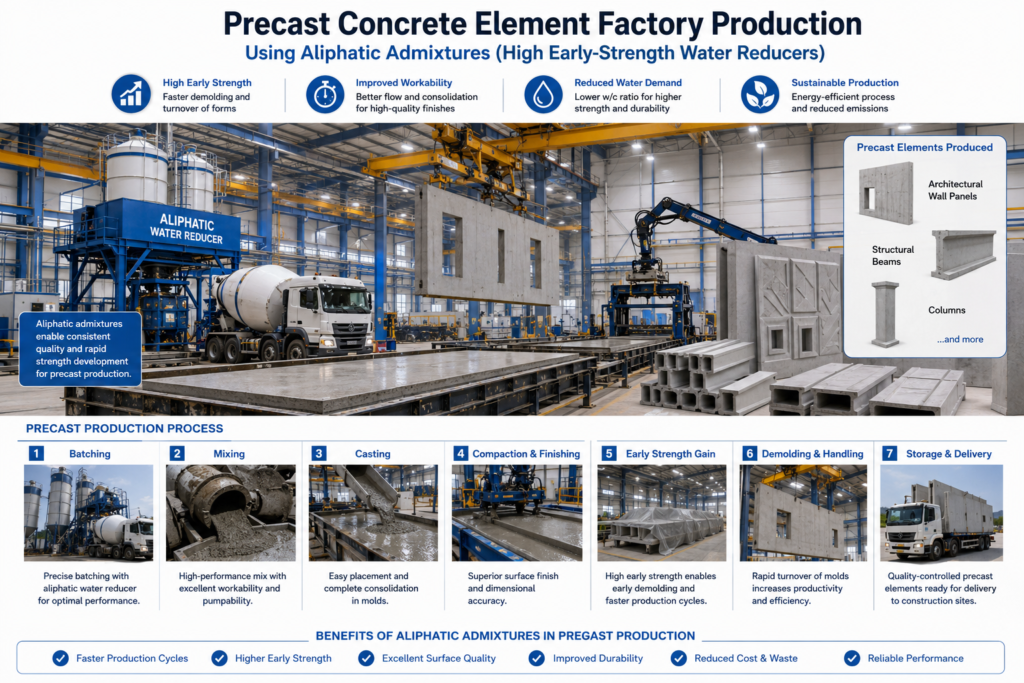
Precast factories require rapid mold turnaround cycles to minimize operational overhead. Aliphatic water reducers provide high water reduction and accelerate early strength (1 to 3 days) without the need for excessive steam curing. This makes them ideal for manufacturing precast pipes, segment linings, and wall panels.
2. High-Strength Pre-stressed Concrete (PHC) Piles
For PHC piles, achieving extreme early strength is critical for handling and post-tensioning. Aliphatic admixtures allow for low water-to-cement ratios while guaranteeing the fluid consistency required for centrifugal compaction casting.
3. Economical High-Performance Ready-Mix Concrete
In regional building projects where the premium cost of PCE is prohibitive, Aliphatic admixtures are used as a core ingredient to formulate affordable, high-fluidity concrete that meets standard structural requirements.
What are the specific application scenarios for Sulfamate water reducers in 2026?
Sulfamate admixtures fill critical engineering voids where extended workability and high aesthetic finishes are mandatory:
1. Ready-Mix Concrete for Medium-Distance Transportation
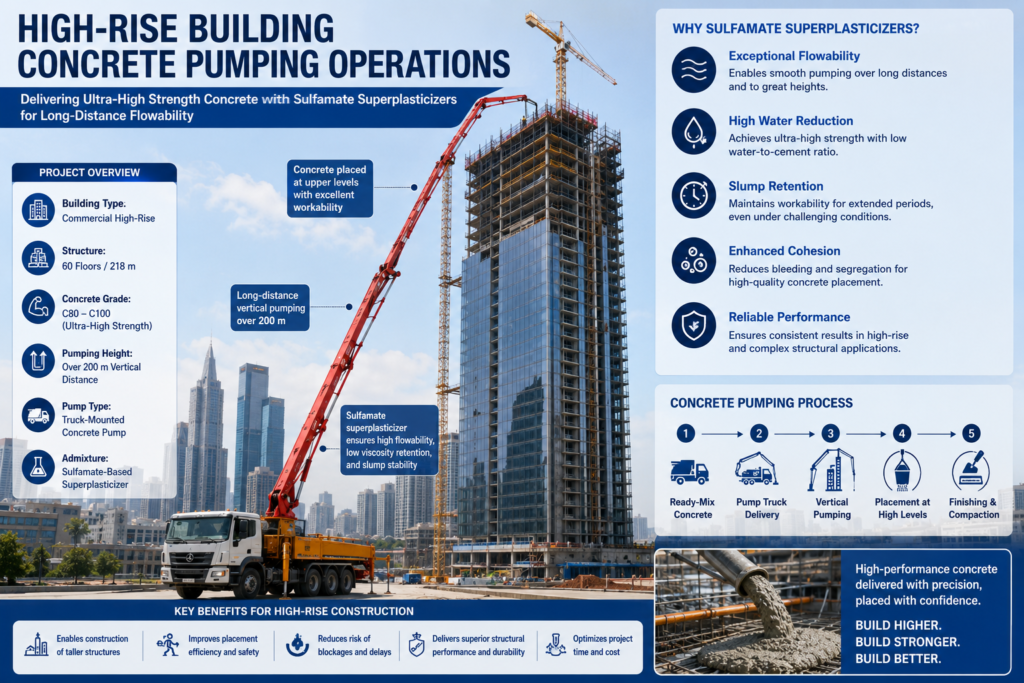
In urban construction environments where concrete transit mixers face unpredictable traffic delays, Sulfamate’s high slump retention ensures that the concrete arrives at the job site with its design fluidity fully intact, preventing premature stiffening or the need for illegal on-site water addition.
2. Fair-Faced Concrete (Architectural Concrete)
Because Sulfamate water reducers significantly mitigate bleeding and segregation, they are the premier choice for fair-faced architectural concrete. They eliminate surface defects, water tracking, and sand-streaking, resulting in a smooth, marble-like structural finish.
3. Complex, Densely Reinforced Concrete Structures
For structures with intricate formwork and dense rebar cages (such as bridge piers or underground subway stations), Sulfamate-modified concrete provides long-lasting self-leveling behavior, allowing the mix to easily flow around steel reinforcements without segregating.
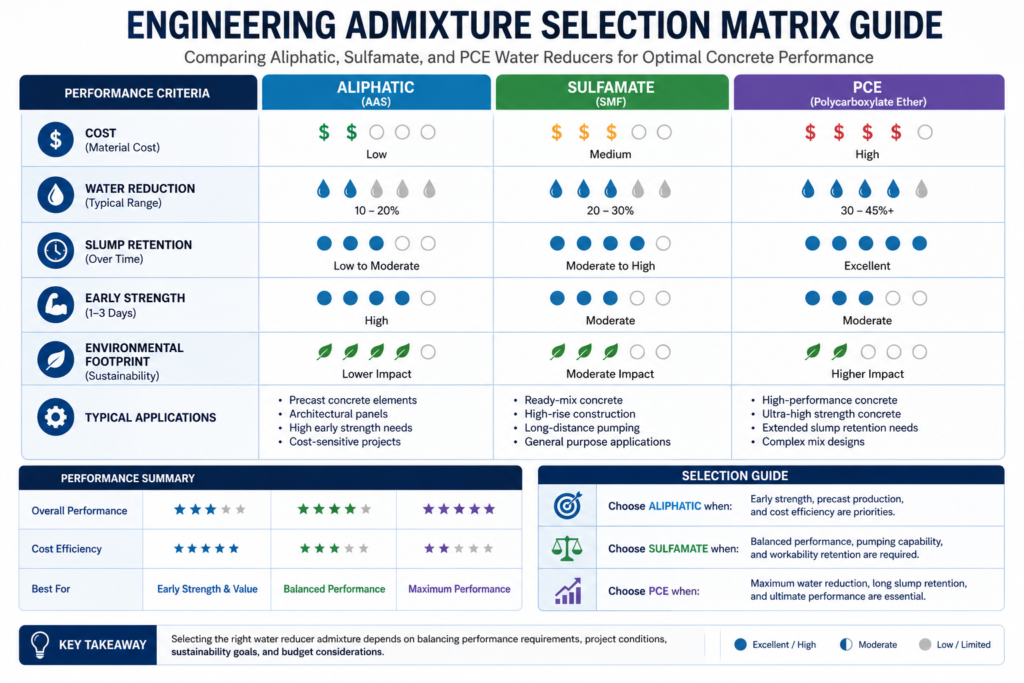
Aliphatic vs. Sulfamate: How do they compare?
To assist engineering teams in making the correct chemical selection, the following table summarizes their core performance metrics based on international standards (such as GB8076 and ASTM C494):
| Performance Metric | Aliphatic Water Reducer | Sulfamate Water Reducer |
| Chemical Basis | Carbonyl-pyrosulfite condensate | Amino-sulfonate formaldehyde condensate |
| Water Reduction Rate | 20% to 25% | 25% to 30% |
| Primary Dispersion Mechanism | Electrostatic Repulsion | Electrostatic Repulsion |
| Slump Retention (60 mins) | Moderate (Slump loss occurs) | Exceptional (Minimal slump loss) |
| Early Strength Gain (1-3 Days) | Extremely Rapid | Moderate to Rapid |
| Concrete Bleeding Risk | Low to Moderate | Extremely Low |
| Optimal Application Goal | Rapid mold removal, cost reduction | Extended transit time, pristine architectural finish |