
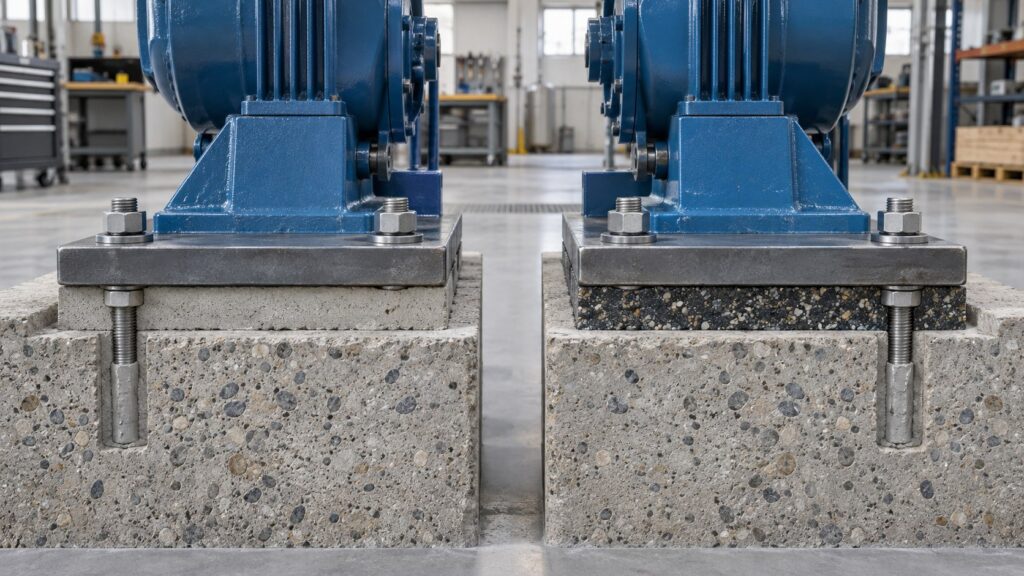
Choosing cementitious grout vs epoxy grout is an engineering decision, not a simple strength comparison. Cementitious grout is usually the practical choice for many static base plates and general structural bearing applications. Epoxy grout becomes valuable when chemical exposure, impact, sustained vibration, rapid return to service or other severe conditions control the design.
However, neither family is automatically superior. A high compressive-strength number does not prove adequate bearing, dimensional stability, creep resistance or thermal compatibility. The correct system must match the equipment, foundation, environment and installation window.
Quick answer: Use a qualified non-shrink cementitious grout when concrete compatibility, moisture tolerance, economy and conventional installation govern. Consider a qualified epoxy grout when the service environment demands greater chemical resistance, high tensile or bond performance, or a specifically verified response to dynamic loading. In both cases, select from project-specific test data rather than generic claims.
What is cementitious grout?
Cementitious precision grout is a hydraulic-cement-based material containing graded aggregate and performance additives. Most packaged products require only measured potable water. When specified as non-shrink grout, the product should demonstrate controlled height change under a recognized standard.
ASTM C1107/C1107M-20 covers packaged dry hydraulic-cement grout used under applied load where a reduction below the initial placement height must be avoided. It does not cover epoxy grout.
Cementitious products can often be mixed to fluid, flowable, plastic or dry-pack consistency within the manufacturer’s limits. They also tend to have thermal movement closer to concrete than many polymer systems. Therefore, they suit column plates, pump bases, static machinery, precast bearing zones and many anchor recesses.
What is epoxy grout?
Epoxy machinery grout normally contains a resin, a hardener and graded mineral aggregate. The installer blends the components at a fixed ratio. Polymerization creates a dense, high-strength composite with strong adhesion and resistance to many oils and industrial chemicals.
Epoxy grout is not simply “cement grout with resin added.” Its curing reaction, exotherm, coefficient of thermal expansion, creep behavior, surface-moisture requirements and test methods differ. ACI SPEC-351.5-24 therefore provides a dedicated specification for epoxy grout installation between foundations and equipment bases.
Typical applications include compressors, turbines, crushers, reciprocating equipment and machinery exposed to chemicals or high operational loads. Yet suitability must come from verified data at the expected temperature and stress.
Cementitious grout vs epoxy grout at a glance
| Decision factor | Cementitious grout | Epoxy grout | Engineering implication |
|---|---|---|---|
| Binder | Hydraulic cement | Thermosetting epoxy resin | Curing mechanisms and surface requirements differ. |
| Supplied components | Usually dry powder plus water | Usually resin, hardener and aggregate | Epoxy proportioning errors cannot be corrected with water. |
| Standard framework | ASTM C1107 and ACI SPEC-351.4 are common references | ACI SPEC-351.5 and product-specific ASTM resin tests are common | Do not apply ASTM C1107 acceptance limits to epoxy. |
| Moisture during installation | Concrete is commonly brought to SSD condition | Dryness or moisture tolerance is product-specific | Follow the approved data sheet and primer system. |
| Chemical resistance | Depends on cement matrix and exposure | Often higher for many oils and chemicals | Verify resistance to the actual chemical, concentration and temperature. |
| Thermal movement | Often relatively close to concrete | Often higher and more temperature-sensitive | Check restraint, shoulder geometry and operating cycles. |
| Creep | Must be checked for sustained load | Resin creep can govern at elevated temperature | Compressive strength alone cannot predict long-term alignment. |
| Lift depth | Governed by product, geometry and heat of hydration | Governed by product, aggregate loading and exotherm | Never exceed the stated pour depth without approval. |
| Cost drivers | Material and curing labor | Higher material cost and tighter temperature control are common | Compare installed lifecycle cost, not bag price. |
The comparison is intentionally qualitative. Product formulations vary widely inside each family.
What published test data really show
The following values are representative product data, not industry-wide design properties. They also use different ASTM methods. Therefore, they should not be ranked as if they came from one test program.
| Property | Representative cementitious grout | Representative epoxy grout |
|---|---|---|
| Compressive strength | 28 MPa at 1 day and 62 MPa at 28 days, fluid consistency | 90–105 MPa at 28 days, depending on aggregate ratio and cure temperature |
| Elastic or flexural modulus | 25.4 GPa at 28 days | 12.9–14.7 GPa at 14 days |
| Tensile strength | 3.4 MPa at 28 days | 12–12.5 MPa at 14 days |
| Coefficient of thermal expansion | 11.7 × 10⁻⁶/°C | 32.9–36 × 10⁻⁶/°C |
| Main referenced methods | Modified ASTM C109/C469 and ASTM C531 | ASTM C579/C580/C307/C531 |
The cementitious figures above come from the current technical page for SikaGrout-885 MF. The epoxy figures come from the Sikadur-42 Grout Pak MultiFlo product data sheet.
Three conclusions follow from this example:
- The epoxy product has higher reported compressive and tensile strengths.
- The cementitious product has a higher reported modulus in the cited tests and much lower thermal expansion.
- Different specimen shapes, loading modes and curing conditions prevent a direct one-number ranking.
Consequently, the engineer should compare declared properties using compatible methods and realistic service temperatures.
Why compressive strength is not enough
The grout must maintain equipment alignment while transferring load across the full bearing area. That requires more than resisting a short-duration laboratory compression test.
Effective bearing area
Voids create local stress concentrations even when the grout itself is strong. Flow, formwork, venting and placement direction control how much plate area receives support. The ACI PRC-351.1-12 report, reapproved in 2024, identifies stable volume and complete filling as central requirements for load-transfer grout.
Creep under sustained load
Creep is time-dependent deformation under sustained stress. A grout may pass compressive-strength tests yet slowly deform under a heavily loaded machine. For epoxy systems, resin stiffness also falls as temperature approaches the material’s transition region. Therefore, obtain creep data at the actual design stress and maximum service temperature.
Thermal compatibility
Machine bases heat and cool during operation. If grout expands more than the concrete foundation and steel plate, restraint can create shear and tensile stresses. The representative data above show why coefficients of thermal expansion belong in the submittal review.
Fatigue, impact and vibration
Vibration resistance is a system property. It depends on grout fatigue behavior, foundation stiffness, anchor preload, plate rigidity, installation quality and machine balance. Do not accept “vibration resistant” as a substitute for relevant test data and equipment-foundation analysis.
When cementitious grout is usually the better choice
Select cementitious grout first when most of these conditions apply:
- The equipment is static or moderately loaded.
- The environment has no severe chemical exposure.
- Thermal compatibility with a concrete foundation is important.
- The prepared concrete will be damp or SSD during placement.
- The project can provide moisture curing and a defined strength-release point.
- Installed cost, simple cleanup and broad availability matter.
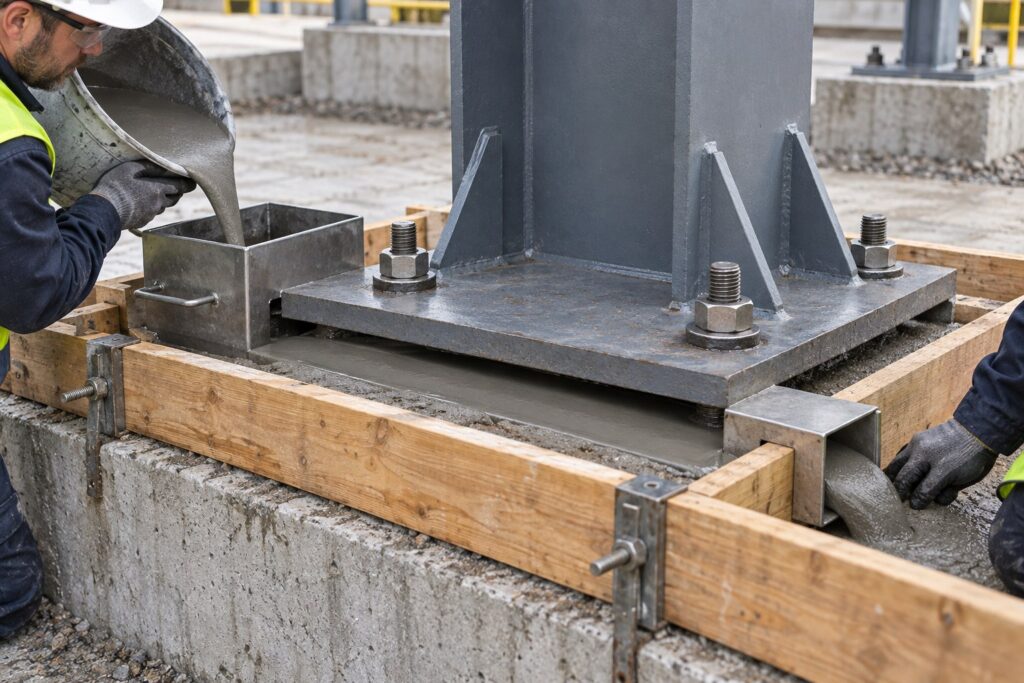
Cementitious grout is still an engineered product. Water content, grout temperature, flow, height change and curing must remain within the approved limits. Extra water can reduce strength and change dimensional behavior.
For equipment-base installation, ACI SPEC-351.4-24 covers minimum requirements for materials, placement and quality control.
When epoxy grout may justify its added complexity
Consider epoxy grout when one or more verified project demands make cementitious performance insufficient:
- Exposure to identified oils, solvents, acids or alkalis
- High impact, shock or dynamic loading
- A rapid installation and strength-development schedule
- High bond or tensile requirements
- A design based on tested long-term creep performance
- Repair of an existing compatible resin-grouted system
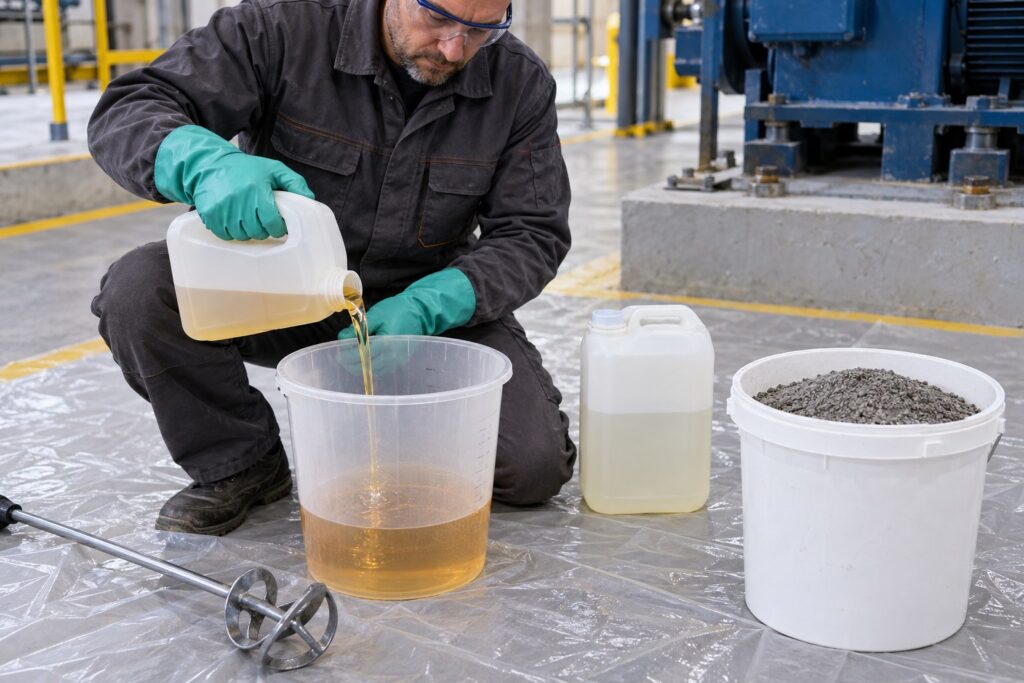
Do not specify “chemical resistant” without naming the chemical. Resistance can change with concentration, temperature, immersion time and cleaning cycle. Likewise, do not assume that every epoxy grout tolerates damp concrete. Verify the selected system’s substrate and primer requirements.
Installation differences that change the risk profile
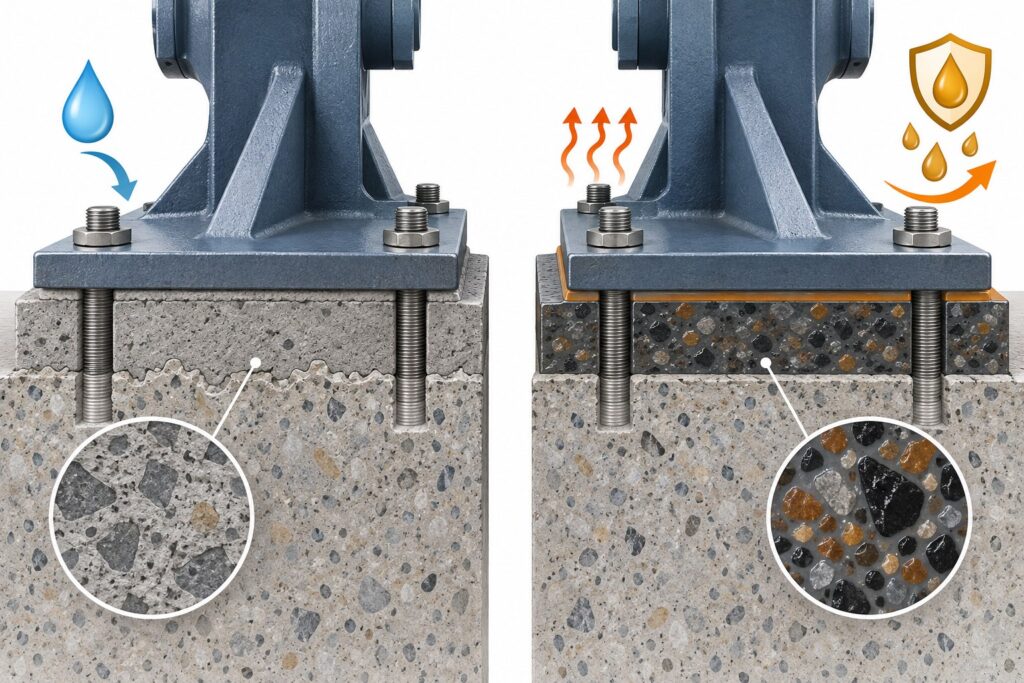
Substrate moisture
Cementitious grout commonly uses an SSD concrete substrate with no standing water. This condition prevents dry concrete from drawing water out of the fresh grout.
Epoxy grout preparation is product-specific. Some resins tolerate residual moisture, while others require dry concrete and a primer. Moisture vapor can also interfere with bond or create defects. Measure and document the required condition instead of relying on appearance.
Mixing and proportioning
For cementitious grout, measure water for every whole bag and stay inside the declared range. For epoxy grout, blend resin and hardener completely before adding the specified aggregate. Scrape the vessel sides and bottom without introducing unmixed material into the pour.
Never change an epoxy aggregate ratio unless the data sheet and approved procedure allow it. Aggregate loading affects flow, exotherm, modulus, thermal expansion and shrinkage.
Temperature control
Both systems are temperature-sensitive. Hot cementitious grout loses working time and water faster. Cold grout gains strength slowly.
Epoxy reaction rate also rises with temperature. A large, hot batch can generate damaging exotherm and shorten placement time. Conversely, cold resin becomes viscous and difficult to mix. Condition all components within the manufacturer’s approved range.
Placement depth and shoulders
Deep lifts increase thermal risk. Epoxy grout is especially sensitive because its polymerization releases heat. Wide exposed shoulders can also crack or debond through thermal movement and restraint. Use the manufacturer’s maximum lift, aggregate ratio and shoulder detail.
Curing and load release
Cementitious grout requires moisture-loss control. Epoxy grout does not receive water curing, but it still requires protection through its temperature-dependent cure. In either system, authorize loading from verified acceptance strength and project criteria, not surface hardness alone.
A seven-step grout selection workflow
- Define the machine and loads. Record static bearing pressure, anchor forces, vibration, impact and alignment tolerance.
- Define the environment. Include minimum installation temperature, maximum operating temperature, chemicals and cleaning cycles.
- Define the geometry. Record plate size, gap, flow distance, shoulders, anchor pockets and access.
- Choose the governing specification. Use ACI SPEC-351.4 for cementitious work or ACI SPEC-351.5 for epoxy work when those standards apply.
- Review comparable data. Check strength, volume change, flow, bearing area, creep and thermal properties using stated methods.
- Trial the installation. For critical work, complete a mock-up or practice batch with the actual mixer, crew and temperature range.
- Approve a method statement. Lock the materials, ratios, batch size, sequence, QC limits, contingency and load-release rule.
Quality-control requirements
Use separate inspection plans for the two grout families.
Cementitious grout records
- Product, lot, expiry and bag condition
- Water per bag and total batch water
- Material, substrate, ambient and mixed-grout temperatures
- Mixing time, flow or consistency, yield and placement time
- Height-change compliance and compressive strength at specified ages
- Curing start, curing method and protection period
Epoxy grout records
- Resin, hardener and aggregate batch numbers
- Component temperatures and conditioning history
- Complete units used and approved aggregate ratio
- Mixing start, placement finish and observed working time
- Substrate moisture condition and primer details
- Batch size, lift depth and peak exotherm where required
- Strength, creep or other project-specific acceptance tests
Field specimens must match the specified method. ASTM C1107 is a cementitious grout specification, not a compressive-strength test and not an epoxy standard.
Common specification mistakes
| Mistake | Why it fails | Better requirement |
|---|---|---|
| Selecting the highest 28-day strength | Ignores creep, bearing and temperature | State service conditions and required properties. |
| Applying ASTM C1107 to epoxy | The standard covers packaged hydraulic-cement grout | Use the correct epoxy specification and test methods. |
| Writing “chemical resistant” | No chemical, concentration or temperature is defined | List the actual exposure and acceptance basis. |
| Allowing field ratio changes | Alters multiple linked properties | Permit only prequalified adjustments. |
| Ignoring thermal movement | Can create shoulder and interface stress | Review CTE, geometry and operating cycles. |
| Using elapsed time for loading | Cure depends on temperature and material | Require verified strength or an approved maturity basis. |
Frequently asked questions
Is epoxy grout always stronger than cementitious grout?
Many epoxy grouts publish higher compressive and tensile values. However, strength depends on the formulation and test method. Higher strength does not automatically mean better thermal compatibility, stiffness or long-term alignment.
Does machinery vibration always require epoxy grout?
No. Some qualified cementitious grouts serve dynamic equipment successfully. The decision should consider fatigue, stiffness, bearing area, anchors, machine balance and service history.
Can cementitious grout resist oil?
Limited incidental exposure may be acceptable for some products, but prolonged or aggressive exposure needs specific evidence. Use chemical-resistance data for the named fluid and temperature.
Can epoxy grout be placed on wet concrete?
Only when the selected system explicitly permits the measured moisture condition. “Moisture insensitive” does not remove the need for surface preparation or compliance with the product instructions.
Which grout is cheaper?
Cementitious material usually has a lower purchase cost. Still, the useful comparison is installed lifecycle cost, including preparation, temperature control, downtime, curing, maintenance and risk of alignment loss.
Can the two grout types be tested with the same cubes?
Not automatically. Cementitious and polymer grouts often use different ASTM methods, specimen preparation and cure conditions. Follow the project specification for each material.
Final engineering recommendation
The best cementitious grout vs epoxy grout decision begins with service conditions, not a preferred chemistry. Cementitious grout provides an efficient, concrete-compatible solution for a wide range of structural and machinery bases. Epoxy grout solves more demanding chemical, impact and bond problems when its thermal and creep behavior are verified.
Require comparable data, a controlled method statement and traceable field records. Those steps protect equipment alignment far more effectively than choosing the largest number on a product sheet.
Technical note: This article provides general engineering information. Project drawings, the engineer’s specification, equipment-manufacturer requirements and the selected product’s current data sheet take precedence.
References
- ASTM International, ASTM C1107/C1107M-20.
- American Concrete Institute, ACI SPEC-351.4-24: Cementitious Grout Installation.
- American Concrete Institute, ACI SPEC-351.5-24: Epoxy Grout Installation.
- American Concrete Institute, ACI PRC-351.1-12, reapproved 2024.
- Sika, SikaGrout-885 MF technical data.
- Sika Canada, Sikadur-42 Grout Pak MultiFlo product data sheet.