
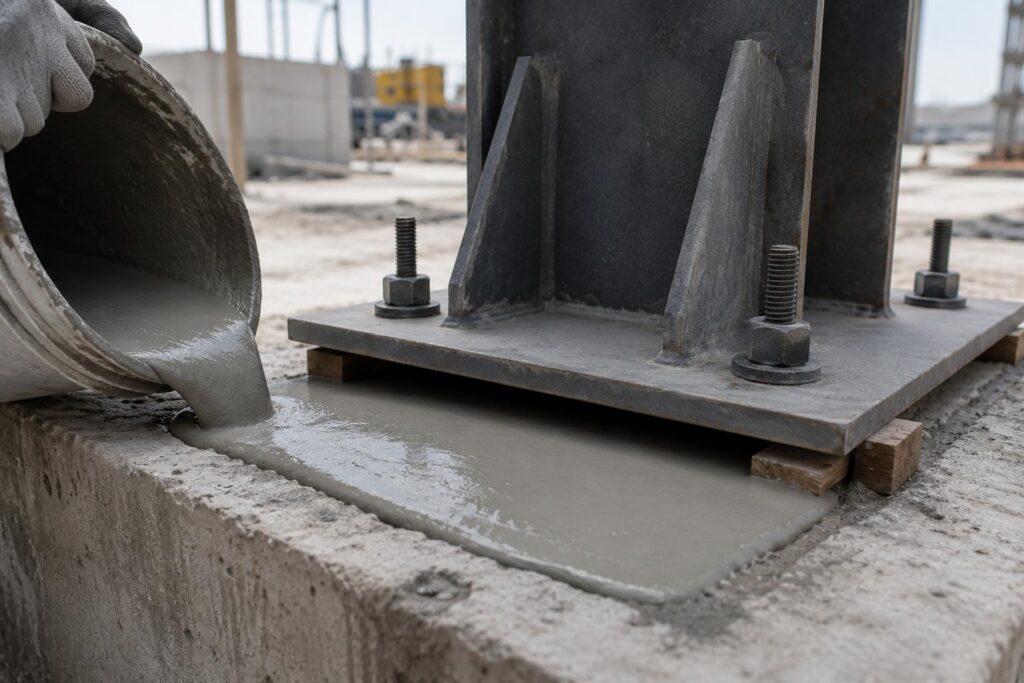
Grouting is an important part of many construction, industrial and infrastructure projects. A properly selected grouting material can fill gaps, transfer loads, support equipment, improve contact between structural components and provide long-term stability.
Among the different types of grout, non shrink grout is widely used where dimensional stability and reliable load transfer are important. Typical applications include equipment foundations, machine bases, steel column base plates, anchor bolts, precast concrete connections and structural repairs.
This guide explains what grout is, how non shrink grout works, the main types of grouting materials, important performance properties, common applications and the correct installation process.
What Is Grout?
Grout is a flowable, fluid, plastic or packable material used to fill voids and gaps between structural or construction components.
Depending on the formulation and application, grout may contain cement, fine aggregates, chemical admixtures, mineral additives, water or resin-based components.
In construction, cementitious grout is commonly used because it can provide high compressive strength, good flowability and reliable load transfer after hardening.
A typical packaged cementitious grout contains hydraulic cement, fine aggregate and other performance-enhancing ingredients. The material is supplied as a dry mixture and normally requires the addition of a specified amount of water before use.
For load-bearing applications, the purpose of grout is not simply to fill a space. The hardened grout must maintain adequate contact with the surrounding surfaces and transfer loads effectively.
What Is Non Shrink Grout?
Non shrink grout is a specially formulated grouting material designed to minimize undesirable volume reduction after placement.
This characteristic is particularly important when grout is used beneath equipment bases, steel plates or other load-bearing components. If conventional grout loses contact with the supported surface because of settlement, bleeding or drying shrinkage, voids can develop and load transfer may become less uniform.
Non shrink grout is therefore commonly selected when the grout must maintain a stable connection between the substrate and the supported component.
ASTM C1107/C1107M covers packaged dry hydraulic-cement grout intended for applications where a reduction in height below the initial placement height needs to be avoided under applied load. The specification covers grout made from hydraulic cement and other ingredients and requires the addition of water before use.
Why Is Non Shrink Grout Important?
The performance of a grouting system depends on more than compressive strength.
For equipment bases and structural connections, important properties may include:
- Volume stability
- Flowability
- Compressive strength
- Bond and contact
- Bleeding resistance
- Segregation resistance
- Workability
- Setting time
- Durability
- Chemical resistance
- Temperature resistance
- Long-term dimensional stability
ACI guidance on grouting between foundations and equipment bases identifies nonshrink cementitious grout and nonshrink epoxy grout as commonly used load-transfer materials.
Main Types of Grouting Materials
Different construction conditions require different types of grout. The most common categories include cementitious grout, non shrink grout, epoxy grout, chemical grout and specialized repair grout.
1. Cementitious Grout
Cementitious grout is based primarily on hydraulic cement and fine aggregate.
It is commonly used for:
- Equipment foundations
- Steel column base plates
- Bearing plates
- Anchor bolt pockets
- Precast concrete connections
- Void filling
- Structural repairs
- General construction grouting
Cementitious grout is often selected because of its compatibility with concrete and relatively simple mixing and installation requirements.
2. Non Shrink Grout
Non shrink grout is formulated to provide controlled volume change and maintain contact with the surfaces being grouted.
Typical applications include:
- Machine base grouting
- Equipment foundation grouting
- Steel base plate grouting
- Column base plate grouting
- Anchor bolt grouting
- Bearing plate installation
- Precast concrete connections
For load-bearing applications, the objective is to create a continuous and stable load-transfer layer rather than simply filling an empty space.
3. Epoxy Grout
Epoxy grout uses resin-based binders rather than hydraulic cement as the primary binder.
It can be considered where projects require specific properties such as high chemical resistance, strong adhesion or resistance to demanding operating conditions.
Epoxy and cementitious grouts have different material characteristics, so selection should be based on the project specification, service conditions and manufacturer’s technical data.
4. High Strength Grout
High strength grout is designed to achieve high compressive strength while maintaining suitable workability and dimensional stability.
It may be used for:
- Heavy machinery
- Structural supports
- Steel columns
- Equipment foundations
- Precast connections
- Heavy-duty base plates
However, compressive strength should not be considered the only selection criterion. Flowability, volume stability, placement thickness and curing conditions can also significantly affect field performance.
Key Properties of High Performance Grout
Flowability
Good flowability allows grout to move into narrow gaps and around reinforcement, anchor bolts and base plates.
For equipment base grouting, the grout should be able to fill the designed space without leaving significant voids.
Compressive Strength
Compressive strength indicates the ability of hardened grout to resist compressive loading.
The required strength depends on the structural design, substrate strength, equipment load and project specification.
Volume Stability
Volume stability is one of the most important characteristics of non shrink grout.
A grout that loses contact with the supported surface may create gaps and reduce effective load transfer.
For this reason, non-shrink performance should be evaluated according to the applicable project standard rather than assumed simply from the product name.
Bleeding and Segregation Resistance
Excessive bleeding can create water-rich zones or voids. Segregation can produce non-uniform material distribution.
A properly designed grouting material should maintain a relatively uniform composition during mixing, transport and placement.
Setting Time
Setting time affects construction scheduling and equipment installation.
A fast-setting grout may be suitable for certain repair or rapid installation applications, while a longer working time may be beneficial for large or complicated placements.
Common Applications of Non Shrink Grout
Equipment Foundation Grouting
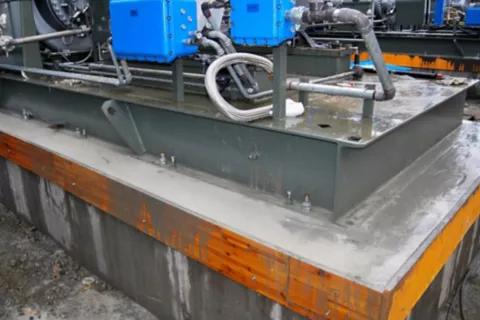
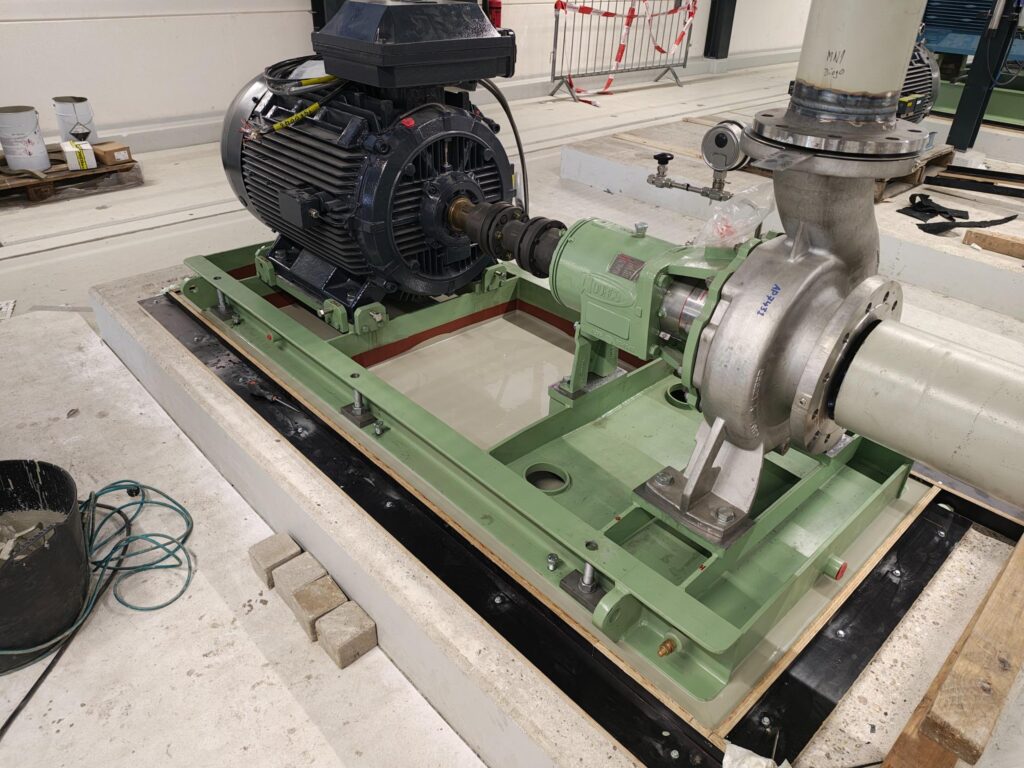
One of the most important applications of non shrink grout is the installation of industrial equipment.
Machinery bases and foundations are rarely perfectly flat. Grout fills the space between the equipment base and concrete foundation and creates a load-transfer layer.
ACI guidance describes grouting as a method for transferring loads between equipment bases and foundations while helping maintain alignment and uniform support.
Typical equipment includes:
- Pumps
- Compressors
- Motors
- Generators
- Industrial machinery
- Steel structures
- Processing equipment
Steel Column Base Plate Grouting
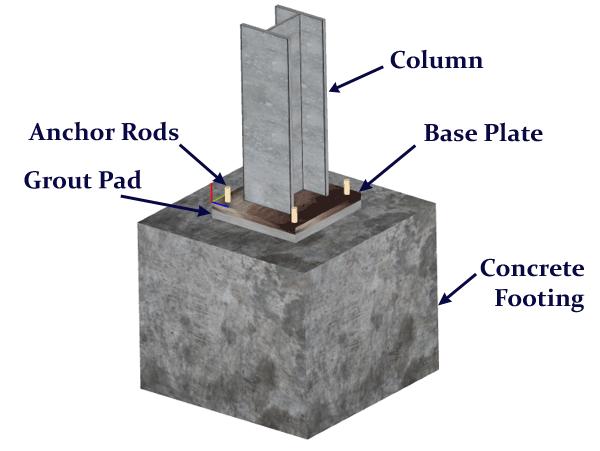
Structural steel columns are commonly supported on steel base plates installed over concrete foundations.
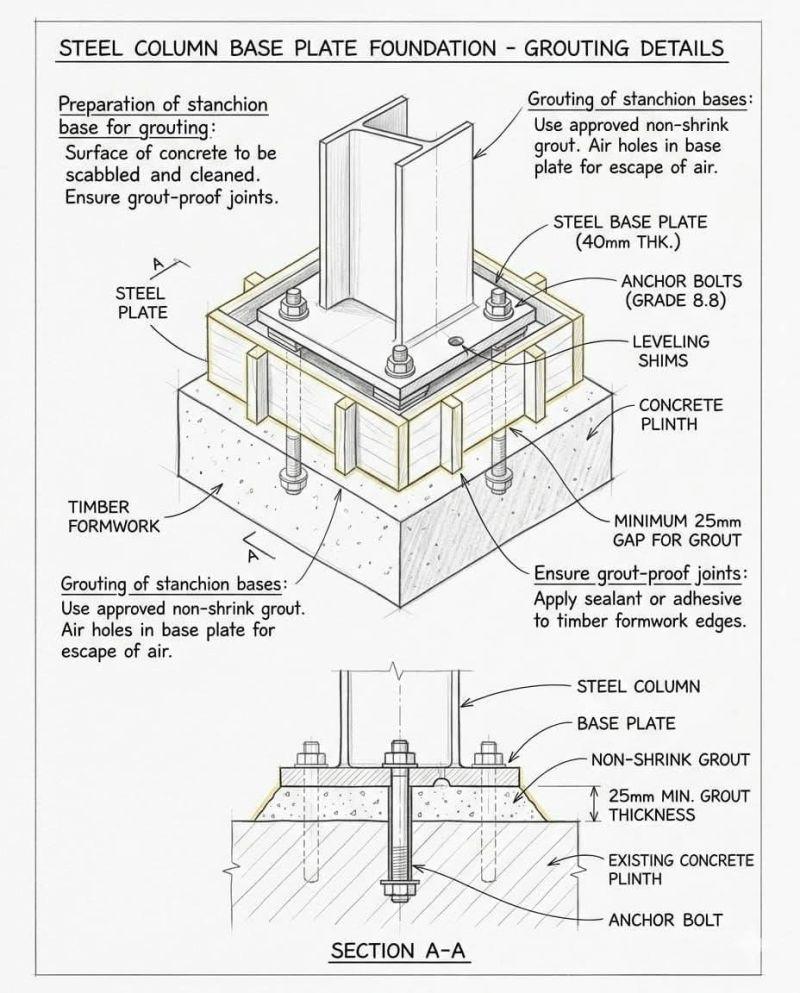
Base plate grout fills the designed gap beneath the plate and provides a continuous bearing surface.
The installation system normally includes:
- Concrete foundation
- Anchor bolts
- Steel base plate
- Leveling system
- Formwork
- Non shrink grout
The grout should completely fill the specified space and achieve the required hardened properties.
Anchor Bolt Grouting
Anchor bolt grout is used in various structural and equipment applications.
Depending on the project design, grout may be used around anchor bolt pockets or beneath base plates.
The actual anchorage capacity should always be determined by the structural design and applicable anchoring system requirements rather than by grout compressive strength alone.
Precast Concrete Connections
Grout can also be used to fill joints, sleeves and connection areas in precast concrete construction.
In these applications, the material must provide suitable flowability, strength, dimensional stability and compatibility with the surrounding concrete system.
Bearing Plate Grouting
Bridge components, structural supports and heavy steel elements may require grout beneath bearing plates.
The objective is to provide reliable contact and load transfer between the bearing component and concrete substrate.
Non Shrink Grout Installation Process
Correct installation is just as important as material selection.
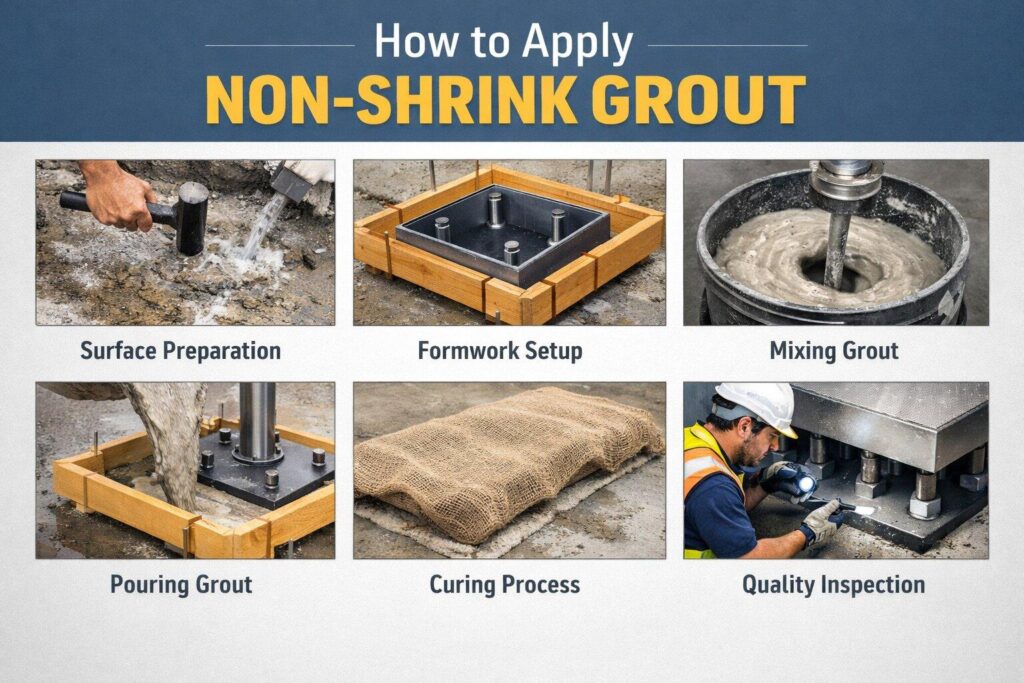
Step 1: Prepare the Concrete Surface
Remove:
- Dust
- Oil
- Grease
- Loose concrete
- Laitance
- Other contaminants
The substrate should be sound and suitable for receiving the grout.
Step 2: Check the Equipment or Base Plate
Before grouting, verify:
- Elevation
- Alignment
- Level
- Anchor bolt position
- Base plate position
- Grouting gap
- Formwork dimensions
The equipment should be correctly positioned before the grout is placed.
Step 3: Install Formwork
Formwork should be sufficiently rigid and sealed to prevent grout leakage.
For base plate grouting, the formwork configuration should allow the grout to flow continuously beneath the entire plate.
Step 4: Precondition the Substrate
For cementitious grout, the concrete surface may need to be pre-dampened according to the manufacturer’s instructions.
Standing water should generally be removed before placement unless the specific product instructions state otherwise.
Step 5: Mix the Grout
Use the water-to-powder ratio specified in the technical data sheet.
A typical mixing sequence is:
Measure water → Add grout powder → Mix mechanically → Check consistency → Place immediately
Do not add excessive water simply to increase flowability.
Too much mixing water can negatively affect strength, shrinkage, segregation and overall durability.
Step 6: Place the Grout
For base plate applications, grout should normally be placed continuously from one side so that air can escape and the cavity can be filled progressively.
Depending on the project and product, placement may be performed by:
- Gravity flow
- Pumping
- Pressure grouting
- Hand placement
- Dry packing
The selected method should be compatible with the grout consistency and installation geometry.
Step 7: Consolidate and Finish
Ensure that the grout completely fills the intended space.
Avoid trapping air beneath base plates or inside confined cavities.
The exposed grout surface should be finished according to the project requirements and manufacturer’s instructions.
Step 8: Cure and Protect
Fresh grout should be protected from:
- Premature drying
- Excessive heat
- Freezing
- Strong wind
- Heavy vibration
- Impact
- Premature loading
Curing requirements vary according to product formulation and environmental conditions.
Common Problems During Grouting
Insufficient Flowability
If the grout cannot flow into the entire cavity, voids may remain beneath the base plate.
Possible causes:
- Incorrect water dosage
- Poor mixing
- Improper placement method
- Excessive placement distance
- Inadequate formwork design
Excessive Water
Adding too much water may make the grout appear easier to place, but it can alter the designed performance of the material.
Always follow the manufacturer’s recommended mixing ratio.
Poor Surface Preparation
Dust, oil, laitance and weak concrete can reduce the quality of the grout-to-substrate interface.
Surface preparation is therefore a critical part of the grouting process.
Interrupted Placement
Large base plates should be planned carefully to avoid unplanned interruptions.
Continuous placement is often preferred where the design requires complete filling of the cavity.
Premature Loading
The equipment or structure should not be subjected to loads or vibration before the grout has achieved the required strength.
How to Choose the Right Grouting Material
When selecting a grouting material, consider the following factors:
| Selection Factor | Why It Matters |
|---|---|
| Application | Determines the appropriate grout type |
| Required strength | Ensures adequate load-bearing capacity |
| Flowability | Helps achieve complete filling |
| Grouting thickness | Influences aggregate and formulation requirements |
| Volume stability | Helps maintain long-term contact |
| Setting time | Affects construction schedule |
| Temperature | Influences setting and curing |
| Chemical exposure | May determine cementitious or epoxy selection |
| Equipment vibration | Important for machinery foundations |
| Installation method | Determines suitable grout consistency |
| Applicable standards | Provides project-specific acceptance criteria |
For packaged non-shrink hydraulic cement grout, ASTM C1107/C1107M is an important reference specification. Project specifications may also require additional testing or standards.
Non Shrink Grout vs Ordinary Cement Grout
Ordinary cement-sand grout and engineered non shrink grout should not automatically be treated as interchangeable.
A conventional grout may experience settlement, bleeding or drying shrinkage that can affect contact with the supported element.
Non shrink grout is specifically formulated for applications where maintaining dimensional stability and load transfer is important.
| Property | Ordinary Cement Grout | Non Shrink Grout |
|---|---|---|
| Formulation | Relatively simple | Engineered formulation |
| Flowability | Depends on mix | Controlled |
| Volume stability | Depends on mix | Specifically controlled |
| Load transfer | Application dependent | Designed for load-transfer applications |
| Quality consistency | Depends on field batching | Usually factory controlled |
| Typical use | General filling | Equipment, base plates and structural applications |
The actual performance of any product should be confirmed through its technical data and applicable project requirements.
Quality Control for Grouting Materials
A reliable grouting system requires quality control at both the material and installation stages.
Material Quality
Check:
- Product batch number
- Manufacturing date
- Packaging condition
- Storage conditions
- Technical data sheet
- Applicable test reports
- Required standards
Mixing Quality
Control:
- Water dosage
- Mixing time
- Mixer type
- Mixing sequence
- Grout temperature
- Consistency
Placement Quality
Inspect:
- Formwork
- Surface preparation
- Base plate alignment
- Continuous filling
- Air release
- Grout coverage
- Finished surface
Curing Quality
Monitor:
- Ambient temperature
- Concrete temperature
- Grout temperature
- Moisture retention
- Protection from premature drying
- Required curing period
ACI’s equipment-grouting guidance specifically addresses grout properties, material requirements, testing, preparation, mixing, placing, curing and quality assurance.
Frequently Asked Questions About Non Shrink Grout
What is non shrink grout used for?
Non shrink grout is commonly used beneath equipment bases, steel column base plates, bearing plates and other load-bearing components where stable contact and load transfer are required.
What is the difference between grout and concrete?
Grout is generally designed to be more flowable and to fill relatively confined spaces, gaps or cavities. Concrete normally contains coarse aggregate and is used for larger structural members.
Is non shrink grout stronger than concrete?
Not necessarily. Grout and concrete are designed for different purposes. The appropriate comparison should consider compressive strength, stiffness, volume stability, bond, placement geometry and service conditions.
Can non shrink grout be used under a steel base plate?
Yes. Non shrink cementitious grout is commonly used beneath steel base plates and equipment foundations when specified for the application.
How much water should be added to grout?
The water quantity must follow the manufacturer’s technical data sheet. Adding water beyond the recommended range can change the designed properties of the grout.
Can grout be used for anchor bolts?
Grout can be used around anchor bolt pockets or as part of base plate and equipment installation systems, depending on the structural design and product specification.
How long does non shrink grout take to cure?
The required curing time depends on the formulation, temperature, humidity, application and specified strength requirement. Always follow the manufacturer’s technical data sheet and project specifications.
Conclusion
Non shrink grout is an important construction material for applications where reliable filling, dimensional stability and load transfer are required.
From equipment foundations and machinery bases to steel column base plates, bearing plates and precast concrete connections, the correct grouting material can help create a stable connection between structural components.
Successful grouting depends on three factors:
Correct material selection + proper installation + effective quality control
For demanding construction and industrial applications, engineers and contractors should evaluate grout based on the actual project requirements, including strength, flowability, volume stability, placement conditions, curing requirements and applicable standards.
A properly engineered cementitious grout or non shrink grout is not simply a gap-filling material. It is an important part of the load-transfer system between structural components and their supporting foundation.