
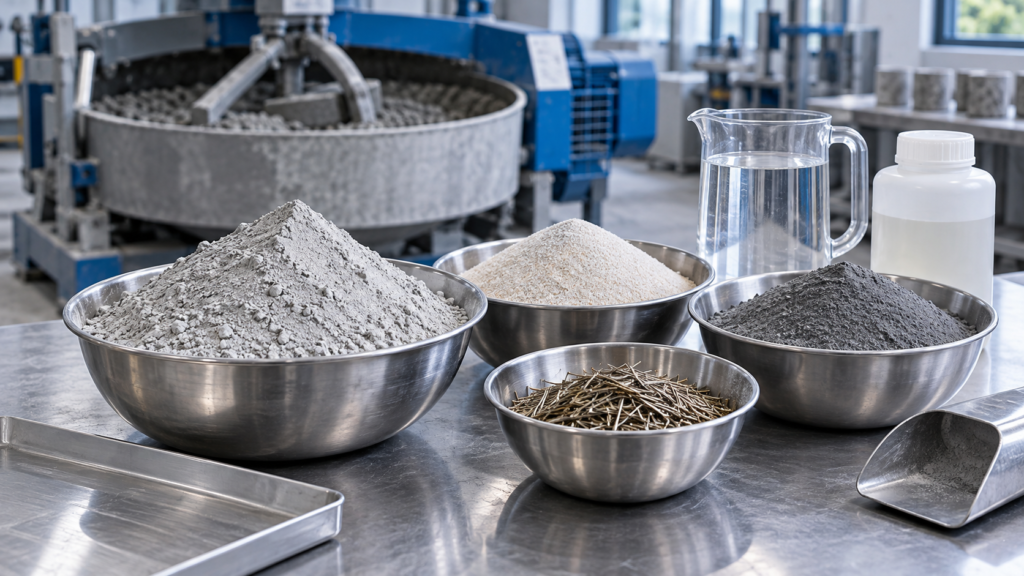
A UHPC concrete mix is a coordinated material system. Powder grading, water, admixtures, steel fiber, mixing equipment, and curing all affect whether the mixture can be produced and placed successfully. Copying ingredient quantities from another project does not establish the performance of local materials or a different production line.
For manufacturers and contractors, the practical task is to qualify a mixture for a defined application. That means connecting fresh properties, hardened performance, and production control before placing an order or starting full-scale work. This guide explains the development process and the records needed to evaluate a UHPC mixture without presenting an unverified universal recipe.
Define What the UHPC Must Achieve
Start with the element or connection being produced. Record geometry, reinforcement congestion, flow distance, surface requirements, exposure, and the intended demolding or loading schedule. Define the material properties required by the designer and the procedures used to verify them.
Do not define UHPC only through compressive strength. Fiber-reinforced structural applications also require attention to tensile behavior and the evidence used in design. The necessary tests and acceptance limits depend on the project and applicable design framework.
The FHWA field-cast UHPC connection guidance emphasizes project-specific requirements for formulation, mixing, placement, and curing. That guidance is a useful reference for understanding the material as part of a construction system, rather than as a bagged strength claim.
The Main Components of a UHPC Concrete Mix
Cementitious Materials and Fine Powders
The binder and fine-powder system influences packing, hydration, and fresh behavior. Cement, supplementary cementitious materials, and other specified fine constituents must be evaluated as a combination. Changes in source or characteristics can require compatibility checks and renewed trial work.
Keep a clear definition of “binder” in the mixture record. Water-to-binder calculations are difficult to compare when different teams include different powders in the denominator. Record each constituent by mass and identify the calculation basis.
Fine Aggregate
Aggregate grading and moisture condition affect mixture consistency and batching accuracy. Verify the supplied grading against the qualified mixture rather than substituting any material sold under the same general name.
Account for aggregate moisture in the water balance. A fixed added-water quantity does not create a consistent effective mixture if aggregate moisture varies without correction. Establish the measurement and correction procedure during qualification.
Superplasticizer
A suitable superplasticizer helps achieve the required fresh behavior within the qualified water content. Performance depends on compatibility with the actual powder system and production conditions. A dosage copied from another formulation may not provide the same result.
Track the supplied admixture form and concentration. Product mass and active-solids mass are different quantities. When comparing laboratory and production batches, use an explicit and consistent basis for both water accounting and admixture dosage.
Steel Fiber
Fiber geometry, surface characteristics, strength, dosage, and distribution are part of the qualified system. Record the approved fiber designation and the basis used to express dosage. Do not replace one fiber with another simply because both are described as micro steel fiber.
FHWA material characterization work identifies fibers as defined constituents with specific properties in the studied mixture. Its reported formulation is research evidence for that system, not a transferable specification for every UHPC product.
Use a Trial Program Instead of a Universal Recipe
A useful trial program changes variables deliberately. First establish a repeatable baseline using documented materials, equipment, and environmental conditions. Then investigate a limited set of changes so that the team can identify why behavior improved or deteriorated.
Record quantities, constituent identification, moisture corrections, mixing sequence, mixing duration, material temperature, and the fresh tests required by the qualification plan. Prepare specimens using the agreed procedures. Keep an explicit link between each trial batch and its results.
The trial should reproduce the intended placement challenge. A mixture that fills an open laboratory mold may behave differently through a narrow connection or around congested reinforcement. Use representative geometry when the application makes flow and fiber distribution critical.
Translate Laboratory Results Into Production
Mixer capacity and mixing action matter when moving to a larger batch. Confirm the working batch size, equipment condition, loading sequence, and practical discharge time. Do not assume that a nominally larger mixer reproduces a successful laboratory process automatically.
Follow the qualified sequence for adding powders, water, admixture, and fibers. Fiber addition needs to avoid localized accumulation and preserve the validated distribution process. The appropriate sequence and duration depend on the chosen system and equipment.
Record mixture temperature and fresh behavior at agreed points. If a production batch falls outside the acceptance window, use the approved disposition procedure. Do not make uncontrolled water or admixture additions simply to match the appearance of a previous batch.
Validate Flow and Placement Together
Fresh testing should answer a practical question: can the mixture fill the intended geometry within the available time while maintaining acceptable uniformity? Choose tests and acceptance windows suited to that purpose.
A mixture that is too stiff can leave incomplete filling. Excessive fluidity can also be a concern if it allows constituent separation. Confirm both filling ability and stability through the qualification program and relevant placement trials.
Plan discharge location, placing direction, access, batch continuity, and any permitted placement assistance. Changes to the flow path can affect fiber orientation, so a successful fresh test alone does not prove that every placement arrangement is equivalent.
Treat Curing as a Defined Production Step
Establish the curing regime before interpreting strength results. Record the actual temperature and moisture environment associated with specimens and production elements. A result from one regime should not be presented as the expected outcome of a different regime without verification.
Heat treatment is not a universal requirement for every UHPC application. Ambient and thermal curing approaches exist, but the selected system must demonstrate the required performance under the proposed conditions. FHWA’s UHPC state-of-the-art review discusses research involving different production and curing approaches.
Define when forms can be removed, how early surfaces are protected, and what evidence permits handling or loading. These decisions should be part of the approved production plan, not improvised after casting.
Production Control Checklist
| Control point | Record | Decision supported |
|---|---|---|
| Constituents | Source, designation, lot, and storage condition | Matches the qualified system |
| Water balance | Added water and relevant moisture contributions | Maintains the approved mixture basis |
| Admixture | Product form, quantity, and concentration basis | Enables accurate batching |
| Fibers | Approved type and dosage | Preserves the qualified reinforcement system |
| Mixing | Equipment, batch size, sequence, and duration | Confirms a repeatable process |
| Fresh properties | Required tests and timing | Supports placement acceptance |
| Curing | Defined regime and actual conditions | Supports interpretation of test results |
| Hardened testing | Methods, specimen details, age, and results | Demonstrates the specified performance |
Use this table to build a project-specific record. It is a planning framework, not a substitute for the acceptance requirements in the design and quality documents.
Investigate Production Problems Systematically
If a batch does not flow as expected, begin with the records. Check weighing, moisture corrections, material identification, temperature, and the mixing sequence. Compare those details with the qualified baseline before changing the formulation.
For fiber accumulation, investigate addition rate, location, equipment, and batch size. For inconsistent hardened results, review specimen preparation and curing alongside production records. A single symptom can have more than one cause.
Keep corrective trials separate from accepted production. Define what evidence is needed before a changed procedure becomes the new baseline. This preserves traceability and avoids gradually drifting away from the qualified mixture.
Procurement Options and Technical Questions
Compare a premix, separately supplied components, and a locally developed formulation on the scope each supplier provides. Confirm whether fibers, admixtures, technical support, qualification testing, and production instructions are included.
A low price for powder alone may omit essential components. Our UHPC concrete cost guide explains why quotations should be normalized to the same delivered mixture and construction scope.
Send a prospective UHPC premix supplier the application, required properties, production equipment, volume, destination, and proposed curing conditions. Ask the supplier to identify what trial work is required with your materials and equipment.
Frequently Asked Questions
Is There One UHPC Mix Ratio for Every Project?
No. Material sources, equipment, geometry, and performance requirements differ. Use a qualified formulation supported by testing for the proposed application.
Can More Water Solve a Mixing Problem?
Use only adjustments allowed by the qualified procedure. Extra water changes the formulation. Investigate batching, moisture accounting, compatibility, and equipment before making a change.
Can Steel Fibers Replace All Reinforcing Bars?
Do not make that substitution without structural design approval. The role of fibers and conventional reinforcement depends on the element and design method.
Must UHPC Always Be Steam Cured?
No single curing regime applies to every system. Demonstrate the required properties under the actual proposed regime and follow the approved production plan.
Qualify the Complete Mixture and Process
A reliable UHPC concrete mix combines documented constituents with controlled batching, mixing, placement, and curing. Start from the project requirements, establish a repeatable trial baseline, and validate the transition to production. Preserve those conditions in the purchase specification and quality records.
For a technical inquiry to Hubei Qiandao New Materials Co., Ltd., provide the application, target performance, equipment, required quantity, and proposed curing method. Request current material information and a trial proposal that addresses the complete system rather than a universal ingredient recipe.