
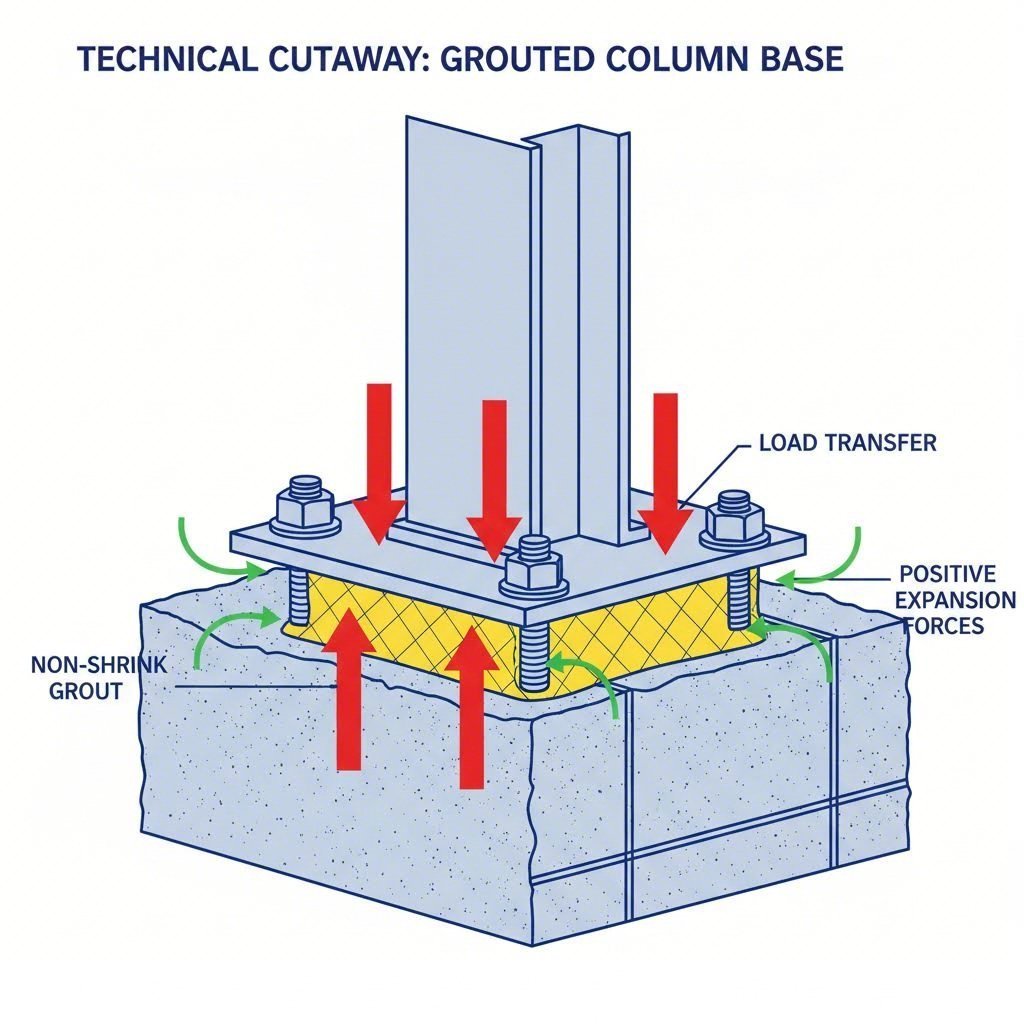
Cement-based non-shrink grout is a hydraulic cement material formulated with additives that counteract natural curing shrinkage, ensuring it maintains volume for 100% load transfer. Unlike standard mortar, it meets ASTM C1107 standards for controlled positive expansion, making it the critical choice for anchoring structural columns, bedding heavy machinery, and sealing precast concrete joints. For most projects, success depends on achieving the correct consistency (Plastic, Flowable, or Fluid) without over-watering, which drastically reduces compressive strength.
What Is Cement-Based Non-Shrink Grout? (Mechanics & Chemistry)
At its core, cement-based non-shrink grout is a high-performance construction material designed to solve a singular problem: the volume loss that occurs when standard cement paste hardens. Ordinary concrete and mortar shrink as water evaporates and hydration creates chemical bonds, which pulls the material away from steel plates or bolts. In structural applications, this gap is catastrophic—it means the load (like a building column or a turbine) is no longer fully supported by the foundation.
To prevent this, non-shrink grouts incorporate gas-generating or air-release additives (such as expansive agents or chemical admixtures) that cause the mixture to expand slightly while in its plastic state. This “positive expansion” continues until the material hardens, forcing the grout tightly against the baseplate and the concrete foundation. This mechanism ensures a high Effective Bearing Area (EBA), often exceeding 95%, which allows for the complete transfer of static and dynamic loads.
Technically, these materials must comply with ASTM C1107 (Standard Specification for Packaged Dry, Hydraulic-Cement Grout). They are engineered to reach compressive strengths far superior to standard concrete—often achieving 8,000 to 14,000 PSI depending on the water ratio—making them indispensable for critical infrastructure where failure is not an option.
Critical Technical Specifications: Fluidity & Strength
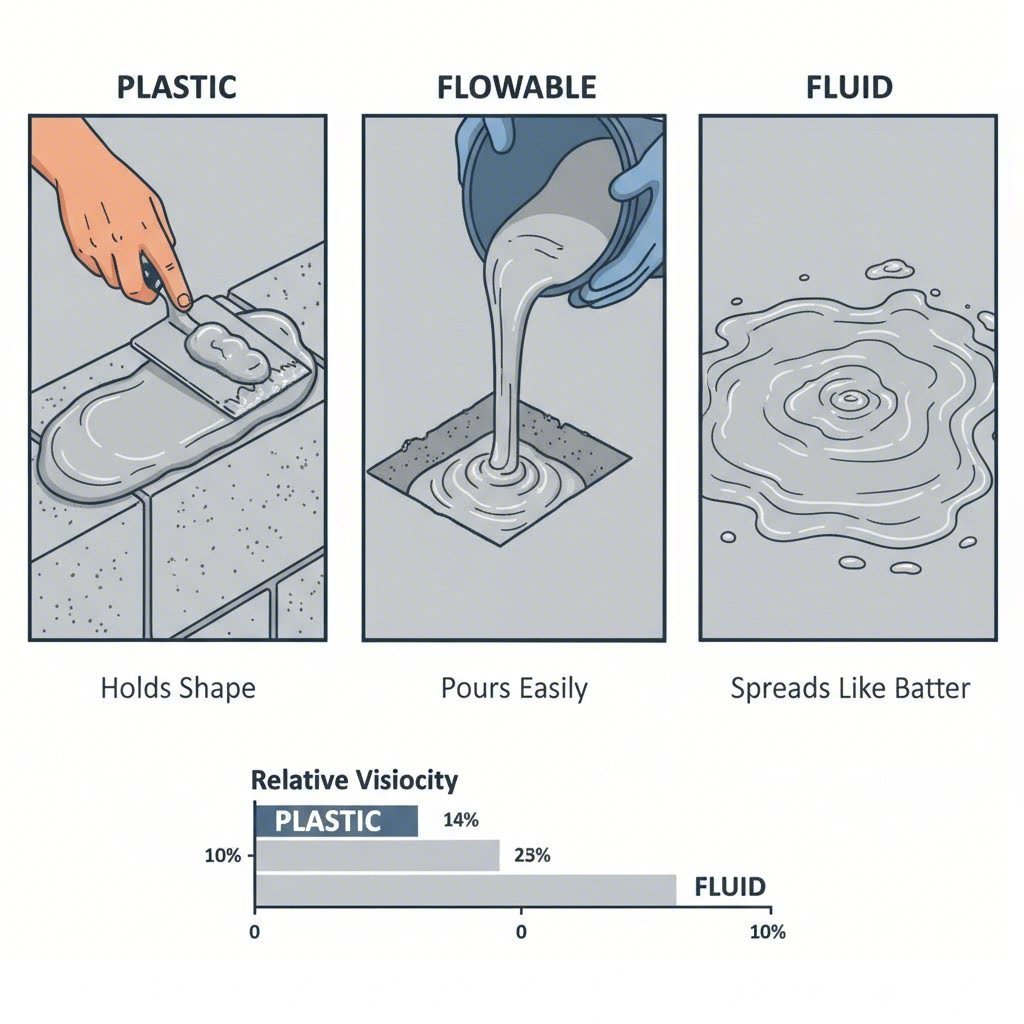
One of the most common causes of grout failure is misunderstanding the relationship between fluidity and strength. Manufacturers like Sika and Quikrete engineer their products to function in three distinct consistency states, each determined by the exact amount of water added. Adding just a pint too much water can degrade the grout’s structural integrity.
1. Plastic Consistency
This is the thickest mix, similar to putty or trowelable mortar. It yields the highest compressive strength because it uses the least amount of water. For example, Quikrete’s precision grout can hit roughly 14,000 PSI in a plastic state. It is best used for “dry packing” voids where forms are not used, or for vertical applications where flow is not desired.
2. Flowable Consistency
A flowable mix has a pourable texture but still requires some assistance (like rodding or light vibration) to travel under large baseplates. It strikes a balance, offering excellent strength (often around 12,500 PSI) with easier placement. This is the standard consistency for many general construction anchoring tasks.
3. Fluid Consistency
A fluid mix looks like thick pancake batter and is self-leveling. It is essential for grouting areas with tight clearances or intricate configurations where the material must flow by gravity alone. However, this ease of flow comes at a cost: the extra water reduces the ultimate strength. A fluid mix might yield around 8,000 PSI—still incredibly strong, but significantly lower than the plastic state. SikaGrout 428 FS, for instance, requires precisely 8 pints of water for fluid consistency, compared to 6.5 pints for plastic.
CRITICAL WARNING: Never exceed the maximum water ratio on the bag. Over-watering causes segregation (where aggregate sinks and water rises), leading to a weak, chalky top layer known as “laitance” that cannot support structural loads.
Cementitious vs. Epoxy Grout: Making the Right Choice
While cement-based grout is the industry workhorse, it is not the only option. Engineers often decide between cementitious and epoxy grouts based on the specific environmental stresses of the project. A cement-based solution is cost-effective, easy to clean up with water, and naturally heat-resistant, making it ideal for static loads like building columns and precast panels.
Epoxy grout, on the other hand, is a resin-based system that offers superior resistance to dynamic loading (heavy vibration from compressors or generators) and harsh chemicals. If your application involves a chemical plant floor or a machine that vibrates violently, cementitious grout may eventually crack under the fatigue. However, epoxy is significantly more expensive, difficult to handle, and has a shorter pot life. For 90% of general construction and static anchoring, cement-based non-shrink grout is the correct and most economical specification.
Step-by-Step Application Masterclass (Fail-Proof Method)
Application errors are responsible for the majority of grout failures. Following a disciplined protocol is more important than the brand of material you choose.
- Surface Preparation (The SSD Rule): The concrete foundation must be clean, roughened to a concrete surface profile (CSP) of 3–5, and free of oil or grease. The most overlooked step is the Saturated Surface Dry (SSD) condition. You must soak the concrete substrate with water for 24 hours prior to pouring. Just before grouting, remove all standing water. The concrete should be damp but not puddled. If the concrete is dry, it will suck the water out of the fresh grout, causing shrinkage cracks and bond failure.
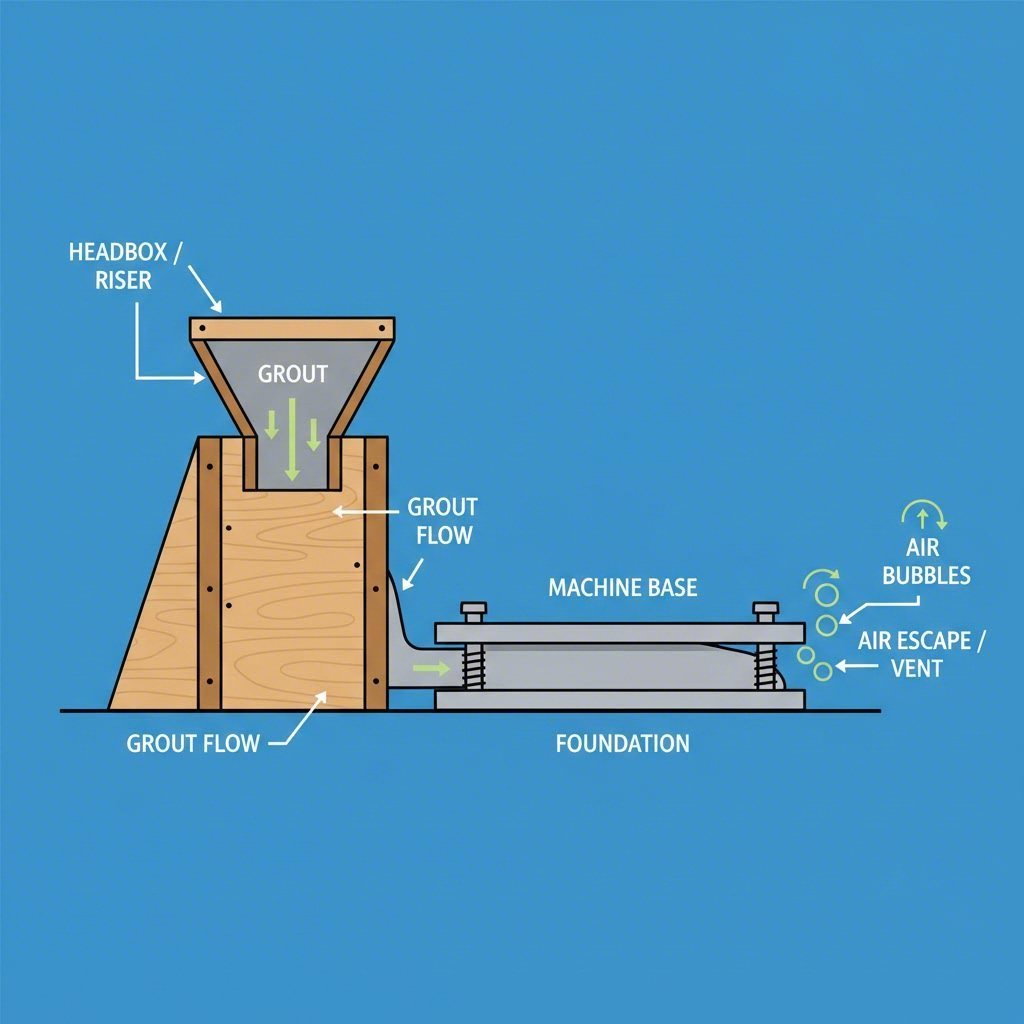
- Formwork Strategy: Forms must be watertight. Grout is fluid and will leak through tiny gaps, which can cause honeycombing. Build a “headbox” on one side of the form—a raised hopper that allows you to pour the grout from a height to create pressure (head), helping push the material under the plate.
- Mixing Protocol: Use a mechanical mixer or a heavy-duty drill with a paddle. Add roughly 75% of the water first, then the powder, then the remaining water to reach the desired consistency. Mix for 3–5 minutes to activate the plasticizing agents. Do not over-mix, as this traps air bubbles. Do not retemper (add more water later) if the mix stiffens; throw it out and start over.
- Placement: Pour from one side only. This forces the air out ahead of the grout stream. If you pour from two sides, you will trap an air pocket in the middle, leaving a void under your equipment. For large areas, use metal strapping or chains to “rod” the material back and forth, ensuring it fills all cavities.
- Curing: Cement-based grout needs wet curing to reach full strength. Cover exposed shoulders with wet burlap or apply a curing compound immediately after the sheen disappears.
Top Brands & Product Comparison
The market is dominated by a few trusted manufacturers, each catering to slightly different needs.
- Quikrete Non-Shrink Precision Grout: A staple found in most hardware stores like Home Depot. It is an excellent general-purpose choice for contractors and DIYers working on column bases or railing posts. It is extremely versatile and widely available.
- SikaGrout Solutions: Sika offers advanced formulations like the SikaGrout 428 FS, which features ViscoCrete technology for rapid strength gain and high fluidity. Ideally suited for time-sensitive commercial projects where quick turnaround is needed.
- Five Star Products: Five Star is often the specification for heavy industrial machinery. Their formulations focus on “Air Release” technology to minimize voids and maximize the Effective Bearing Area (EBA) for critical equipment support.
Sourcing for Industrial & Specialized Projects:
While retail brands cover standard construction needs, large-scale infrastructure and precast projects often require specialized admixture solutions to customize grout performance. For enterprise-level needs, companies like Hubei Qiandao New Materials Co., Ltd. provide professional concrete admixture application solutions and PC connection systems. These specialized partners are essential when projects demand custom R&D support or specific performance modifications that off-the-shelf bags cannot offer.
Conclusion
Choosing the right cement-based non-shrink grout goes beyond picking a bag off the shelf; it requires balancing the structural load requirements with the practical realities of the job site. Whether you are anchoring a steel column or setting a turbine, the success of the installation hinges on respecting the water-to-powder ratio and mastering the Saturated Surface Dry (SSD) preparation method.
Remember that while these materials are engineered to be “non-shrink,” they are not magic. They rely on precise chemical reactions that only occur under the right conditions. By following ASTM C1107 guidelines and adhering to strict placement protocols, you ensure a connection that transfers loads safely and effectively for the lifespan of the structure.
Frequently Asked Questions
1. Is cement-based non-shrink grout waterproof?
Cement-based grouts are water-resistant and durable, similar to high-quality concrete, but they are not inherently waterproof membranes. While they have low permeability due to their density, they can still absorb moisture over time. For applications requiring a complete water seal, you should apply a secondary waterproofing coating or consider an epoxy grout if chemical containment is necessary.
2. Can I use non-shrink grout as a patch repair mortar?
Yes, but with caveats. Non-shrink grout is excellent for filling deep voids or holes in concrete because it expands to lock itself in. However, it is often more fluid than repair mortar, making it difficult to use on vertical surfaces without formwork. For vertical or overhead repairs, a dedicated non-sag repair mortar is usually easier to apply.
3. How thick can I pour non-shrink grout?
Most neat (pure) grouts can be poured in thicknesses ranging from 1/4 inch to 2 inches. If you need to fill a void deeper than 2–3 inches, you must “extend” the grout by adding clean, 3/8-inch pea gravel (aggregate). This prevents excessive heat generation during curing, which could otherwise lead to thermal cracking. Always check the manufacturer’s data sheet for the specific extension ratio, typically around 25–50% by weight.