
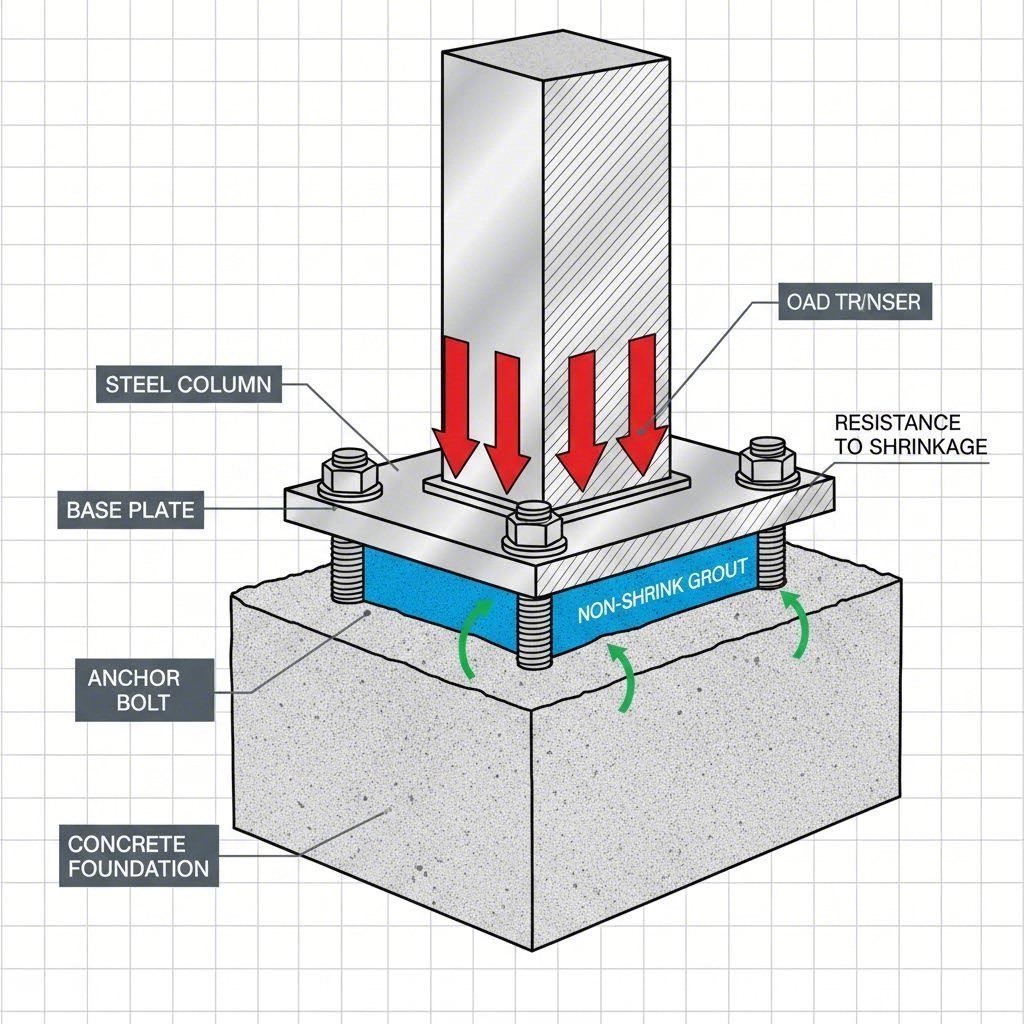
Non-shrink grouting material is a specialized hydraulic cement or epoxy-based compound engineered to offset the natural shrinkage that occurs during curing. Unlike standard tile grout, which is cosmetic, non-shrink grout is structural, designed to transfer heavy loads between bearing plates and foundations while maintaining volume stability. It typically meets ASTM C1107 standards and can achieve compressive strengths exceeding 8,000 PSI.
Engineers and contractors rely on this material for anchoring steel columns, supporting heavy machinery, and repairing structural concrete voids. Its critical function is to ensure 100% surface contact; if the grout were to shrink, it would create gaps (voids) that compromise the structural integrity of the connection. Success depends on strict adherence to mixing ratios and surface preparation, particularly achieving a Saturated Surface Dry (SSD) condition.
What Is Non-Shrink Grout & How Does It Work?
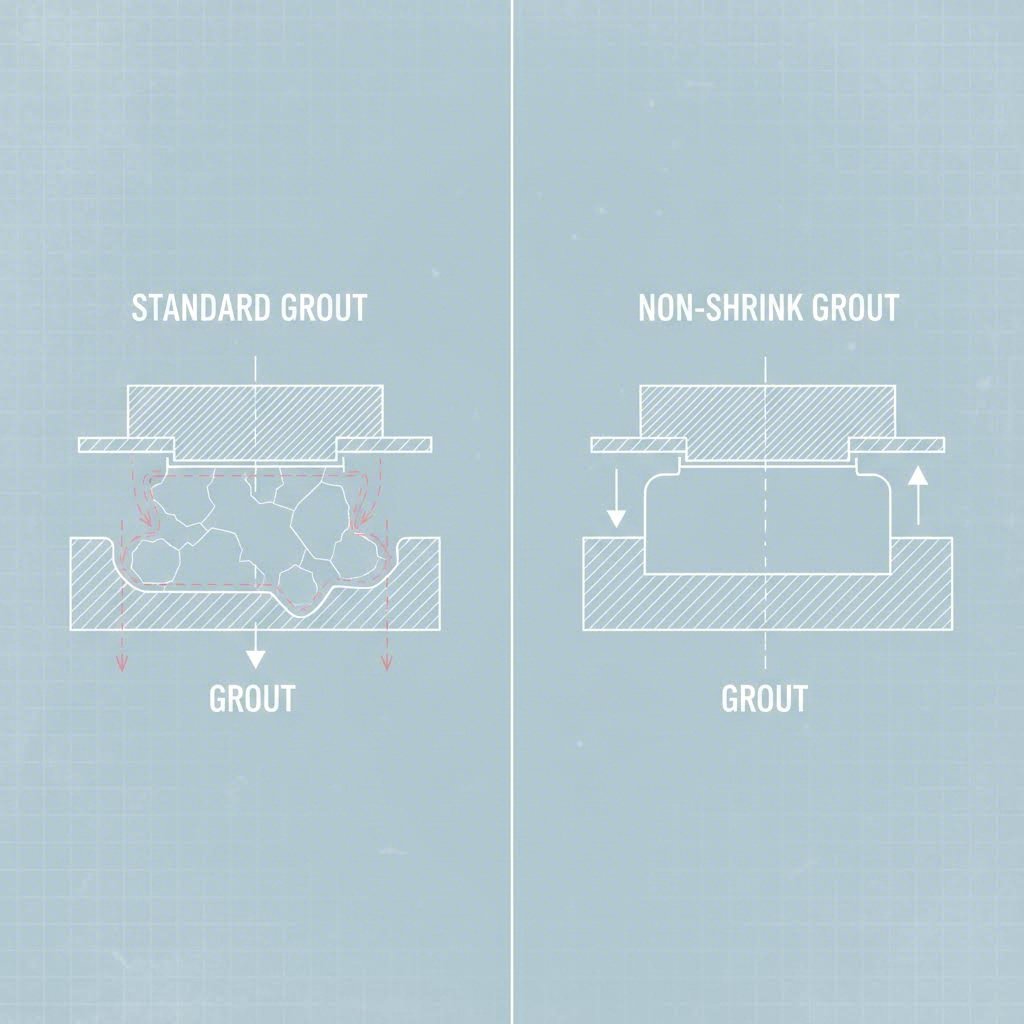
Non-shrink grout is a construction material formulated to maintain its original volume—or expand slightly—after setting. Standard concrete and regular grouts shrink as water evaporates and the cement hydrates, a process that causes the material to pull away from surfaces. In structural applications, such as under a steel column base plate, even microscopic shrinkage creates a gap, preventing the load from being transferred effectively to the foundation. Non-shrink grout solves this by incorporating additives (expansive agents) that generate a controlled expansion during the plastic or hardening phase, effectively “locking” the material against the contact surfaces.
The performance of these materials is governed by rigorous standards, most notably ASTM C1107 (Standard Specification for Packaged Dry, Hydraulic-Cement Grout (Nonshrink)). To be classified as “non-shrink,” the grout must show no volume loss after hardening and must typically exhibit high compressive strength. Depending on the water-to-powder ratio, these grouts can be mixed to three distinct consistencies: plastic (trowelable), flowable (pourable), and fluid (self-leveling). Interestingly, the strength often varies by consistency; for example, Quikrete’s technical data indicates that a plastic mix can reach 14,000 PSI, while a fluid mix may yield around 8,000 PSI, both well above standard concrete strength.
The mechanism behind this stability involves either gas-generating agents or crystallizing admixtures. Gas-generating systems release tiny bubbles (often hydrogen or nitrogen) that cause the wet mix to expand before it sets. Crystallizing systems form ettringite crystals during hydration, pushing the cement matrix outward to compensate for shrinkage. This engineering ensures that when a heavy machine vibrates or a building sways, the grout pad remains solid, providing a continuous load path from the equipment to the ground.
Types of Non-Shrink Grout: Cementitious vs. Epoxy
Selecting the right non-shrink grouting material is a critical engineering decision that depends on the load type, environmental conditions, and installation window. The two primary categories are cementitious (mineral-based) and epoxy (resin-based).
Cementitious Non-Shrink Grout is the industry workhorse. It is composed of hydraulic cement, graded aggregates, and shrinkage-compensating additives. It is cost-effective, easy to use, and behaves similarly to concrete. It is ideal for static loads, such as building columns and precast wall panels. However, it can be susceptible to staining and chemical attack. High-tech manufacturers like Fritz-Pak produce specialized admixtures that transform standard mixes into high-performance non-shrink grouts, allowing for greater control over flow and set times.
Epoxy Grout, on the other hand, consists of a resin base and a hardener. It offers superior chemical resistance and typically higher early strength. More importantly, epoxy grouts are designed for dynamic loads—machinery that vibrates, rotates, or pounds (like compressors, crushers, or crane rails). While cementitious grout might crack under constant vibration, epoxy has the tensile strength and bond capability to endure it. However, epoxy is significantly more expensive and sensitive to temperature during installation.
| Feature | Cementitious Grout | Epoxy Grout |
|---|---|---|
| Primary Component | Hydraulic Cement | Epoxy Resin + Hardener |
| Best Use Case | Static loads (Columns, Precast) | Dynamic loads (Heavy Machinery) |
| Compressive Strength | High (6,000 – 10,000+ PSI) | Very High (12,000+ PSI) |
| Chemical Resistance | Moderate | Excellent |
| Cost | Low to Moderate | High |
For large-scale industrial projects requiring specific chemical formulations or bulk admixture supplies, partnering with a specialized manufacturer is often necessary. Companies like Hubei Qiandao New Materials Co., Ltd., a high-tech enterprise integrating R&D and production, provide professional concrete admixture solutions and PC connection systems that ensure these materials meet rigorous non-shrink specifications at scale.
Critical Applications and Use Cases
Non-shrink grouting material is essential anywhere heavy loads must be transferred safely to a foundation. The most common application is base plate grouting. When a steel column is erected, it is set on leveling nuts or shims, leaving a gap between the steel plate and the concrete footer. This gap must be filled with non-shrink grout to distribute the building’s weight evenly; without it, the weight would rest entirely on the anchor bolts, leading to catastrophic failure.
Another major use case is machinery anchoring. Heavy industrial equipment, such as turbines, generators, and stamping presses, requires a perfectly level and rigid base. Non-shrink grout provides this interface, filling every void between the machine base and the floor. This prevents the machine from “walking” or vibrating itself loose. According to Wikipedia, this material acts as the vital transfer medium between load-bearing members.
Structural repair is the third critical category. Engineers use non-shrink grout to fill honeycombs (voids) in new concrete pours or to patch damage in existing structures. Because the material does not shrink, it bonds tightly to the existing concrete, restoring the structural monolithic integrity. It is also widely used in precast concrete connections, such as filling the keyways between bridge beams or grouting the dowels that connect wall panels.
Step-by-Step Application Guide (Best Practices)
1. Surface Preparation (The SSD Rule)
The most common cause of grout failure is improper surface preparation. The concrete substrate must be clean, sound, and rough (CSP 5-9) to ensure a mechanical bond. Crucially, the concrete must be brought to a Saturated Surface Dry (SSD) condition. This involves soaking the concrete with water for 24 hours prior to grouting, then removing all standing water just before placement. As noted in Sakrete’s technical data sheet, if the concrete is dry, it will suck the water out of the grout, causing “flash setting” and shrinkage cracks. If it is too wet (puddles), the water will dilute the grout and ruin its strength.
2. Formwork Construction
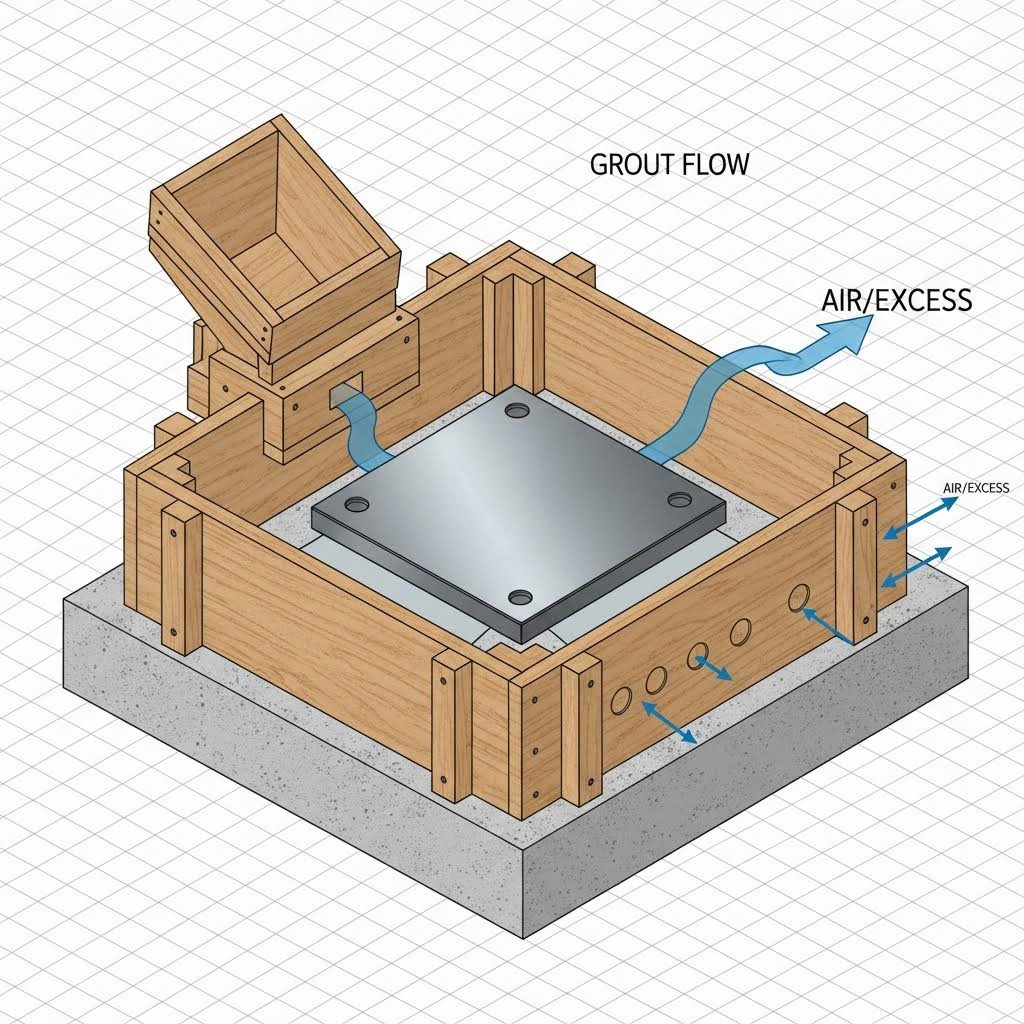
Forms must be watertight and rigid. Non-shrink grout, especially in fluid consistency, will leak through the smallest pinhole. Forms should be coated with a release agent (form oil) to prevent adhesion. Critical to success is the construction of a headbox on one side of the form. A headbox is a slanted hopper that allows the grout to be poured from a height, creating pressure (head) that helps flow the material under the plate. Vent holes should be drilled in the base plate or formwork on the opposite side to allow trapped air to escape.
3. Mixing and Water Control
Precision is non-negotiable. You must use potable water and adhere strictly to the manufacturer’s specified water ratios. Adding too much water—even a pint—to make it “flow better” is a cardinal sin in grouting. Excess water causes segregation (sand settling to the bottom) and bleeding (water rising to the top), which destroys the non-shrink properties and strength. Mix for the recommended time (typically 3–5 minutes) using a mechanical mixer; hand mixing is rarely sufficient for achieving a uniform consistency.
4. Placement and Curing
Pour the grout continuously from one side only to prevent trapping air pockets under the plate. If you pour from two sides, the flows will meet in the middle and trap a large air bubble, creating a void. Use a rod or strap to assist flow if necessary, but do not over-vibrate. Once placed, immediate curing is vital. For cementitious grouts, wet curing (covering with wet burlap) is standard practice for the first 48 hours to prevent the water from evaporating too quickly, which would cause shrinkage cracks.
Common Failures and Troubleshooting
Cracking: The appearance of hairline cracks usually indicates that the grout dried too quickly (plastic shrinkage). This is often due to high temperatures, wind, or failure to wet-cure. In hot weather (above 90°F), use cold mixing water and shade the work area.
Voids: If the grout does not fully contact the plate, the load transfer is compromised. This is typically caused by trapped air from pouring from multiple sides, or by a lack of vent holes. Sounding the plate with a hammer after curing can reveal voids (a hollow ring vs. a solid thud).
Low Strength: If the grout crumbles or fails to reach its PSI rating, the culprit is almost always retempering. Retempering is the bad habit of adding more water to a mix that has started to stiffen. Once the chemical set begins, adding water breaks the crystal matrix and permanently weakens the material. Never retemper non-shrink grout; if it sets before you pour it, discard the batch.
Why Precision Matters
Non-shrink grouting material is the unsung hero of structural stability. It is the bridge between the raw power of machinery or the weight of a skyscraper and the earth beneath it. While the material itself is scientifically advanced, its performance relies entirely on the precision of the application. Ignoring the SSD condition, guessing at water ratios, or rushing the pour can turn a high-strength engineering product into a liability.
Whether you are anchoring a simple column in a garage or installing a turbine in a power plant, the rules remain the same: respect the water ratio, control the environment, and ensure continuous contact. By following these technical standards, you ensure that the load path remains unbroken and the structure stands the test of time.
Frequently Asked Questions
1. What is the difference between non-shrink grout and regular concrete?
Regular concrete shrinks as it cures due to water evaporation, which causes it to pull away from surfaces. Non-shrink grout contains additives that cause it to expand slightly (or chemically compensate for shrinkage) during hardening. It is also engineered for much higher compressive strengths (often 8,000+ PSI) and finer aggregate sizes to flow into tight spaces significantly better than standard concrete.
2. Can I use non-shrink grout for bathroom tiles?
No. Non-shrink grout is a structural material, typically gray and containing sand/aggregates meant for thick applications (1 inch or more). It is too coarse and difficult to work with for thin cosmetic tile joints. Bathroom tile grout is designed for aesthetics and water resistance in thin lines, whereas non-shrink grout is designed for load bearing.
3. How long does non-shrink grout take to cure?
While cure times vary by product and temperature, most non-shrink grouts achieve initial set within 3 to 4 hours. However, they continue to gain strength rapidly. Many precision grouts reach 2,000–3,000 PSI within 24 hours, allowing for relatively quick construction sequencing. Full cure typically takes 28 days, similar to concrete.