

When estimators ask exactly what is the cost of ultra-high-performance concrete, the answer is $600 to $3,000 per cubic yard, compared to $180 to $210 for traditional mixes. This premium is driven by a specialized mix design featuring brass-coated steel fibers and silica fume.
However, evaluating this material solely on unit price ignores its structural economics. Its extreme strength allows for elements that are up to 70% thinner. Over a 100-year lifespan, its near-zero permeability drastically reduces maintenance, frequently yielding a 25% to 35% lower total lifecycle cost than conventional concrete in demanding environments.
The Upfront Cost: UHPC vs. Traditional Concrete
Establishing an accurate project budget requires a direct, unflinching look at the raw material pricing. The cost delta between conventional mixes and ultra-high-performance concrete (UHPC) is not a marginal increase; it is an entirely different financial category. While a standard traditional concrete delivery costs between $180 and $210 per cubic yard for a typical 4,000 to 5,000 PSI mix, UHPC commands anywhere from $600 to $3,000 per cubic yard delivered.
This massive pricing spectrum within the UHPC category itself depends heavily on the sourcing strategy. Commercially available, pre-bagged UHPC products (often utilized for small-volume joint connections or specialized architectural elements) frequently exceed the $2,000 per cubic yard threshold. Conversely, large-scale precasters who have invested in developing their own proprietary, optimized mix designs can drive the raw material cost down to a more manageable $600 to $800 per cubic yard.
Delivery logistics also play a critical role in the final invoice. Industry-standard ready-mix trucks handle 10 cubic yards of conventional concrete with full-load delivery fees averaging $55 to $65. UHPC, however, requires specialized high-shear mixing equipment and strict temperature controls. It is rarely mixed on-site in standard transit mixers for large structural pours, meaning that precast facility overhead is typically baked into the final component price rather than a simple per-yard delivery fee.
For estimators, understanding this baseline is crucial. The sticker shock is real, and applying a traditional volume-based estimating formula to a UHPC project will instantly kill its financial viability. Below is a comparative breakdown of baseline costs.
| Material Type | Compressive Strength | Average Cost per Cubic Yard | Typical Delivery / Sourcing Method |
|---|---|---|---|
| Standard Concrete (Residential) | 2,500 – 3,000 PSI | $150 – $170 | Standard Transit Mixer |
| Commercial Concrete (Structural) | 4,000 – 5,000 PSI | $180 – $210 | Standard Transit Mixer |
| UHPC (Precaster Proprietary Mix) | >21,700 PSI | $600 – $800 | Precast Facility Production |
| UHPC (Pre-Bagged Commercial) | >21,700 PSI | $2,000 – $3,000+ | Palletized Dry Mix (On-Site Mix) |
Why is UHPC So Expensive? Material & Production Breakdown
To understand the premium pricing, one must look at the material science. UHPC is not simply a stronger version of standard concrete; it is an advanced cementitious composite engineered at the microscopic level. Traditional concrete relies on cheap, widely available coarse aggregates like gravel or crushed stone. UHPC eliminates coarse aggregates entirely to prevent micro-cracking at the aggregate-paste interface.
Instead, a typical UHPC mix design demands a highly refined, expensive list of ingredients. A standard cubic yard requires approximately 1,200 pounds of portland cement, 250 pounds of highly reactive silica fume, and 1,700 pounds of fine quartz sand with a maximum grain size of just 0.03 inches. These particles are meticulously proportioned to achieve maximum packing density, leaving virtually no voids in the matrix. Furthermore, the water-to-binder ratio is kept exceptionally low—between 0.16 and 0.20—necessitating the use of advanced high-range water-reducing admixtures (superplasticizers) just to make the material flowable.
The most significant cost driver, however, is the structural reinforcement mixed directly into the paste. Unlike normal concrete that relies entirely on external rebar grids, UHPC achieves its remarkable tensile ductility through the inclusion of high-strength, brass-coated steel fibers. These microscopic fibers typically make up about 2% of the total volume.
This 2% volumetric addition equates to roughly 265 pounds of steel fibers per cubic yard. Depending on the global steel market and the specific tensile requirements of the project, these specialized fibers alone add between $250 and $500 to the cost of a single cubic yard. When analyzing the cost breakdown, the financial impact of each component becomes clear:
- Elimination of Coarse Aggregates: Replaced by expensive, highly processed fine quartz sands and powders to maximize particle packing density.
- High Cementitious Content: Utilizing nearly triple the portland cement and silica fume of a standard mix to create a dense, impenetrable binder.
- Chemical Admixtures: Heavy reliance on premium superplasticizers to maintain flowability despite a water-to-cement ratio below 0.20.
- Steel Fiber Reinforcement: High-tensile, brass-coated micro-fibers that provide post-cracking ductility, representing up to 40% of the total material cost.
- Quality Control: Extensive mixing times in high-shear mixers and strict environmental controls during curing increase operational overhead.
Reframing the Price: Installed System Cost vs. Unit Cost
Evaluating UHPC purely on a per-cubic-yard basis is a fundamental error in structural economics. Because the material possesses compressive strengths exceeding 21,700 PSI (150 MPa) and post-cracking tensile strengths above 725 PSI, the volume of material required to achieve a specific structural capacity drops dramatically. The unit cost is high, but the total number of units required plummets.
This strength-to-weight ratio allows architects and engineers to design elements that are vastly thinner and lighter than their conventional counterparts. For example, architectural cladding panels cast in UHPC are routinely 50 to 70 percent thinner—dropping from a standard 65 to 100 millimeters down to just 20 to 25 millimeters. Consequently, the panels are 40% to 65% lighter.
This massive reduction in dead load cascades through the entire construction budget, offsetting the high material unit cost. Lighter panels mean the structural steel or concrete frame supporting the building can be downsized. Connections can be smaller and less complex. Transportation costs drop because more panels fit on a single flatbed trailer. On-site, the contractor can utilize smaller, less expensive cranes and reduce total hoisting time.
In heavy civil infrastructure, the economic reframing is even more pronounced. Consider a standard prestressed bridge I-beam. A conventional concrete girder might max out at a 180-foot span. By replacing it with a UHPC girder of the exact same depth, the span can be pushed to 265 feet. This eliminates entire pier foundations and bent caps from a bridge project. Furthermore, the immense tensile strength provided by the steel fibers often allows engineers to completely eliminate traditional steel shear reinforcement, drastically reducing labor costs and fabrication time at the precast plant.
The 75-Year Lifecycle ROI: Maintenance and Durability
For institutional developers, municipalities, and infrastructure owners, capital expenditure is only half the financial equation. Operating expenditure over a multi-decade horizon often dwarfs the initial construction costs. This is where UHPC transitions from a premium specialty material into a highly pragmatic financial investment, driven by its unparalleled durability.
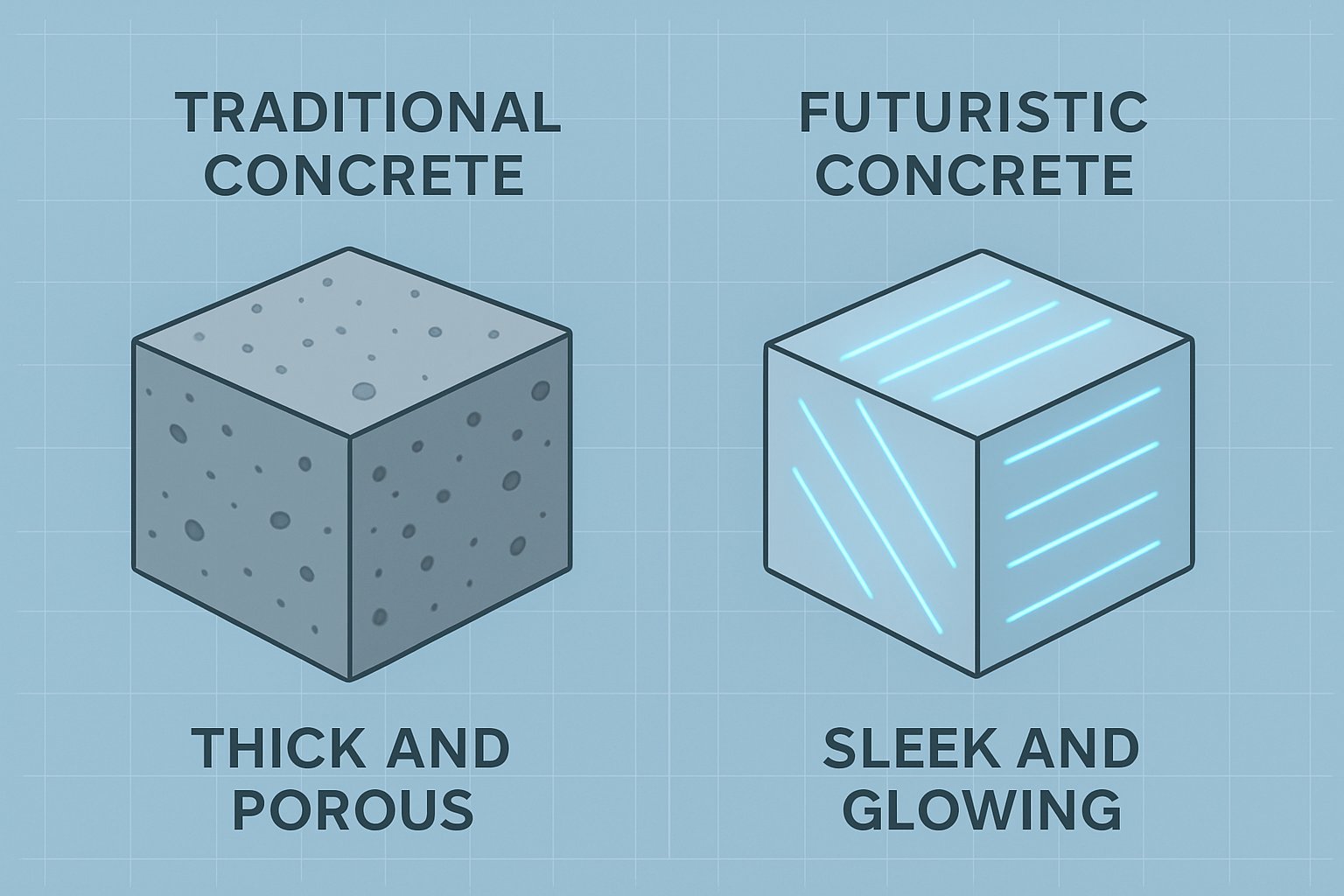
The secret to UHPC’s longevity lies in its dense microstructure and discontinuous pore network. Conventional concrete is inherently porous; over time, water, de-icing salts, and airborne chlorides penetrate the matrix, reach the embedded steel rebar, and cause corrosion. This corrosion expands the steel, leading to spalling, costly structural repairs, and eventually, total failure within 40 to 60 years in aggressive environments.
UHPC, by contrast, acts as an almost impenetrable barrier. Empirical testing demonstrates that chloride penetration in UHPC is typically less than 1 millimeter, compared to 15 to 25 millimeters in standard concrete. This near-zero permeability effectively halts the primary mechanism of structural decay. Consequently, structures built or rehabilitated with UHPC are routinely engineered for a 100-year service life with virtually zero mid-life maintenance requirements.
When financial estimators run a 75-year lifecycle cost analysis—factoring in the avoidance of major rehabilitations, reduced traffic disruptions, and zero routine patching—UHPC frequently yields a 25% to 35% lifecycle savings over conventional materials. The initial capital premium is fully amortized by the total elimination of future maintenance liabilities.
| Durability Metric | Conventional Concrete (5,000 PSI) | Ultra-High-Performance Concrete |
|---|---|---|
| Expected Service Life | 40 – 60 Years | 100+ Years |
| Chloride Penetration Depth | 15mm – 25mm | < 1mm |
| Freeze-Thaw Resistance | Moderate (Requires Air Entrainment) | Exceptional (No Degradation) |
| 75-Year Lifecycle Cost | Baseline (High Maintenance) | 25% – 35% Savings |

Strategic Deployment: When is UHPC Actually Worth the Investment?
Despite its structural and financial advantages over a century-long timeline, this must be stated explicitly: UHPC is not a universal replacement for conventional concrete. Blindly specifying this advanced composite for every structural element is a fast track to severe budget overruns. The material earns its premium only when its specific properties—extreme strength-to-weight ratio, zero permeability, and high tensile ductility—are doing actual engineering work.
Determining whether the investment is justified requires a strict cost-benefit triage. If a project involves massive, gravity-based elements where weight is not a penalty and the environment is benign, conventional concrete remains the economically superior choice. However, if the project is constrained by weight, exposed to brutal environmental conditions, or requires hyper-slender architectural forms, UHPC becomes the most cost-effective solution available.
Structural engineers and commercial estimators should use the following parameters to guide their material specification:
When to Specify UHPC (High ROI)
- Coastal and Marine Infrastructure: Seawalls, piers, and bridge decks exposed to constant saltwater spray and tidal forces where standard rebar would rapidly corrode.
- High-Rise Architectural Facades: Projects requiring complex, hyper-slender geometric panels where reducing dead load on the primary structure yields massive steel savings.
- Bridge Joint Connections: Casting longitudinal joints between precast bridge girders, allowing for shorter development lengths for rebar and rapid on-site construction.
- Seismic Retrofits: Strengthening existing columns and foundations where adding massive amounts of conventional concrete would reduce usable square footage.
When to Avoid UHPC (Negative ROI)
- Standard Foundations and Footings: Buried elements in non-aggressive soil where mass and volume are the primary requirements.
- Residential Driveways and Patios: Flatwork that experiences minimal load and can be easily maintained with standard 4,000 PSI mixes.
- Interior Floor Slabs: Climate-controlled, low-impact environments where the extreme durability and tensile strength of UHPC provide zero practical benefit.
Frequently Asked Questions
1. How much do steel fibers add to the total cost of UHPC?
The high-tensile, brass-coated steel fibers are one of the most expensive components in the mix design. Typically comprising about 2% of the total volume (roughly 265 pounds per cubic yard), these fibers alone can add between $250 and $500 to the cost of a single cubic yard of ultra-high-performance concrete, depending on current global steel prices.
2. Can I use ultra-high-performance concrete for a residential driveway?
While technically possible, using UHPC for a residential driveway is highly impractical and economically unsound. The material costs up to 20 times more than the standard 3,000 to 4,000 PSI concrete typically used for residential flatwork. Furthermore, the specialized high-shear mixing equipment required makes it extremely difficult to deliver and pour in a typical residential setting. Standard concrete is more than sufficient for driveway loads.
3. Why does UHPC have a lower lifecycle cost if it is so expensive upfront?
The lifecycle savings of UHPC stem entirely from its dense, discontinuous pore structure. Because it is virtually impermeable to water, de-icing salts, and chlorides, the internal reinforcement does not corrode. This eliminates the need for routine patching, spall repair, and major structural rehabilitation. Over a 75- to 100-year period, the money saved on maintenance and replacement far exceeds the initial upfront premium.