
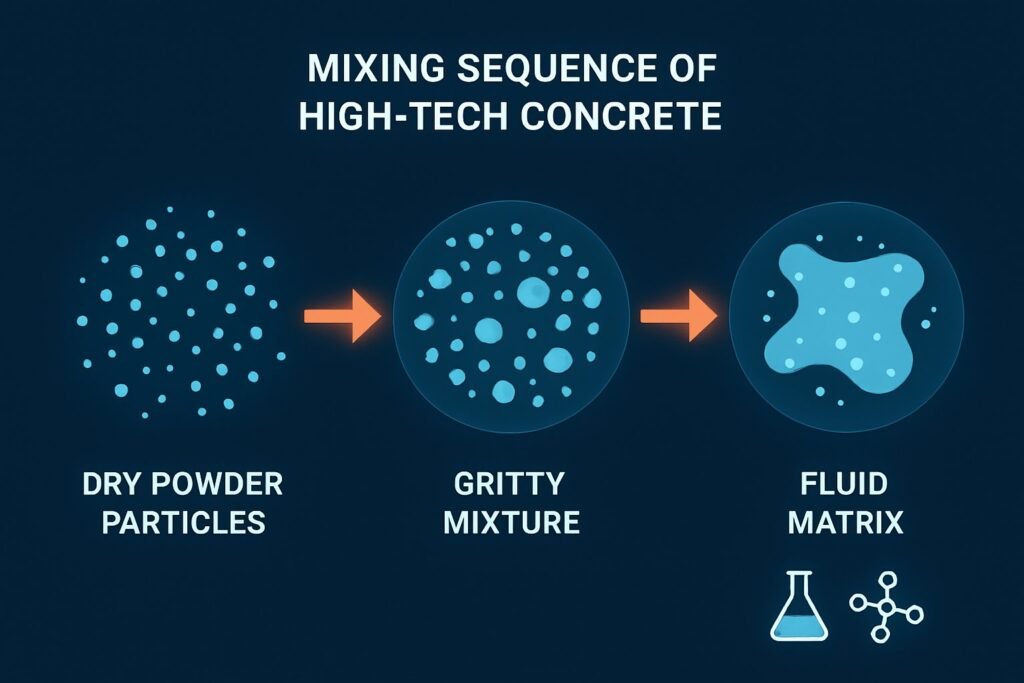
Learning how to make ultra high performance concrete (UHPC) requires completely rethinking traditional mixing methods. The process involves combining Portland cement, highly reactive silica fume, fine quartz sand, polycarboxylate superplasticizers, and high-tensile steel microfibers at a strict water-to-binder ratio of 0.15 to 0.20. By eliminating coarse aggregates entirely, this mix achieves maximum particle packing density, resulting in a self-consolidating material with compressive strengths exceeding 22,000 psi (150 MPa).
The Science of UHPC: Particle Packing and Matrix Density
Traditional concrete relies on a mixture of coarse gravel, sand, cement, and water, typically yielding a compressive strength between 3,000 and 5,000 psi. In contrast, Ultra-High Performance Concrete achieves strengths upwards of 30,000 psi by completely eliminating coarse aggregates. This fundamental shift is based on the principle of optimized particle packing density.
In a standard concrete mix, the varying sizes of gravel create microscopic voids and interfacial transition zones (ITZ) where micro-cracking inevitably begins under stress. By removing coarse aggregates and replacing them with carefully graded fine silica sand and microscopic pozzolans like silica fume, the UHPC matrix becomes incredibly dense and homogeneous. This microscopic density prevents the interlocking issues associated with large aggregates and drastically reduces the material’s porosity.
Recent literature reviews analyzing the influence of materials on the mechanical properties of UHPC emphasize that this precise selection of micro-fillers dictates the final compressive and tensile capabilities. The result is a highly durable, virtually impermeable material that can resist extreme environmental degradation, chemical attacks, and mechanical abrasion.
| Property | Traditional Concrete | Ultra-High Performance Concrete (UHPC) |
|---|---|---|
| Compressive Strength | 3,000 – 5,000 psi (20 – 35 MPa) | 22,000 – 30,000+ psi (150 – 200+ MPa) |
| Water-to-Cement Ratio | 0.40 – 0.60 | 0.15 – 0.20 |
| Aggregates Used | Coarse gravel and standard sand | Fine silica sand only (max 1 mm) |
| Tensile Strength | Low (requires traditional rebar) | High (1,200 – 2,200 psi) via steel microfibers |
The Exact UHPC Mix Design and Material Specifications
Creating UHPC is a highly technical process that functions more like a precise chemical formulation than a traditional construction mix. The baseline recipe requires specific industrial-grade materials to achieve the necessary rheological and mechanical properties. A typical mix design, aligned with guidelines from the Federal Highway Administration (FHWA), utilizes the following proportions per cubic yard:
- Portland Cement (Type I/II): Approximately 1,200 lb/yd³ (712 kg/m³). The cement should ideally have a moderate fineness and a low C3A content (below 8%) to control the heat of hydration.
- Fine Silica Sand: Approximately 1,720 lb/yd³ (1,020 kg/m³). The maximum grain size must be restricted to 0.8 mm to 1.0 mm to ensure matrix homogeneity.
- Silica Fume: 390 lb/yd³ (231 kg/m³), which equates to roughly 20% to 25% of the cement weight. This highly reactive pozzolan is non-negotiable, as it fills the micro-pores between cement particles and reacts with calcium hydroxide to form additional strength-bearing calcium silicate hydrate (C-S-H) gels.
- Polycarboxylate Superplasticizer (HRWR): 51 lb/yd³ (30 kg/m³). A high-range water reducer is mandatory to provide flowability despite the extreme lack of water.
- Water: 184 lb/yd³ (109 kg/m³). You must maintain a water-to-binder ratio of 0.20 or lower. Exceeding this ratio will introduce voids and catastrophically compromise the final strength.
- Steel Microfibers: 263 lb/yd³ (156 kg/m³), representing about 2% to 2.5% by volume. These short, high-tensile brass-coated steel fibers provide the material’s signature ductility and post-cracking toughness.
While this standard formula is highly effective, sustainable material innovations are continuously emerging. For instance, recent engineering developments have successfully demonstrated the utilization of glass shards obtained from municipal waste streams as a partial replacement for fine silica sand. This approach maintains the required particle packing density while significantly reducing the environmental footprint of the mix.
Step-by-Step Mixing Sequence for Optimal Rheology
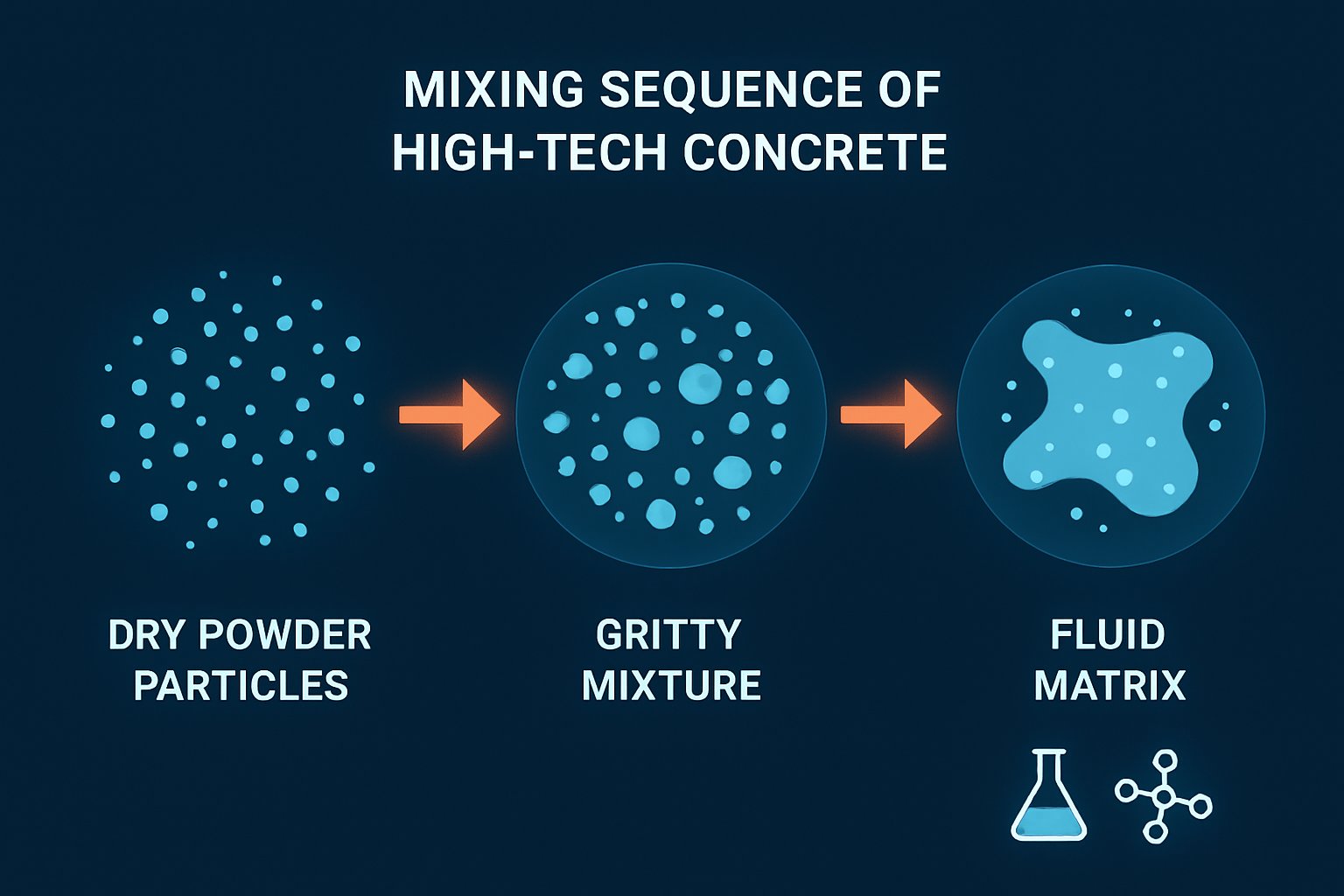
Because of the exceptionally low water content, standard drum mixers cannot generate the shear force required to blend UHPC. A high-shear pan mixer or planetary mixer is absolutely required. The mixing sequence is critical; deviating from it will result in unmixed powder or severe clumping.
- Dry Powder Homogenization: Begin by adding the Portland cement, silica fume, and fine silica sand into the mixer. Mix these dry ingredients for 4 to 5 minutes. Silica fume tends to agglomerate, so this extended dry mixing phase is essential to ensure a perfectly uniform distribution of the microscopic particles.
- Fluid Activation: Premix approximately 80% of the required superplasticizer into your measured water. Slowly pour this liquid solution into the dry powders while the mixer is running. Do not add extra water if the mix appears dry and crumbly at first. It takes several minutes of high-shear mechanical energy to break down the superplasticizer molecules and transition the dry powder into a fluid, self-consolidating paste.
- Final Hydration and Viscosity Adjustment: Once the mixture turns fluid, add the remaining 20% of the superplasticizer. Continue mixing for an additional 3 to 4 minutes. This staged addition of the chemical admixture prevents the silica fume from clumping upon initial water contact and ensures maximum workability.
- Fiber Integration: Finally, slowly disperse the steel microfibers into the fluid concrete. Adding them too quickly will cause “balling,” where fibers tangle into useless clumps. Mix for a final 2 minutes until the fibers are homogeneously suspended throughout the matrix. The concrete is now ready to be poured or cast.
Curing Protocols and Mitigating Autogenous Shrinkage
One of the most significant challenges when working with UHPC is managing autogenous shrinkage. Because the water-to-binder ratio is so low, the rapid hydration of the cement and silica fume rapidly consumes all available pore water. This creates internal capillary negative pressure, leading to microscopic shrinkage and potential early-age cracking before the concrete has fully cured.
To prevent autogenous shrinkage, engineers employ internal curing strategies. The most effective method involves introducing Superabsorbent Polymers (SAP) or pre-saturated lightweight aggregates, such as ceramsite, into the mix. These materials act as microscopic water reservoirs. As the surrounding cement matrix dries out during hydration, the SAPs slowly release their stored water, maintaining internal relative humidity and effectively neutralizing the shrinkage forces without altering the overall water-to-cement ratio.
Once poured, external curing protocols dictate the final strength. While UHPC will cure at room temperature to impressive strengths, achieving the maximum 30,000 psi rating requires thermal treatment. After an initial setting period of 24 to 48 hours, the concrete is typically subjected to steam curing at 90°C (194°F) for an additional 48 hours. This intense heat accelerates the pozzolanic reactions of the silica fume, rapidly densifying the microstructure and locking the matrix into its strongest possible state.
Conclusion: The Future of High-Strength Construction
Mastering the production of Ultra-High Performance Concrete requires a strict adherence to material science principles. By eliminating coarse aggregates, optimizing particle packing with silica fume, and leveraging high-range water reducers, you can create a material that defies the traditional limitations of concrete. While the initial material costs and mixing requirements are significantly higher than standard mixes, the resulting structural longevity, impermeability, and extreme compressive strength make UHPC an invaluable asset for modern infrastructure, bridges, and advanced architectural applications.

Frequently Asked Questions
1. What is the exact mix ratio for ultra high performance concrete?
A standard UHPC mix ratio by weight is approximately 28.5% Portland cement, 40.8% fine silica sand, 9.3% silica fume, 8.4% ground quartz or glass powder, 4.4% water, 1.2% superplasticizer, and 6.2% steel microfibers. This equates to a strict water-to-binder ratio of 0.15 to 0.20.
2. Can you make UHPC without silica fume or superplasticizers?
No, it is functionally impossible to make true UHPC without these ingredients. Silica fume is required to fill the microscopic voids between cement particles and trigger secondary hydration reactions. Superplasticizers are mandatory to make the mix fluid, as the water content is too low to create a workable paste on its own.
3. Why does UHPC not use coarse aggregates like gravel?
Coarse aggregates create weak points in the concrete matrix. The varying sizes of gravel lead to microscopic voids and weak interfacial transition zones (ITZ) where cracks originate. By using only fine silica sand, UHPC achieves a perfectly homogeneous, tightly packed matrix that distributes stress evenly.
4. What kind of mixer is required for UHPC?
A high-shear pan mixer or planetary mixer is required. Standard rotating drum mixers do not generate enough mechanical shear force to break down the superplasticizer and transition the extremely low-water powder mix into a fluid state.
5. How do you prevent autogenous shrinkage and cracking in UHPC?
Autogenous shrinkage is prevented through internal curing techniques. This is achieved by adding Superabsorbent Polymers (SAP) or pre-saturated lightweight aggregates to the mix, which slowly release internal moisture as the concrete cures. Additionally, applying a thermal steam cure after the initial set helps stabilize the matrix and prevent cracking.