
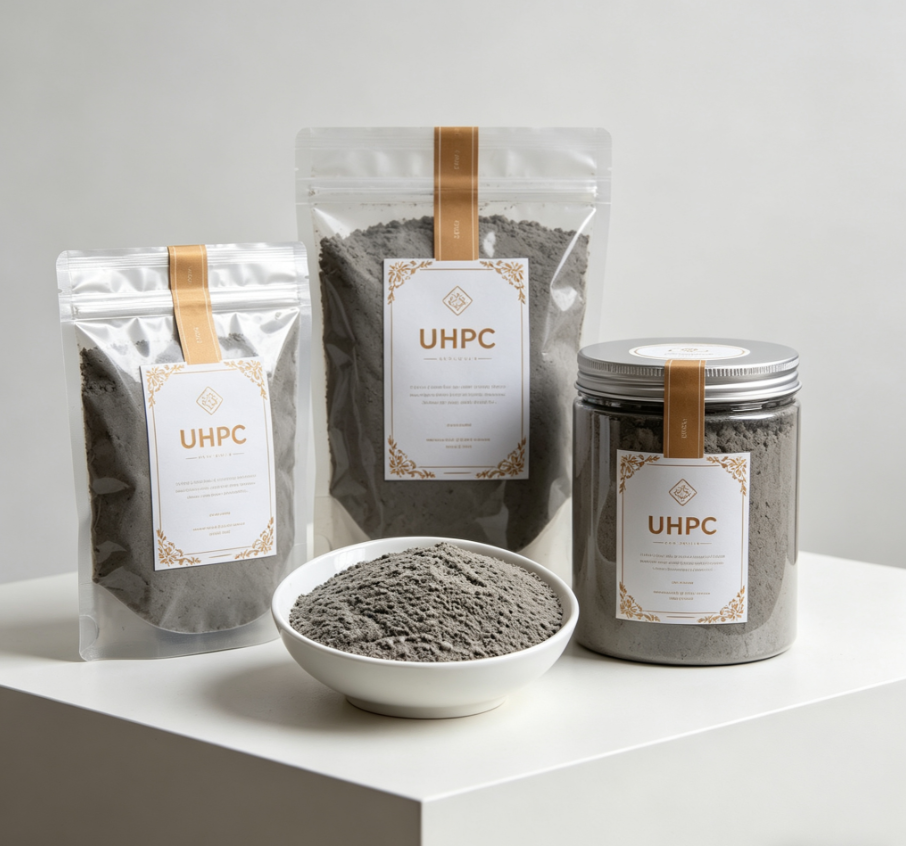
When you invest in infrastructure, you aren’t just buying materials; you are buying time. For decades, the construction industry accepted a “planned obsolescence” where bridges and buildings were expected to show significant decay within 40 to 50 years.
Ultra-High Performance Concrete (UHPC) has fundamentally shifted this timeline.
If you are looking for a definitive answer on how long UHPC will last, the empirical data from accelerated aging tests and real-world field monitoring points to a service life of 100 to 150 years, even in the most aggressive environments.
In this comprehensive technical guide, you will explore the mechanisms that grant UHPC its extraordinary longevity, backed by scientific facts and comparative data.
1. The Science of Immortality: Microstructure and Porosity
To understand why you can expect over a century of service from UHPC, you must look at the material at a microscopic level. Traditional concrete is essentially a sponge; it contains interconnected capillary pores that allow water, salts, and oxygen to reach the internal steel reinforcement.
The Disconnected Pore Network
UHPC is engineered with a density that rivals natural stone. By using a precise grain-size distribution—from cement particles down to nano-silica—UHPC eliminates the large voids found in conventional concrete.
- Fact: The water-to-cement (w/c) ratio of UHPC is typically below 0.20, compared to 0.40–0.50 for standard concrete.
- The Result: Water cannot penetrate the surface. While standard concrete might have a water absorption rate of 5% to 10%, UHPC measures at less than 0.1%.
2. Chemical Resistance: Shielding Against the Elements
If you are building in a marine environment or a region that uses heavy de-icing salts, “concrete cancer” (reinforcement corrosion) is your primary concern. UHPC acts as a chemical fortress.
Chloride Permeability
Chlorides are the leading cause of bridge failure worldwide. They migrate through concrete and attack the protective layer around steel rebar.
- ASTM C1202 Testing: In rapid chloride permeability tests, standard concrete often scores 3,000 to 4,000 Coulombs (Moderate/High permeability). UHPC consistently scores below 100 Coulombs (Negligible permeability).
- Diffusion Rates: You are looking at a material where it would take decades for chloride ions to penetrate even a few millimeters into the surface.
Carbonation Resistance
Carbonation occurs when $CO_2$ from the air reacts with the concrete, lowering its pH and leaving the steel vulnerable.
- Fact: Studies on 20-year-old UHPC structures show carbonation depths of near zero. For your project, this means the internal chemistry remains stable for the duration of its life cycle.
3. Physical Durability: Beating the Freeze-Thaw Cycle
If you work in northern climates, you know that the expansion of freezing water is the most common cause of surface scaling and cracking.
Resistance to Mechanical Weathering
UHPC is virtually immune to freeze-thaw damage because there is no room for water to enter and freeze.
- The Data: In the ASTM C666 test (which subjects concrete to 300+ cycles of rapid freezing and thawing), UHPC typically retains 95% to 100% of its relative dynamic modulus.
- Comparison: High-performance standard concrete often begins to degrade after 200 cycles, losing structural integrity as the internal matrix shatters.
4. Real-World Longevity: Lessons from the Field
While lab tests are essential, you likely want to see how this performs in the “real world.” Since the first commercial applications in the late 1990s, the performance has been flawless.
Case Study: The Mars Hill Bridge (Iowa, USA)
Built in 2006, this was the first bridge in the United States to use UHPC girders.
- Observation: Periodic inspections over nearly 20 years show zero structural cracking and no signs of rebar corrosion.
- Projection: Based on the current rate of chloride ingress, engineers estimate the bridge will exceed a 150-year service life without requiring a major deck replacement.
Case Study: Pont du Diable (France)
This footbridge, located in a high-traffic area, serves as a testament to the aesthetic and structural longevity of UHPC. Despite exposure to environmental stress, the surface remains as crisp and dense as the day it was cast in 2007.
5. Life Cycle Cost (LCC): The Financial Expectancy
You may find the upfront cost of UHPC higher than traditional materials. However, your financial perspective must shift from “construction cost” to “ownership cost.”
| Metric | Normal Strength Concrete (NSC) | UHPC |
| Service Life | 40 – 50 Years | 100 – 150 Years |
| Maintenance Frequency | Every 10 – 15 Years | Every 40 – 50 Years |
| Total Major Overhauls | 2 – 3 | 0 |
| End-of-Life Cost | High (Demolition/Replacement) | Minimal (Extended Utility) |
Conclusion for your budget: By spending more today, you eliminate the need for your successors to fund a complete replacement 40 years from now.
FAQ: Frequently Asked Questions
Q: Does UHPC eventually “wear out”?
A: All materials eventually degrade, but UHPC’s degradation is surface-level. It is highly resistant to abrasion from traffic or flowing water (hydro-abrasion), making it ideal for dam spillways and high-traffic bridge decks.
Q: Is the life expectancy affected by the type of fibers used?
A: Yes. For maximum longevity in marine environments, you should specify stainless steel fibers or non-metallic (PVA/Carbon) fibers. While standard steel fibers are encased in the dense matrix and rarely rust, stainless steel provides an extra layer of “insurance” for a 100-year plan.
Q: Can UHPC be recycled at the end of its 100-year life?
A: Yes. Because it is so dense and strong, crushed UHPC makes an exceptional high-grade aggregate for new construction projects.
6. Summary: Your Legacy in Stone
Choosing UHPC means you are designing a structure that will outlast its creators. Its life expectancy isn’t just a marketing claim—it is a result of advanced particle packing, ultra-low permeability, and exceptional mechanical toughness.
Technical Takeaway:
- Compressive Strength: 150+ MPa
- Chloride Ion Pen. : < 100 Coulombs
- Service Life: 100+ Years
Call to Action (CAT)
Ready to Build for the Next Century?
If you are planning an infrastructure project where maintenance-free longevity is a priority, don’t settle for 20th-century materials.
[Contact Our Engineering Team for a Life-Cycle Analysis] | [Request a UHPC Durability Data Sheet]
Invest in UHPC today. Save on maintenance forever.