
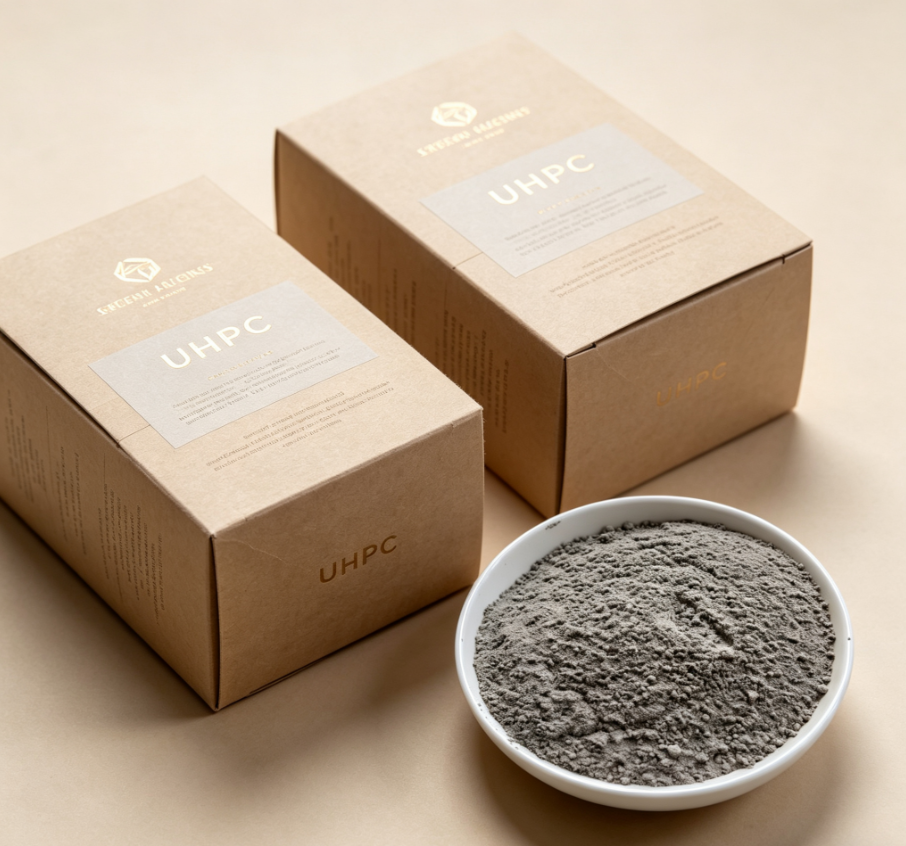
If you have recently requested a quote for Ultra-High Performance Concrete (UHPC), you might have experienced a brief moment of “sticker shock.” While traditional concrete usually costs between $100 and $150 per cubic yard, UHPC can easily exceed $2,000 to $3,000 per cubic yard—a price jump of nearly 20 times.
But why? Is it just a premium brand markup, or is there a scientific and logistical reason for this massive disparity?
In this deep dive, you will understand the five specific “cost drivers” that make UHPC an expensive material to buy, but a highly profitable one to own.
1. The High Cost of Material Science: Beyond Sand and Gravel
Traditional concrete is a simple mix of Portland cement, water, and large rocks (aggregates). UHPC, however, is a precisely engineered composite. You aren’t paying for “rocks”; you are paying for chemistry and micro-engineering.
Specialized Ingredients
- Reactive Powders: UHPC often uses ultra-fine silica fume and quartz flour. These materials fill the microscopic gaps between cement grains. Silica fume prices have risen significantly (up to 18% in recent years) due to environmental regulations closing the smelters that produce it as a byproduct.
- High-Dose Admixtures: To make the mix flow with a water-to-cement ratio of only 0.18 to 0.22, you need massive amounts of advanced Superplasticizers (HRWR). These chemicals are expensive to synthesize and represent a large portion of the material cost.
- The Steel Fiber Factor: This is often the single biggest expense. UHPC usually contains 2% to 3% steel micro-fibers by volume. These aren’t standard rebar pieces; they are high-strength, precision-cut needles that provide the material’s legendary ductility. In many mixes, the steel fibers alone can cost between $450 and $1,250 per cubic meter.
2. Manufacturing and Quality Control Intensity
You cannot mix UHPC in a standard rotating drum truck and expect it to work. The process requires a level of precision that traditional concrete plants aren’t designed for.
- High-Shear Mixing: Because the particles are so fine, they tend to “clump.” Breaking these clumps requires high-energy, high-shear mixers. This increases energy consumption by about 40% compared to standard mixing.
- Precision Batching: A mistake of even 1% in water content or chemical dosage can cause the entire batch to fail its strength requirements. This necessitates rigorous lab testing and highly trained personnel, adding significant overhead.
- Slower Production Cycles: UHPC takes longer to mix (often 10–20 minutes per batch compared to 2–3 minutes for NC) and sometimes requires specific temperature-controlled environments to cure properly.
3. The “Skills Gap” and Specialized Labor
When you use UHPC, you aren’t just hiring a concrete crew; you are hiring technical specialists.
The placement of UHPC is a sensitive operation. Factors like relative humidity, thermal conditions, and setting time all impact the final structural integrity. Because the material is relatively new to many regions, there is a limited pool of contractors who are certified and experienced in handling it. This lack of competition and the need for specialized equipment (like specialized pumps and vibrators) keeps the labor and installation price high.
4. Supply Chain and Proprietary Formulas
For a long time, the UHPC market was dominated by a few large international players (like LafargeHolcim’s Ductal®).
- Proprietary Costs: Many “pre-packaged” UHPC solutions include licensing fees or technical support costs bundled into the price.
- Logistics: Because the raw materials (like high-quality silica fume or specific steel fibers) are often sourced globally, transportation and import duties play a major role in the final price you pay at the job site.
5. The “Initial Cost” vs. “Life-Cycle Cost” Paradox
While you might pay 20x more today, the Life-Cycle Cost Analysis (LCCA) often tells a different story.
| Cost Category | Traditional Concrete (NSC) | UHPC |
| Initial Purchase Price | $ | $ |
| Maintenance & Repairs | Negligible | |
| Service Life | 30 – 50 Years | 100+ Years |
| Structural Volume | Thick/Heavy | Thin/Lightweight |
Because UHPC is so strong (150+ MPa), you can design structures that are 30% to 50% thinner. This means you buy less material, use smaller cranes, and require smaller foundations. When you factor in the fact that UHPC structures require almost zero maintenance for 100 years, the “expensive” material often becomes the cheaper long-term solution.
FAQ: Common Concerns About UHPC Pricing
Q: Can I lower the cost by using local materials?
A: Yes, “non-proprietary” UHPC mixes developed by universities and local agencies are becoming more common. By sourcing local sand and general-purpose cement, you can sometimes reduce costs by 30-50%, though quality control remains a challenge.
Q: Why don’t we use UHPC for everything if it’s so much better?
A: It’s a matter of “right material for the right job.” For a residential driveway or a simple foundation, the durability of UHPC is overkill. It is most economical in high-stress environments like bridge joints, marine piers, and seismic zones.
Q: Are prices expected to drop in the next few years?
A: Yes. As the market grows (projected to reach over $900 million by 2031), increased competition and local production are expected to drive down the cost of steel fibers and specialized admixtures.
Conclusion: Investing in the Future
You aren’t paying for “expensive concrete”; you are paying for an advanced composite material that eliminates the need for future repairs. The high price reflects the purity of the raw materials, the energy required for production, and the specialized engineering required to deploy it.
If your project requires a 100-year lifespan with zero maintenance, UHPC isn’t an expense—it’s an insurance policy against future infrastructure failure.
Call to Action (CAT)
Is UHPC the right choice for your budget?
Don’t let the initial price tag deter you without seeing the full picture. Our team specializes in Life-Cycle Cost Analysis to help you determine if the long-term savings of UHPC outweigh the upfront investment for your specific project.
[Request an Economic Feasibility Study] | [Compare Mix Designs & Costs]