
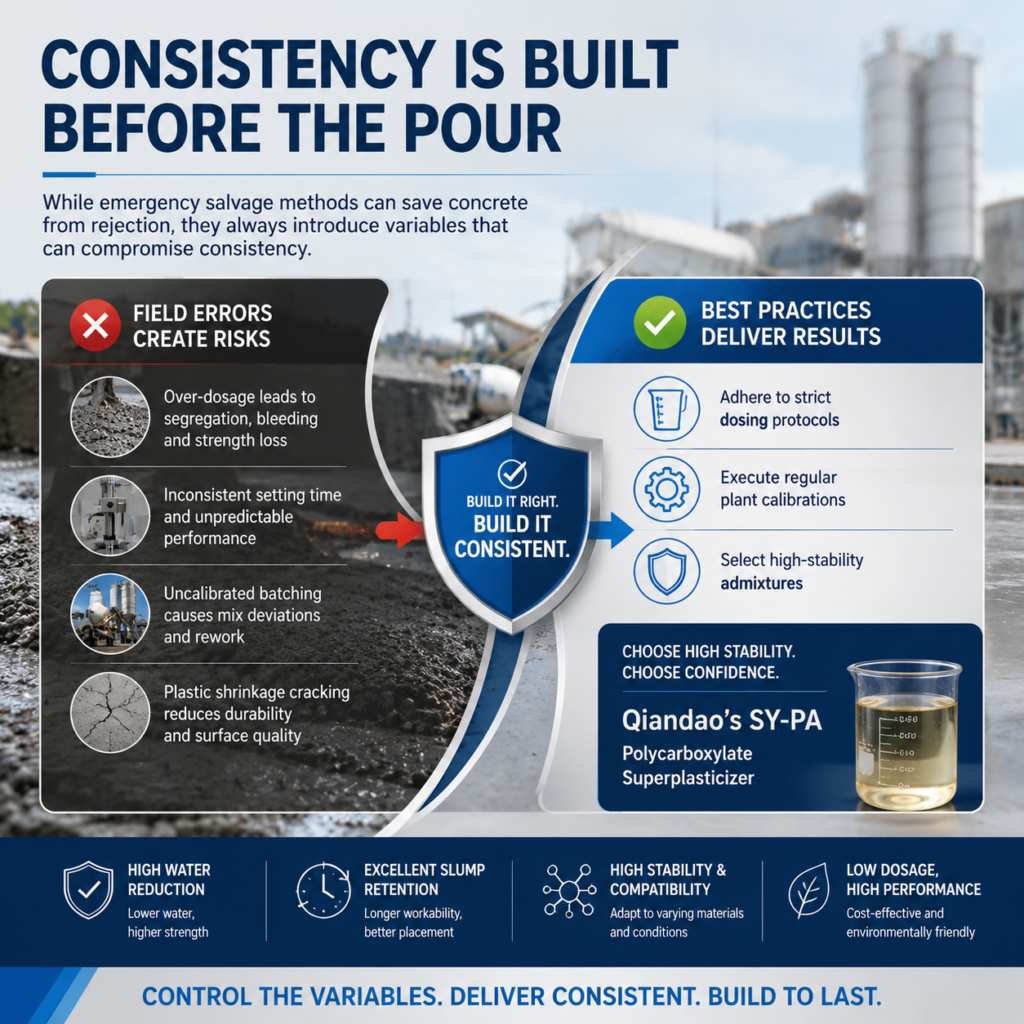
What happens if you overdose concrete water reducers and how is it resolved in an emergency?
Overdosaging concrete water reducers (superplasticizers) causes severe segregation, bleeding, excessively prolonged setting times (extreme retardation), and a drastic drop in early-stage compressive strength. In severe cases, the concrete mix completely loses its cohesive structure, leading to structural failures.
To salvage over-dosaged concrete in an emergency:
- Add Dry Materials (Cement & Aggregates): Re-introduce dry cement and sand/gravel in the original mix-design proportion to absorb excess fluid and lower the relative admixture concentration.
- Apply Chemical Accelerators: Dose the mix with early-strength agents (such as calcium formate, sodium sulfate, or triethanolamine) to counteract extreme retardation and accelerate hydration.
- Use Air-Defoaming Agents: If the overdose introduces excessive macro-bubbles, apply defoamers to collapse the weak structural voids.
- Extend Curing & Delay Formwork Stripping: Maintain warm, moist curing conditions and keep formwork in place significantly longer to allow the delayed hydration process to complete and restore long-term strength.
What is the normal dosage of water reducers in concrete?
To understand an overdose, we must first define the baseline. In modern concrete engineering, high-efficiency water reducers—particularly third-generation Polycarboxylate Superplasticizers (PCE)—are highly dosage-sensitive.
- Standard Dosage Range: Typically 0.5% to 1.5% of the total cementitious material weight (solid-to-solid basis or liquid equivalent depending on product concentration).
- Saturation Point: Every mix has a “saturation dosage.” Beyond this threshold (often around 1.0% to 1.2% for high-performance PCE), adding more water reducer will not further increase water reduction or workability. Instead, it triggers severe chemical side effects.
What are the main consequences of overdosaging water reducers?
When the dosage of a water-reducing admixture exceeds the saturation point (typically by 2x to 5x of the design limit), the chemical balance of the fresh concrete paste is shattered. This leads to several distinct physical and mechanical issues:
1. Severe Segregation and Bleeding
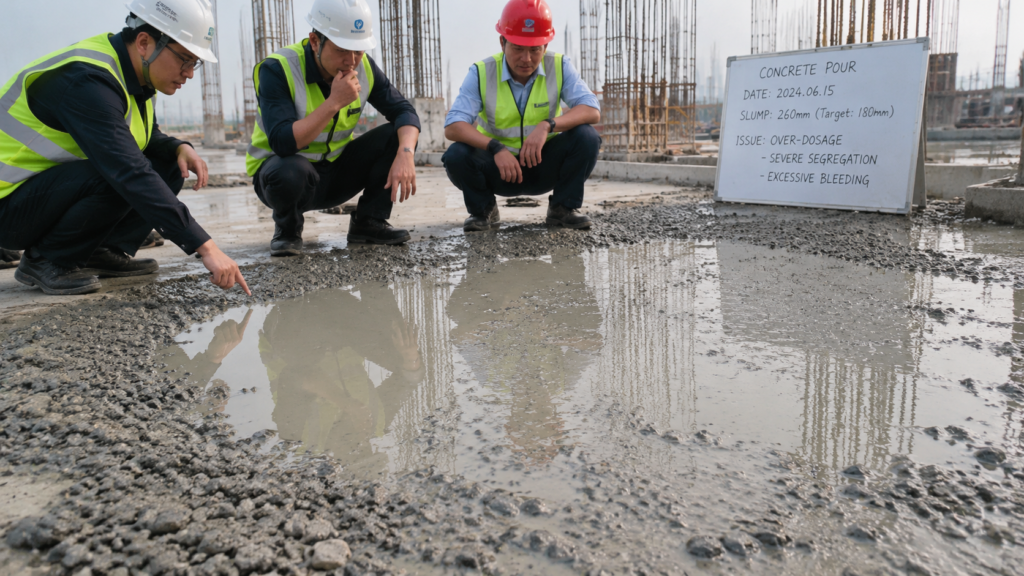
Overdosaging causes excessive dispersion of cement particles. The water-retention capacity of the cement paste drops to zero, causing the water and fine cement slurry to separate from the heavy aggregates.
- The Result: Coarse aggregates sink to the bottom of the formwork, while watery grout bleeds to the surface. This ruins the homogeneity of the structure.
2. Extreme Retardation (Delayed Setting Time)
Many water-reducing formulations, especially retarding-type PCEs, contain sugar-based or phosphate retarders.
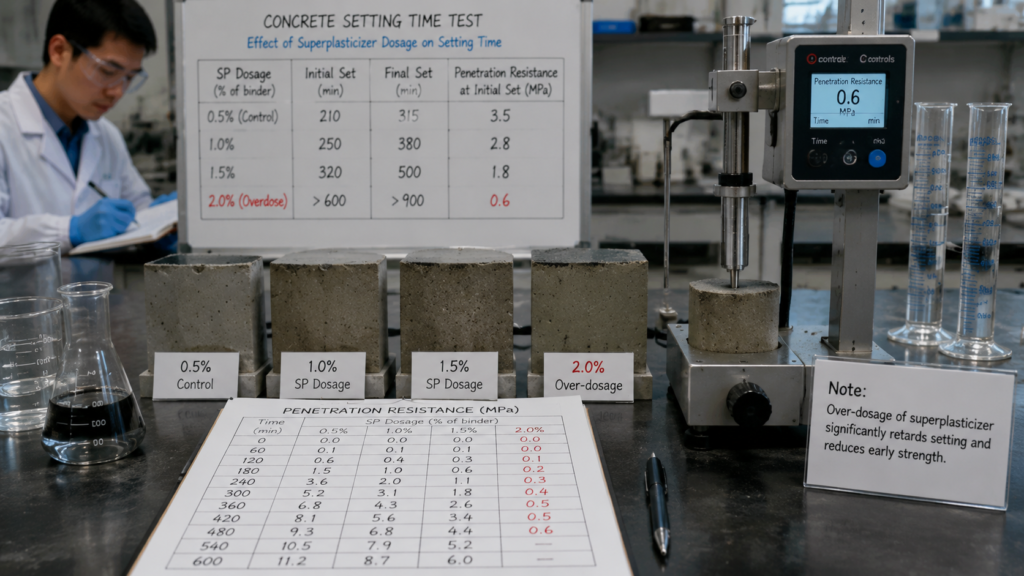
- The Result: An overdose can delay the initial and final set times of concrete from the standard 6–12 hours to 48 hours, 72 hours, or even over a week. Under cold weather conditions, the concrete may remain in a semi-liquid state indefinitely.
3. Drastic Reduction in Early Compressive Strength
Because hydration is severely delayed, the formation of calcium silicate hydrate (C-S-H) gel is arrested.
- The Result: The 1-day and 3-day compressive strengths drop close to zero. Although the 28-day or 90-day strength might eventually recover if the concrete is properly cured, the immediate inability to strip formwork halts the construction schedule.
4. Excessive Air Entrainment and Porosity
Many commercial superplasticizers naturally contain surfactants that entrain micro-bubbles to improve workability.
- The Result: Overdosaging introduces an uncontrolled volume of large, unstable macro-bubbles. These bubbles create internal structural voids, dramatically reducing the concrete’s density, structural load capacity, and durability.
How to diagnose over-dosaged concrete on-site?
Detecting an overdose early—ideally before the concrete is discharged into the pump or formwork—is critical to preventing structural catastrophes. On-site QC teams should watch for the following warning signs:
| Diagnostic Parameter | Normal Concrete | Over-Dosaged Concrete |
| Slump Test Appearance | Cohesive dome, steady flow without separation | Complete collapse, watery ring (halo) of paste spreading outward |
| Pumping Behavior | Smooth, continuous flow | High risk of line blockage due to aggregate settling in the pipe |
| Surface Bleeding | Minimal, uniform surface moisture | Heavy pooling of discolored water on top of the placed concrete |
| Formwork Pressure | Dissipates as concrete begins to stiffen | High hydro-static pressure sustained for days, risking form blowout |
Step-by-step: How to salvage over-dosaged concrete in an emergency?
If a batching plant error or on-site addition mistake results in an over-dosaged concrete batch, do not panic. Depending on when the error is detected, apply these emergency engineering countermeasures:
Step 1: Immediate Action in the Transit Mixer (Before Pouring)
If the overdose is detected while the concrete is still in the truck mixer, the mix can be chemically re-balanced.
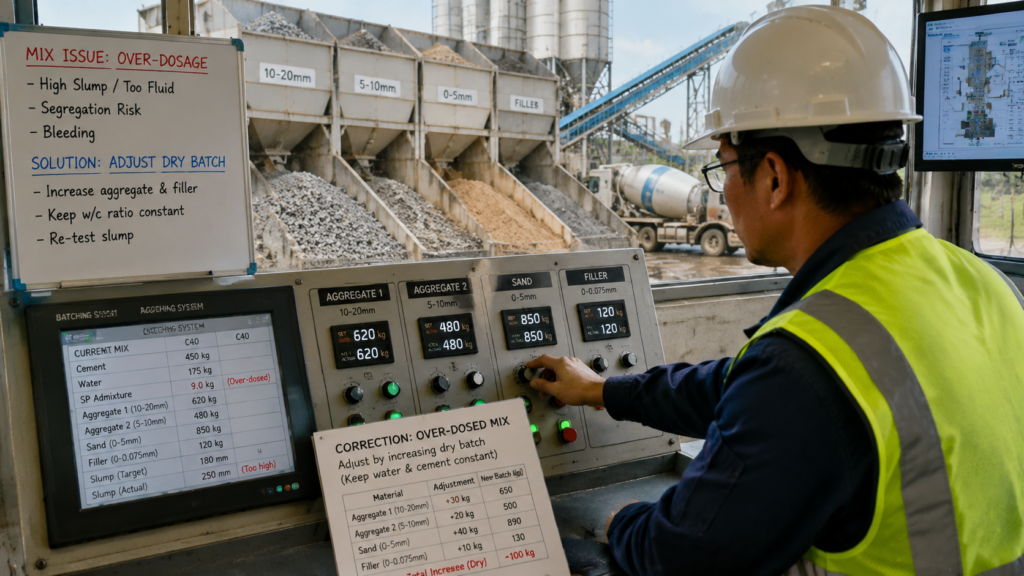
- Action: Calculate the excess dosage volume. Add a proportionate amount of dry cement, sand, and gravel directly into the drum.
- Execution: Run the mixer at high speed for at least 5 to 10 minutes to ensure a completely homogeneous redistribution. This increases the solid surface area, absorbing the excess superplasticizer molecules.
- Alt Text: Adding dry cement and aggregates to a concrete transit mixer drum to remedy admixture overdose
Step 2: Introduce Counter-Active Chemical Admixtures
If the setting time is extremely delayed, you can introduce neutralizing agents to jump-start the hydration process.
- Accelerators: Add 0.5% to 2.0% (by weight of cement) of a non-chloride accelerator, such as calcium formate, sodium sulfate, or calcium chloride (if not used in reinforced structures). These chemicals provide abundant calcium and sulfate ions to trigger rapid C3A and C3S hydration.
- Defoamers: If the overdose has entrained massive macro-bubbles, add a small dose of silicone or polyether-based defoaming agents to collapse the bubbles and restore concrete density.
Step 3: Implement Extended Curing and Delay Formwork Stripping
If the over-dosaged concrete has already been poured into the structural formwork, physical remediation is no longer possible. The strategy must shift to protection and patience.
- Do Not Strip Formwork: Keep the formwork in place until the concrete has reached sufficient structural strength. Do not rely on standard timetables (e.g., 48 hours). Use non-destructive testing (such as rebound hammer or maturity sensors) to verify actual strength.
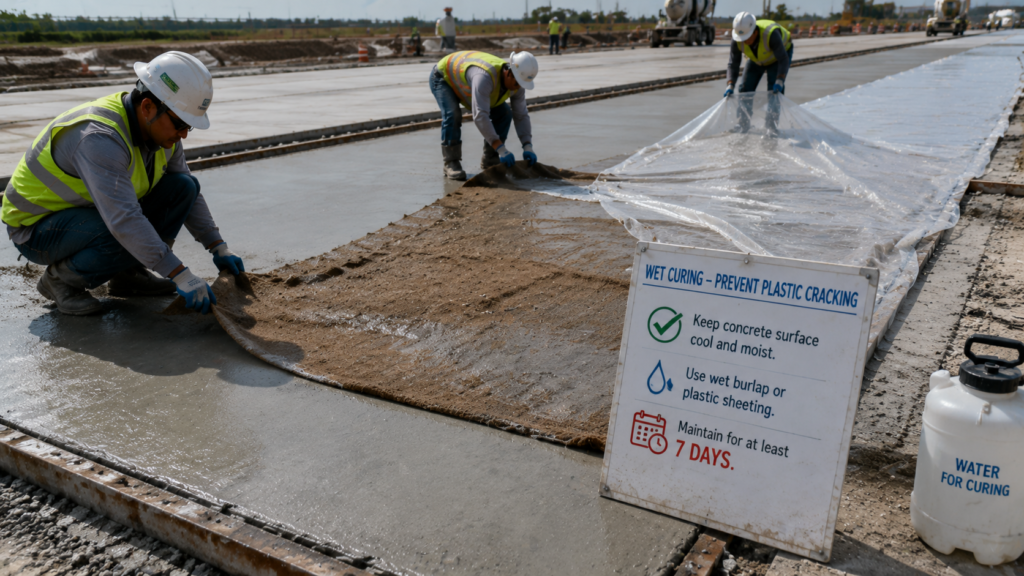
- Optimize Curing Conditions: Maintain a warm and moist environment. Cover the surface with plastic sheeting or geotextile membranes. Keeping the concrete warm helps counteract the retarding effect of the excess water reducer.
- Alt Text: Extended moist curing of concrete columns with plastic wrapping on construction site
How to prevent water reducer overdosing?
Prevention is far more cost-effective than emergency salvage. Concrete batching plants and construction sites must enforce strict operational controls:
- Calibrate Dispensing Systems Weekly: Ensure that liquid admixture meters, scales, and automated valves at the batch plant are perfectly calibrated.
- Forbid Unsupervised On-site Dosing: Concrete truck drivers or site laborers must never add raw water reducers to the mixer drum to increase workability on their own. All adjustments must be directed by a certified quality control engineer.
- Conduct Pre-Construction Trial Mixes: Always test the saturation dosage of your selected Polycarboxylate Superplasticizer (PCE) against the exact cement and supplementary cementitious materials (SCMs) to be used on-site.
- Alt Text: Calibration of automated liquid admixture dispensing system at a concrete batching plant
FAQ: Frequently asked questions about admixture overdosing
Will over-dosaged concrete eventually gain its full 28-day strength?
Yes, in many cases. If the overdose primarily caused retardation without severe segregation, and the concrete is cured properly without being disturbed, the ultimate 28-day and 56-day compressive strengths can reach or even exceed the design strength. However, if severe segregation occurred, the structural integrity of that section is permanently compromised.
How does weather affect over-dosaged concrete?
Cold weather exacerbates the retardation of over-dosaged concrete. A mild overdose that delays setting by 12 hours in hot summer can delay setting by 72 hours or more in winter. Conversely, hot weather helps accelerate hydration, helping to naturally mitigate the retarding effect of an overdose.
Can you mix different brands of water reducers to solve an overdose?
No. Never mix different brands or types of water reducers (e.g., mixing naphthalene-based and polycarboxylate-based admixtures) in an attempt to solve an overdose. This often leads to severe chemical incompatibility, resulting in immediate flash setting or complete structural failure of the mix.
Summary: Managing risk in modern concrete placement
While third-generation polycarboxylate water reducers have revolutionized modern concrete technology, their high sensitivity means that even minor overdosing can lead to operational emergencies. By understanding the chemical mechanisms of segregation and retardation, implementing rapid on-site diagnostics, and applying structured salvage protocols (such as adding dry material and accelerators), engineering teams can safely navigate admixture overdosing and protect structural durability.