
What is cement-admixture incompatibility and how is it resolved?
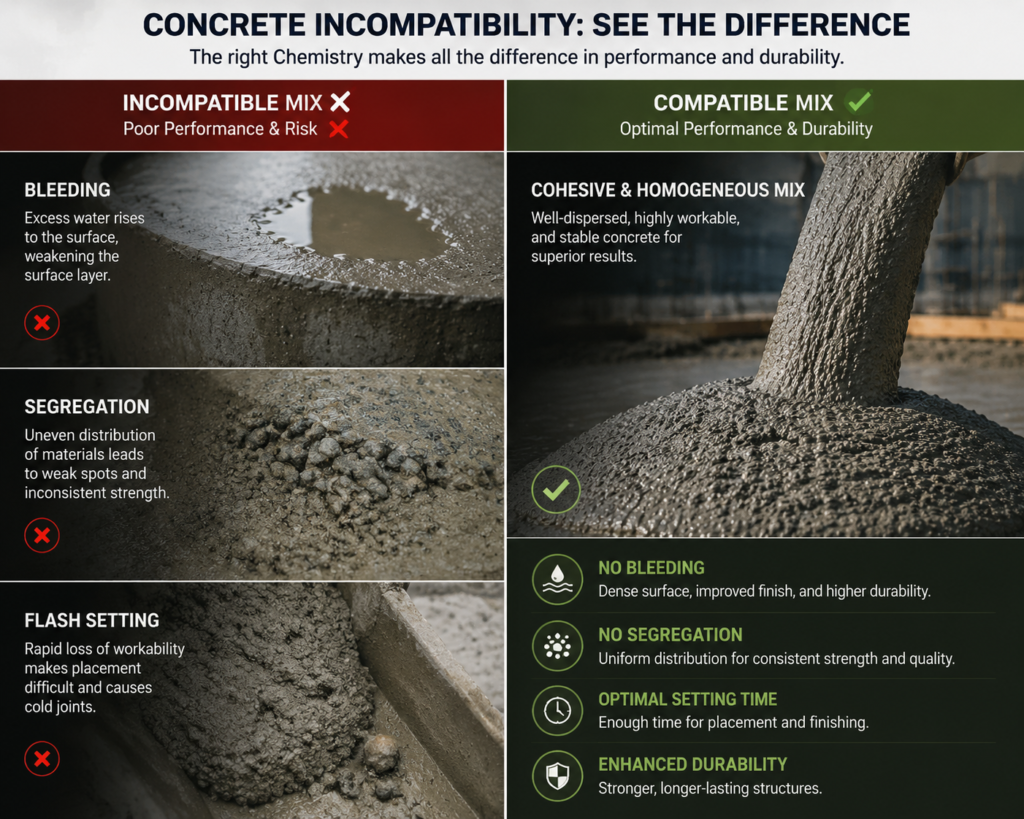
Cement-admixture incompatibility is a chemical mismatch between cement mineral phases (specifically C3A and gypsum) and concrete admixtures, leading to rapid slump loss, flash setting, or bleeding. It is practically resolved by:
- Checking clay content and applying clay-resisting agents if fine aggregate MB values are high.
- Adjusting PCE molecular design to lower initial adsorption rates.
- Adding soluble sulfates (such as 0.1%–0.5% Na2SO4) to restore the sulfate-to-C3A balance.
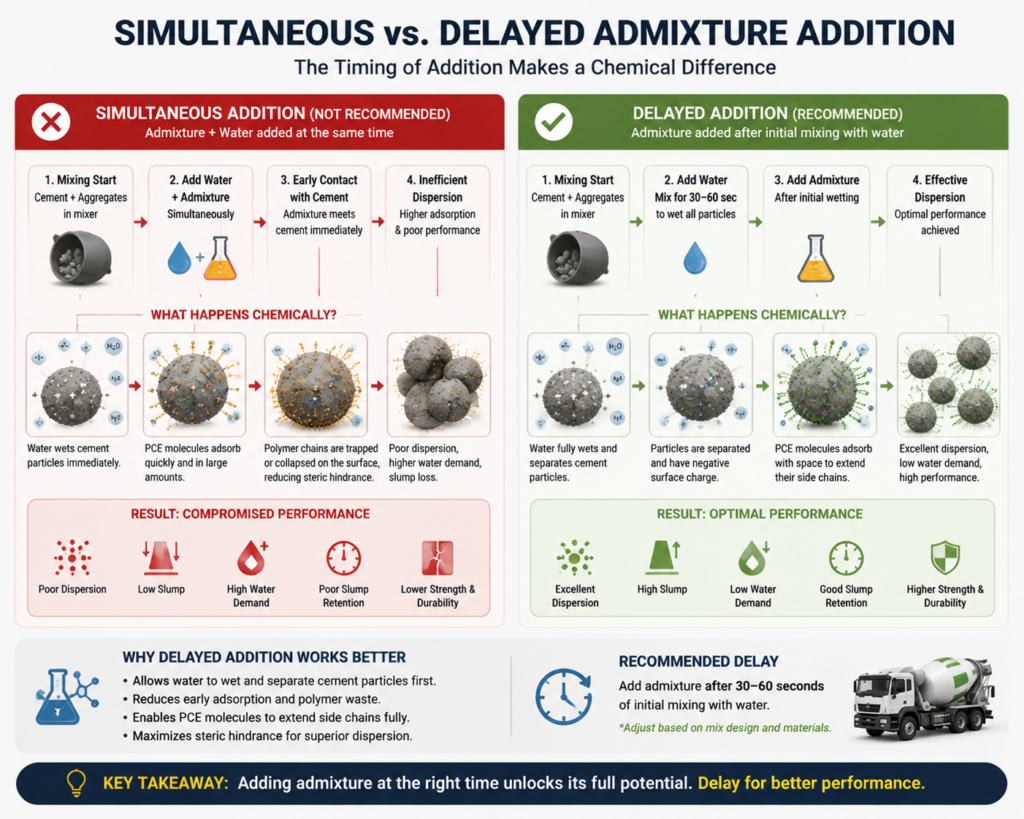
- Implementing a delayed addition method, adding the superplasticizer 30 to 60 seconds after the water to allow initial cement passivation.
Why does cement-admixture incompatibility happen in modern concrete?
In modern construction, concrete mix designs have become highly complex. The root cause of cement-admixture incompatibility lies in the competitive adsorption between sulfate ions from cement gypsum and the functional groups of concrete admixtures (such as Polycarboxylate Ether, or PCE) on the surface of tricalcium aluminate (C3A).
When the concentration of soluble sulfates is insufficient, or when the cement contains high amounts of C3A, the superplasticizer is rapidly consumed by the early hydration products. This leaves no chemical dispersion matrix in the interstitial water, triggering severe rheological failures.
What are the key symptoms of cement-admixture incompatibility?
Before applying a troubleshooting guide, field engineers must accurately diagnose the field failure symptoms:
- Flash Setting: The concrete matrix loses its workability within minutes after mixing, accompanied by an anomalous release of hydration heat.
- Rapid Slump Loss: The concrete leaves the batching plant with excellent fluidity but arrives at the job site completely stiffened, making pumping impossible.
- Severe Bleeding and Segregation: The admixture fails to adsorb effectively onto cement particles, causing water to separate and rise to the surface, creating structural weak layers.
Step-by-Step Practical Troubleshooting Guide to Resolve Incompatibility
Step 1: Analyze raw materials and check the aggregate Methylene Blue (MB) value
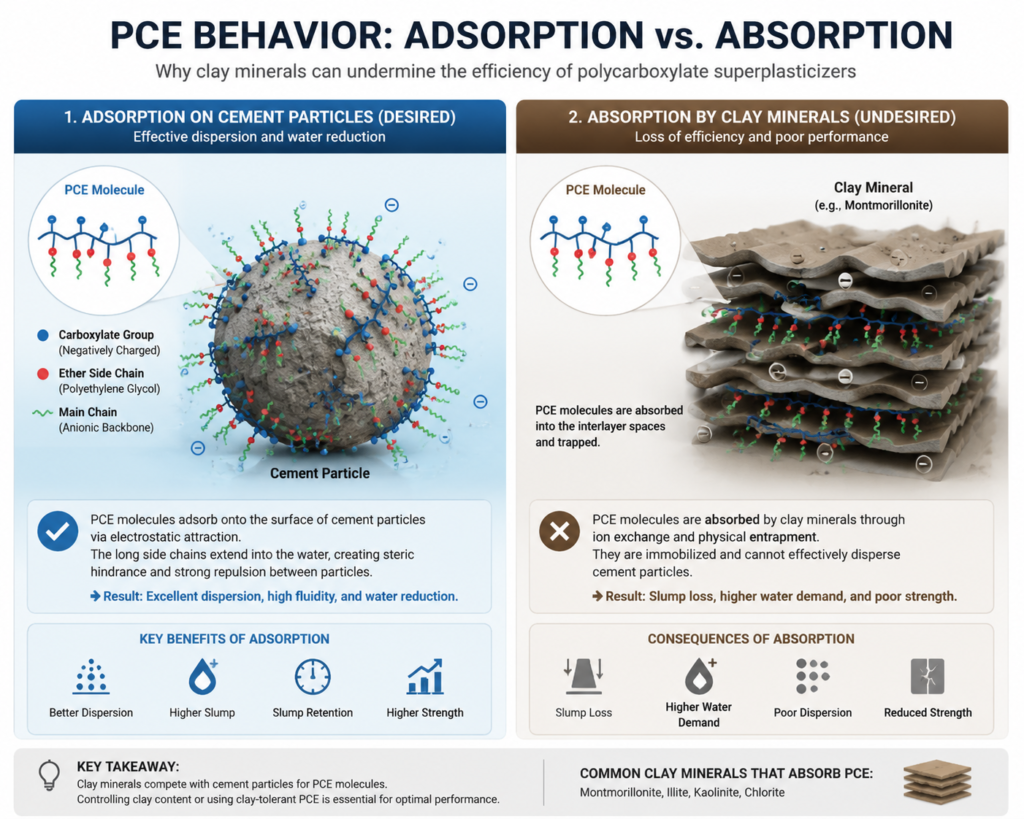
High clay content in fine aggregates is the most common “hidden killer” of admixture performance.
- Conduct an MB value test on the sand. If the MB value exceeds 1.4, the clay minerals will preferentially absorb the water-reducing molecules.
- Solution: Introduce a specialized clay-resisting agent into the mix, or select a PCE admixture engineered with sacrificial side-chains that temporarily block clay adsorption sites.
Step 2: Evaluate cement chemistry and sulfate availability
Check the mill certificate of the cement batch to evaluate the C3A content and the types of gypsum used (dihydrate vs. anhydrite).
- If the cement uses a high proportion of anhydrite, the dissolution rate of sulfate ions may lag behind the adsorption rate of the superplasticizer.
- Solution: Supplement the mix with 0.1% to 0.5% soluble sodium sulfate (Na2SO4) to immediately restore the chemical equilibrium in the liquid phase.
Step 3: Optimize the molecular structure of the Polycarboxylate Ether (PCE)
Standard PCE superplasticizers with high charge density adsorb too quickly onto cement grains, causing a rapid decline in later-stage slump retention.
- Solution: Coordinate with the admixture manufacturer to adjust the synthesis parameters. Increase the density of the polyoxyethylene (PEO) side-chains and use a low-charge-density backbone to slow down the initial adsorption rate and prolong the workability.
Step 4: Modify the mixing sequence via the delayed addition method
The timing of chemical introduction significantly affects how the admixture interacts with early hydration phases.
- Solution: Do not add the superplasticizer simultaneously with the batching water. Implement a delayed addition method—add the chemical 30 to 60 seconds after the cement has been fully wetted by the water. This allows the sulfate ions to naturally passivate the C3A surface before the PCE molecules enter the system.
How to conduct lab verification before full-scale batching?
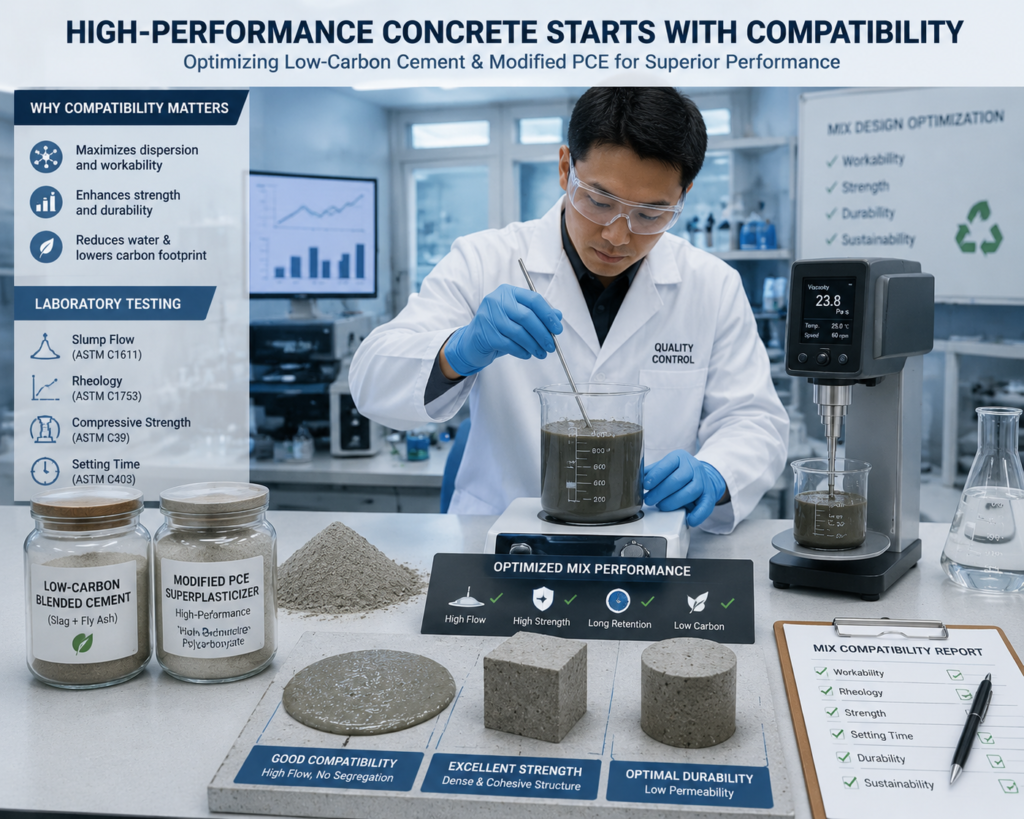
Never attempt to resolve incompatibility directly in the field without laboratory proof. Run the following multi-point verification protocol:
- Marsh Funnel Test: Measure the flow time of cement pastes with varying admixture dosages to find the saturation dosage point.
- Paste Fluidity Loss Over Time: Measure paste spread diameters at 0, 30, 60, and 90 minutes to plot a precise slump loss curve.
- Concrete Trial Batching: Scale up the paste test into a full concrete trial to check for secondary issues like bleeding, segregation, or excessive air entrainment.
Summary: Proactive Measures for Future Concrete Projects
Resolving cement-admixture incompatibility requires a holistic approach that bridges raw material control, chemical customization, and practical mixing adjustments. By running routine MB tests, coordinating with chemical suppliers for PCE modification, and utilizing the delayed addition method, engineering teams can guarantee reliable, high-performance concrete placement under any construction scenario.