
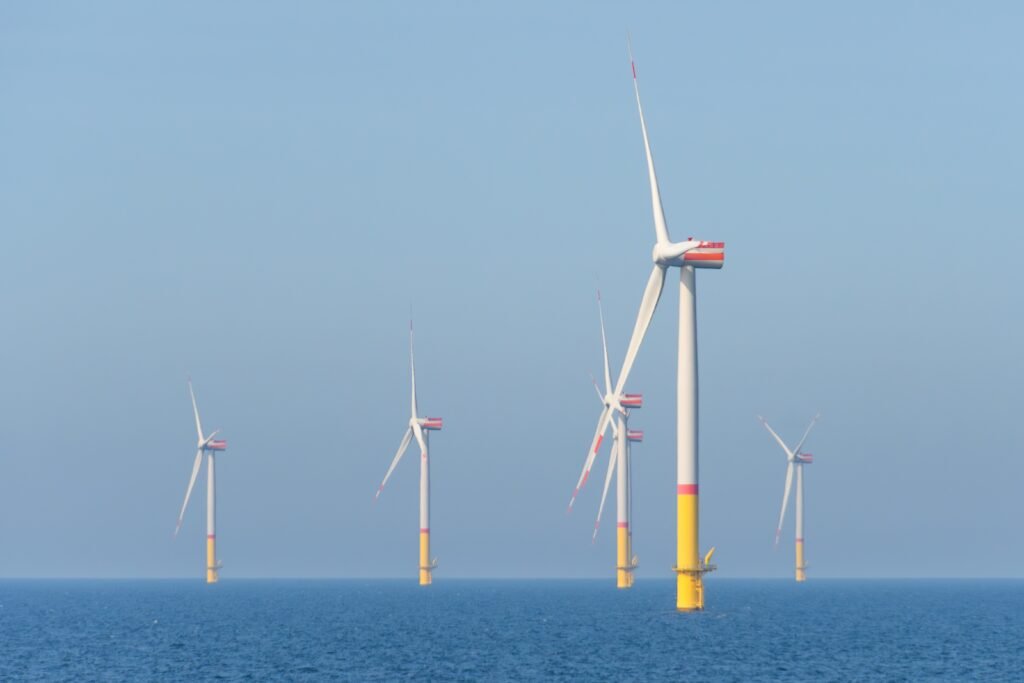
In the wind power industry’s pursuit of higher generation efficiency and greater environmental resilience, a critical question looms large: how to build taller and more robust wind turbine towers to capture stronger, more consistent winds while ensuring their long-term safety and durability under extreme natural conditions? The emergence of Ultra-High Performance Concrete (UHPC) presents a highly promising solution to this challenge.
As a revolutionary cement-based composite material, UHPC combines ultra-high strength, exceptional toughness, extremely low permeability, and outstanding self-compacting ability. These properties have already demonstrated significant potential in demanding fields such as architecture and bridge engineering. In recent years, UHPC has successfully entered the wind power sector and achieved large-scale application.
The Necessity of Application
Current wind power development is rapidly evolving towards larger turbines, longer blades, and taller towers. This trend places unprecedented demands on the load-bearing capacity, stability, and durability of tower structures. For instance, the world’s first 180-meter ultra-tall concrete tower constructed using UHPC not only handles greater static and dynamic loads with ease thanks to its ultra-high compressive and tensile strength, but its exceptional toughness also effectively dissipates energy from extreme loads such as earthquakes and strong winds. This significantly reduces the risk of brittle structural failure, providing crucial safety assurance for tall wind turbine systems.
Core Performance Advantages
The core advantages of UHPC are mainly reflected in two aspects:
Exceptional Strength and Toughness: Its compressive strength typically exceeds 120 MPa, which is 2-3 times that of traditional high-performance concrete and 4-6 times that of ordinary concrete. This allows it to bear larger loads with smaller cross-sections, aiding in optimized structural design. More importantly, UHPC exhibits steel-like strain-hardening behavior under tension, continuing to carry load even after cracking, greatly enhancing structural ductility and fatigue resistance.
Dense Durability and Construction Convenience: UHPC’s extremely low porosity makes it nearly impermeable, with excellent resistance to chloride ion and carbon dioxide penetration. This provides outstanding corrosion protection for wind turbine towers long exposed to harsh environments like humidity and salt spray, thereby substantially extending service life and reducing whole-lifecycle maintenance costs. Simultaneously, its superior self-compacting properties allow for mold filling without vibration during pouring, ensuring structural uniformity and integrity, and improving construction quality and efficiency.
Future Application Potential
With these irreplaceable performance advantages, UHPC is becoming one of the key materials driving the advancement of wind power technology boundaries. Its application in the construction of ultra-tall towers (e.g., over 200 meters) will help break the limitations of traditional wind resource classifications, enabling economically efficient development in lower wind speed regions and further reducing the levelized cost of energy (LCOE). Looking ahead, as material costs are optimized and design and construction standards are refined, UHPC is expected to play a significant role in more critical components such as wind turbine foundations, offshore wind jacket structures, and blade root connections. It promises to inject strong momentum into the wind power industry’s efforts to reduce costs, increase efficiency, and ensure safe and reliable operation.