
Introduction: The Evolution of Modern Concrete Technology
Concrete is the most consumed man-made material on Earth. However, the traditional dilemma of concrete mix design has always been the balance between workability and strength. Historically, adding more water was the only way to make concrete fluid enough for placement, but this came at a severe cost to compressive strength and long-term durability.
The introduction of concrete superplasticizers, chemically classified as High-Range Water Reducers (HRWR), completely revolutionized civil engineering. These advanced chemical admixtures allow for a radical reduction in water content while simultaneously achieving self-leveling flowability. This comprehensive guide explores the deep chemistry, classification, application protocols, and future trends of concrete superplasticizers.
1. Fundamental Chemistry: How Do Superplasticizers Work?
To understand how a concrete superplasticizer alters the rheology of cement paste, one must look at the microscopic behavior of cement particles.
When cement clinker is ground and mixed with water, the fine particles naturally develop opposing electrical charges on their surfaces. This leads to flocculation—a state where cement particles clump together, trapping a significant portion of the mixing water inside these clusters. Trapped water cannot contribute to the hydration process or the fluidity of the mix.
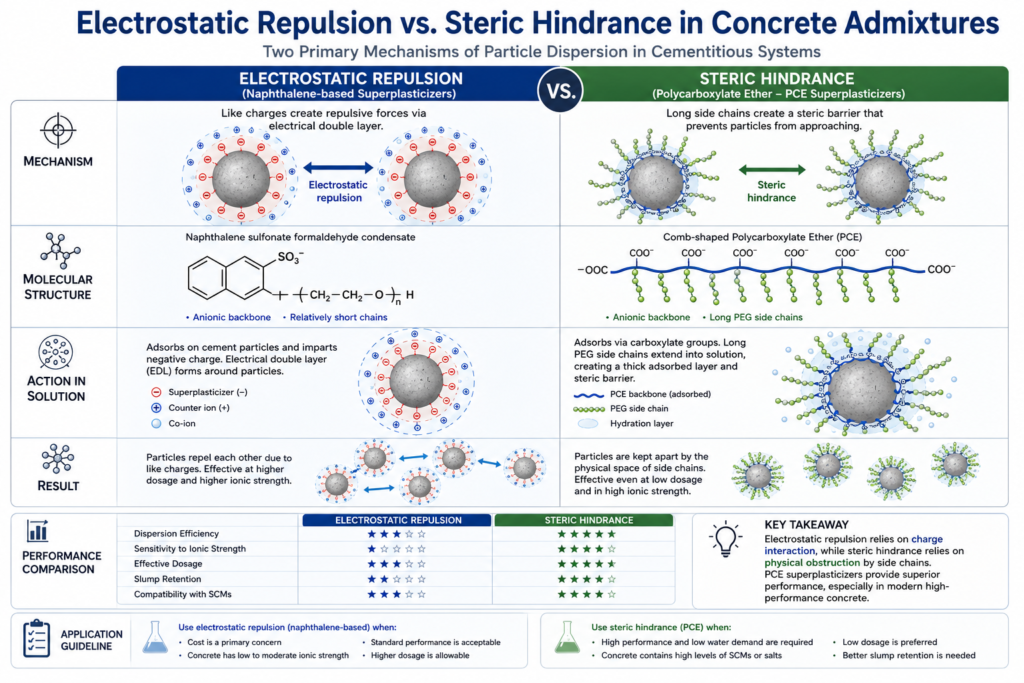
Superplasticizers break these flocs apart through two primary chemical mechanisms:
[Flocculated Cement] + Superplasticizer
       │
       ├─► Mechanism A: Electrostatic Repulsion (SNF/SMF) ──► Particles Repel
       └─► Mechanism B: Steric Hindrance (PCE)          ──► Physical Separation
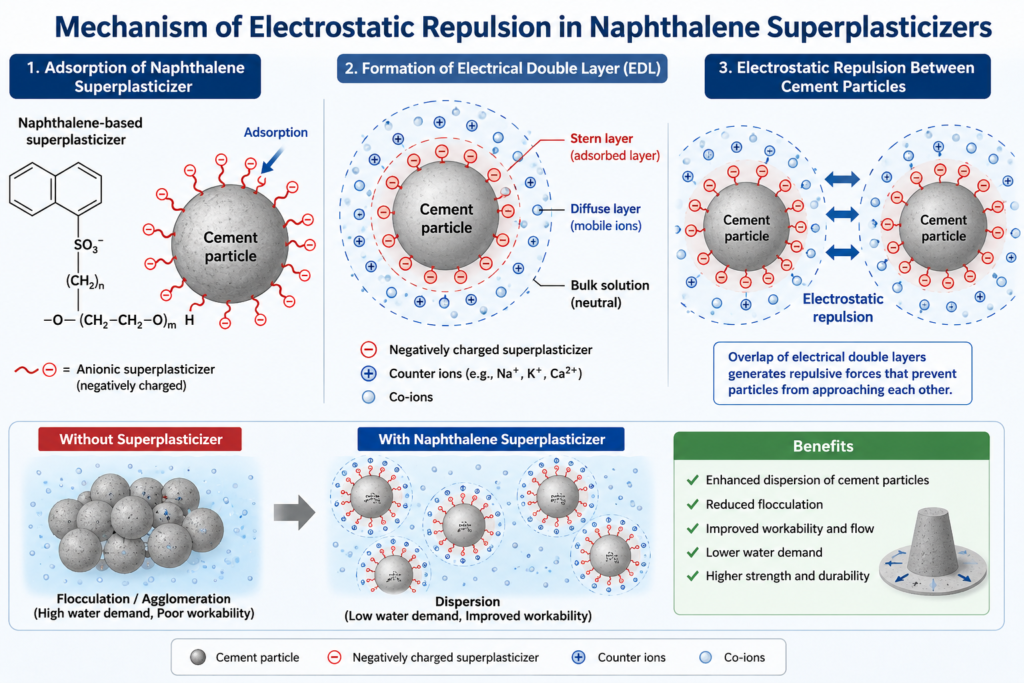
Mechanism A: Electrostatic Repulsion (Zeta Potential)
Traditional superplasticizers, such as Naphthalene-based variants, adsorb onto the surface of cement grains. These molecules carry strong negative charges, imparting a uniform negative charge to all cement particles. According to Coulomb’s Law, like charges repel. This electrostatic repulsion (measured via Zeta Potential) breaks the cement clusters, releasing the trapped water and thinning the paste.
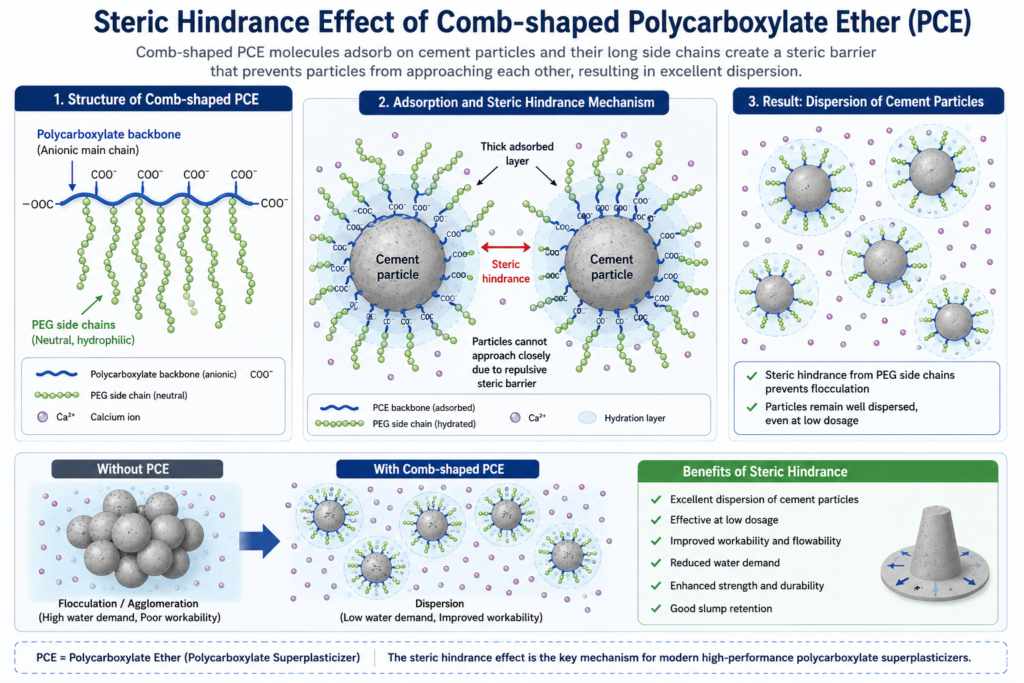
Mechanism B: Steric Hindrance
Modern superplasticizers, specifically Polycarboxylate Ethers (PCE), utilize a much more sophisticated mechanism. The PCE molecule has a highly branched structure consisting of a main carboxylic backbone and long polyethylene glycol (PEG) side chains.
While the backbone anchors to the cement particle, the side chains extend into the aqueous phase. When two cement particles approach each other, these bulky side chains overlap, generating a powerful physical barrier known as steric hindrance. This mechanism is independent of the electrical charge and provides vastly superior dispersion stability.
2. In-Depth Classification of High-Range Water Reducers
Not all superplasticizers are created equal. They are classified into distinct generations based on their chemical composition and performance profiles.
First & Second Generation: Sulfonated Polymers
These linear polymers rely exclusively on electrostatic repulsion. While highly reliable, they have performance plateaus.
- Polynaphthalene Sulfonate (PNS / SNF): Produced from naphthalene, sulfuric acid, and formaldehyde. They typically offer a water reduction rate of 15% to 25%. They are highly compatible with most standard cements but suffer from rapid slump loss (the concrete loses its fluidity within 30 to 45 minutes).
- Polymelamine Sulfonate (PMS / SMF): Modified melamine resins that provide rapid early strength. They do not entrain air and are highly favored in precast concrete and architectural concrete where surface aesthetics are critical.
Third Generation: Polycarboxylate Ether (PCE)
PCE represents the absolute pinnacle of current admixture technology. Because PCE molecules are synthesized via radical polymerization, chemical engineers can alter the length of the backbone and the density of the side chains to customize performance.
- Water Reduction: Easily exceeds 30%, reaching up to 45% in optimized mix designs.
- Slump Retention: Can maintain concrete workability for over 120 minutes without causing excessive retardation of setting times.
- Dosage Sensitivity: Highly sensitive; small changes in dosage can result in drastic changes in concrete rheology.
3. Comprehensive Comparison Table
To aid in proper material selection, the table below highlights the core performance matrix of the primary superplasticizer types used in modern construction:
| Technical Parameters | Naphthalene Sulfonate (SNF) | Melamine Sulfonate (SMF) | Polycarboxylate Ether (PCE) |
| Water Reduction Capacity | 15% – 25% | 15% – 25% | 25% – 45%+ |
| Primary Dispersion Mode | Electrostatic Repulsion | Electrostatic Repulsion | Steric Hindrance |
| Slump Retention | Poor (30–45 mins) | Moderate | Excellent (90–120+ mins) |
| Early Strength Gain | Good | Excellent | Highly Customizable |
| Air Entrainment | Low to Moderate | Extremely Low | Variable (Requires Defoamers) |
| Environmental Impact | Higher (Formaldehyde based) | Moderate | Low (Eco-friendly synthesis) |
4. Key Factors Influencing Superplasticizer Performance
Achieving the perfect mix design requires balancing several variables. A superplasticizer does not work in isolation; its efficacy depends heavily on the chemical ecosystem of the concrete mix.
Cement Chemistry and Mineralogy
The mineral composition of cement—specifically Tricalcium Aluminate (C₃A) content and the type of sulfate used as a setting regulator (gypsum, hemihydrate, or anhydrite)—drastically alters superplasticizer adsorption. Cements with high C₃A content absorb superplasticizers rapidly, reducing the amount of admixture left in the water to provide fluidity, which leads to rapid slump loss.
Supplementary Cementitious Materials (SCMs)
The integration of SCMs like Fly Ash, Slag (GGBS), and Silica Fume alters the water demand and particle packing of the mix.
- Fly Ash: Spherical particles that create a “ball-bearing” effect, working synergistically with PCE to maximize flow.
- Silica Fume: Extremely fine particles with huge surface areas that drastically increase initial water demand, requiring precise, higher dosages of PCE to prevent stickiness.
Clay Content in Aggregates
This is the single biggest threat to PCE performance. If the fine aggregates (sand) contain swelling clays like montmorillonite, the clay layers will absorb the PEG side chains of the PCE molecule, completely neutralizing its dispersing capabilities. In such cases, specialized clay-blocking sacrificial agents must be blended into the admixture.
5. Industrial Applications & Specialized Concrete Formulations
Without superplasticizers, many of the world’s modern architectural wonders would be structurally impossible to build.
                  ┌──► High-Strength Concrete (HSC) ──► High-Rise Columns
                  │
Superplasticizer ─┼──► Self-Consolidating Concrete ──► Congested Rebar Zones
                  │
                  └──► Ultra-High-Performance (UHPC) ──► Bridges & Marine Tech
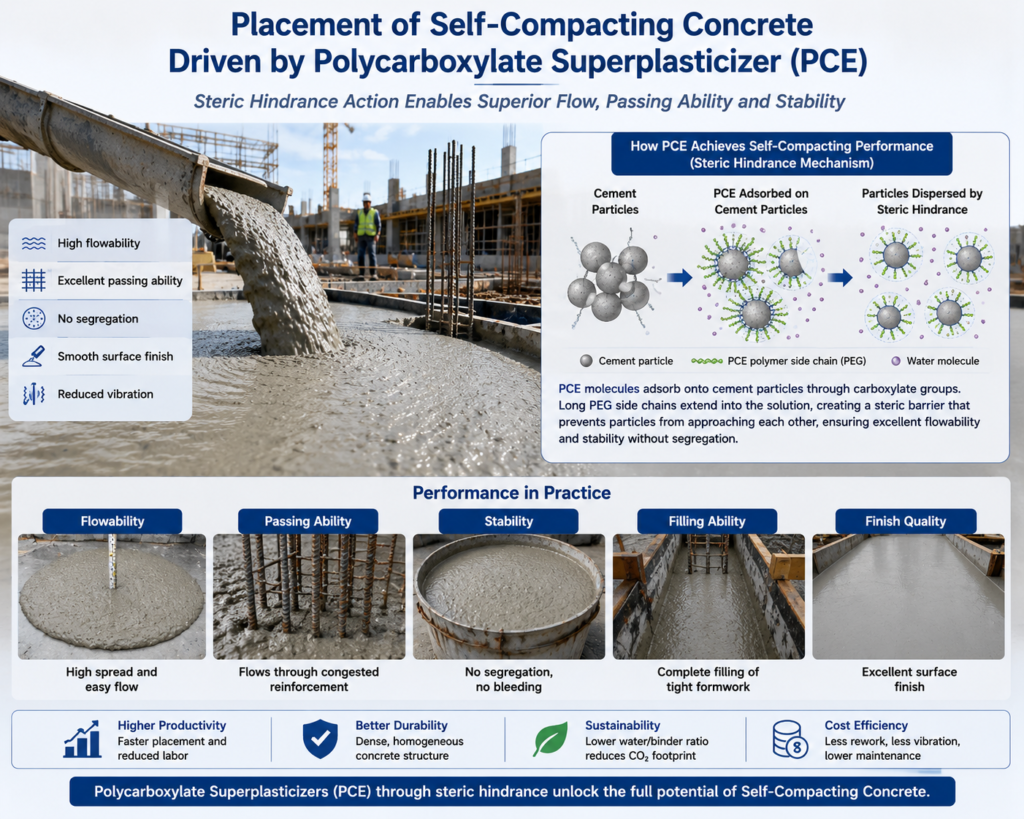
Self-Consolidating Concrete (SCC)
SCC is a highly fluid concrete that flows into formwork, flows through dense reinforcement cages, and consolidates entirely under its own weight without any mechanical vibration. PCE superplasticizers formulated with Viscosity Modifying Agents (VMA) are essential to give SCC its fluid yet cohesive nature, preventing segregation and bleeding.
High-Strength and Ultra-High-Performance Concrete (UHPC)
For structures requiring compressive strengths exceeding 100 MPa up to 200 MPa, the water-to-binder ratio must be dropped below 0.02. At this level, the mix is practically a dry powder without chemical intervention. PCE superplasticizers fluidize this ultra-dense particle matrix, making UHPC pourable.
Marine and Offshore Structures
In marine environments, permeability is the enemy. By reducing the water content, superplasticizers create an incredibly dense micro-porosity network. This prevents the ingress of harmful chloride ions, shielding embedded steel rebar from corrosion and extending the lifespan of docks, bridges, and offshore wind turbine foundations.
6. Frequently Asked Questions (FAQ)
What happens if you overdose a concrete superplasticizer?
Overdosing leads to several critical failures: severe segregation (separation of aggregate from paste), excessive bleeding, loss of structural uniformity, and extreme retardation of setting times. In worst-case scenarios, the concrete may take days to set or fail to reach its design strength entirely.
Are concrete superplasticizers toxic or hazardous?
Most modern third-generation PCE superplasticizers are water-based, non-toxic, and environmentally safe. Older generations like SNF contain trace amounts of free formaldehyde, which requires stricter handling protocols during manufacturing, though cured concrete containing them poses no health risks.
How do temperature variations affect superplasticizer efficiency?
High ambient temperatures accelerate cement hydration and water evaporation, leading to faster slump loss. In hot-weather concreting, specialized “retarding-type” PCEs are used. Conversely, cold weather slows down hydration, meaning standard superplasticizer dosages might over-retard the concrete set time.
Conclusion: The Sustainable Future of Civil Engineering
The construction industry is under immense pressure to reduce its carbon footprint. Since cement production accounts for roughly 8% of global CO2 emissions, reducing cement utilization is a environmental priority.
Concrete superplasticizers are the primary tool for achieving this goal. By allowing the substitution of cement with recycled industrial byproducts (like slag and fly ash) and maximizing the structural efficiency of thin, ultra-high-strength elements, superplasticizers are no longer just optional additives—they are the foundation of sustainable, next-generation green building infrastructure.