
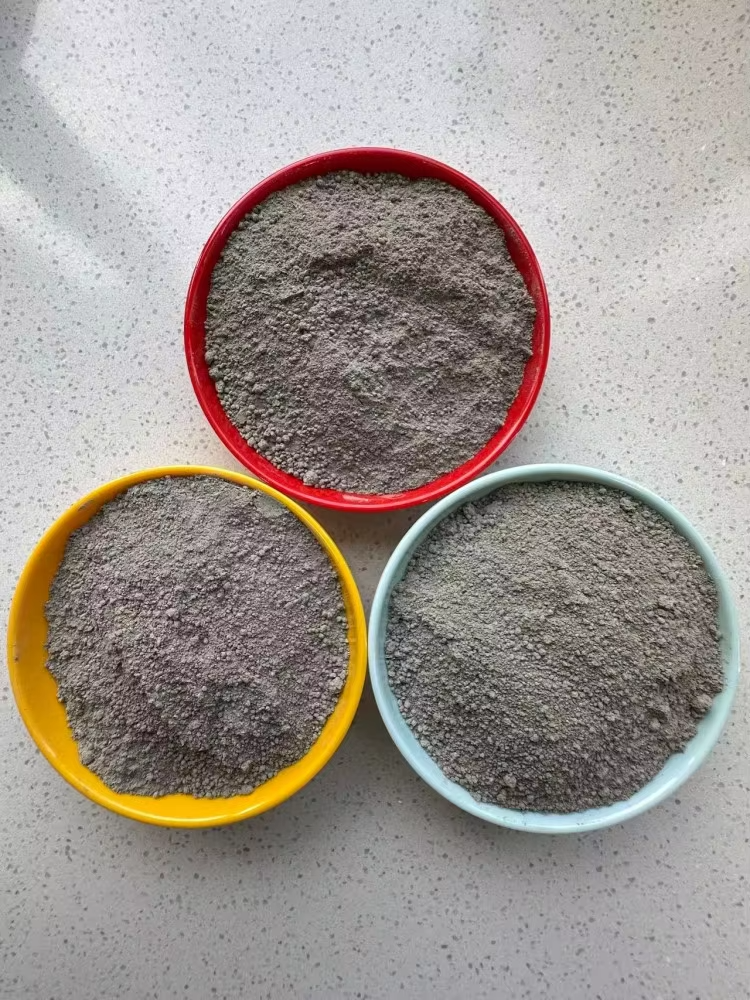
When you look at a standard sidewalk, you are seeing the result of a thousand-year-old technology: traditional concrete. But when you examine a slender, high-performance bridge joint or a blast-resistant wall, you are likely looking at Ultra-High Performance Concrete (UHPC).
To the untrained eye, UHPC might look like regular concrete, but chemically and mechanically, it is a different species entirely. Understanding its composition is the first step in mastering its application. This guide deconstructs the specific ingredients that allow UHPC to achieve its signature durability and strength.
1. The Particle Packing Theory: The Foundation of UHPC
Before diving into the “shopping list” of ingredients, you must understand the logic behind the mix. Traditional concrete relies on a skeleton of large rocks (aggregates) held together by a cement paste. This creates voids—microscopic gaps where water and salts can enter.
UHPC is designed based on Particle Packing Density. The goal is to select ingredients of varying sizes—from microns to millimeters—so that each smaller particle fills the gaps between the larger ones.
By eliminating the space for air and water, you create a material that is nearly as dense as natural granite.
2. The Core Ingredients: A Breakdown
What exactly goes into the mixer? While specific proprietary formulas vary, the “DNA” of UHPC consistently includes these five categories of materials.
A. Portland Cement (The Binder)
Like traditional concrete, UHPC uses Portland cement, but in much higher quantities. You will typically see cement content in UHPC that is two to three times higher than in a standard mix. This ensures that every surface of every aggregate particle is thoroughly coated and bonded.
B. Supplemental Cementitious Materials (SCMs)
The most critical SCM in UHPC is Silica Fume.
- The Size Factor: Silica fume particles are roughly 100 times smaller than a grain of cement.
- The Chemical Factor: It acts as a “pozzolan,” reacting with the calcium hydroxide produced during cement hydration to create additional calcium silicate hydrate (C-S-H)—the “glue” that gives concrete its strength.
C. Fine Sand (The Aggregate)
You will notice one major omission in UHPC: there is no gravel or crushed stone. Large aggregates are the “weak links” in traditional concrete because they create zones where cracks easily form. UHPC uses only fine, high-quality sands—often masonry sand or ground quartz—with particle sizes usually capped at 0.5mm to 1.0mm.
D. Steel or Organic Fibers (The “Muscle”)
This is what gives UHPC its “ductility.” In traditional concrete, if the material cracks, it fails. In UHPC, high-strength steel fibers (usually 0.2mm in diameter and 13mm long) act as internal stitches.
- Volume: Fibers typically make up 2% to 3% of the total volume.
- Function: They bridge micro-cracks, preventing them from growing and allowing the material to carry tension—a feat traditional concrete cannot perform.
E. High-Range Water Reducers (The Fluidity)
To get UHPC to flow without using a lot of water (which creates pores), you must use advanced “superplasticizers.” These chemicals coat the cement particles, giving them a negative charge so they repel each other. This allows the mix to behave like a liquid even though it has a water-to-cement ratio often below 0.20.
3. Comparison: Traditional vs. UHPC Mix Designs
To see the difference in your specifications, compare these typical proportions:
| Component | Traditional Concrete (per yd³) | UHPC (per yd³) |
| Water/Cement Ratio | 0.40 – 0.50 | 0.15 – 0.20 |
| Large Aggregate | 1,800 lbs | None |
| Fine Sand | 1,200 lbs | 1,500 – 2,000 lbs |
| Cement | 500 – 600 lbs | 1,200 – 1,500 lbs |
| Silica Fume | 0 – 50 lbs | 100 – 200 lbs |
| Steel Fibers | None | 150 – 250 lbs |
4. Why the Ingredients Matter for Your Project
When you understand what is inside, you understand the performance:
- Impermeability: Because of the silica fume and fine sands, there are no interconnected pores. This means salt water can’t reach any internal steel, preventing corrosion.
- Compressive Strength: The extreme density allows UHPC to withstand over 20,000 psi, compared to the 4,000 psi of your standard driveway.
- Longevity: Because the ingredients create a chemically stable and physically dense matrix, the service life often exceeds 100 years.
FAQ: Common Questions About UHPC Composition
Q: Can I mix UHPC using a standard concrete truck?
A: Usually, no. Because the water content is so low and the powder content is so high, the mix has high “viscosity.” You need a high-shear mixer to properly distribute the silica fume and break up “clumps” of cement.
Q: Are the steel fibers always necessary?
A: If your project requires tensile strength or “toughness” (like a bridge joint), yes. If you only need high compression and durability, “non-structural” UHPC can sometimes be made with lower fiber volumes or synthetic fibers.
Q: Does it use special water?
A: The water must be clean and potable, but the temperature is more important. Because the high cement content generates heat during mixing, ice is often used to replace a portion of the mix water to keep the batch cool.
CAT (Critical Action Task)
Before placing an order for UHPC, request the “Gradation Curve” from your supplier.
A high-quality UHPC mix should show a smooth, continuous curve of particle sizes. If there are “gaps” in the particle sizes, the mix will be more porous and less durable. Ensure your supplier can prove their packing density through a standard sieve analysis of their dry components.
Conclusion
UHPC is a masterpiece of material engineering. By removing the bulky aggregates of the past and replacing them with a meticulously graded matrix of powders and fibers, you gain a material that behaves more like steel than stone. When you specify UHPC, you aren’t just buying concrete; you are buying a sophisticated composite designed for the most demanding environments on Earth.