
Introduction
Concrete is one of the most widely used construction materials in the world. While it offers excellent compressive strength, traditional concrete has a significant limitation: it is relatively weak in tension and prone to cracking. To overcome these challenges, engineers and contractors increasingly use steel fiber reinforced concrete (SFRC).
By incorporating steel fibers into the concrete mix, structures can achieve enhanced crack control, improved durability, greater impact resistance, and superior load-bearing capacity. Today, steel fiber reinforced concrete is widely used in industrial floors, tunnels, precast elements, bridges, ports, and infrastructure projects.
This article explores the role of steel fibers in concrete, their advantages, applications, and why they have become a preferred reinforcement solution in modern construction.
What Is Steel Fiber Reinforced Concrete?
Steel Fiber Reinforced Concrete (SFRC) is a composite material made by dispersing small steel fibers uniformly throughout a concrete mixture.
Unlike traditional reinforcement methods that rely solely on rebar or welded wire mesh, steel fibers provide three-dimensional reinforcement throughout the concrete matrix.
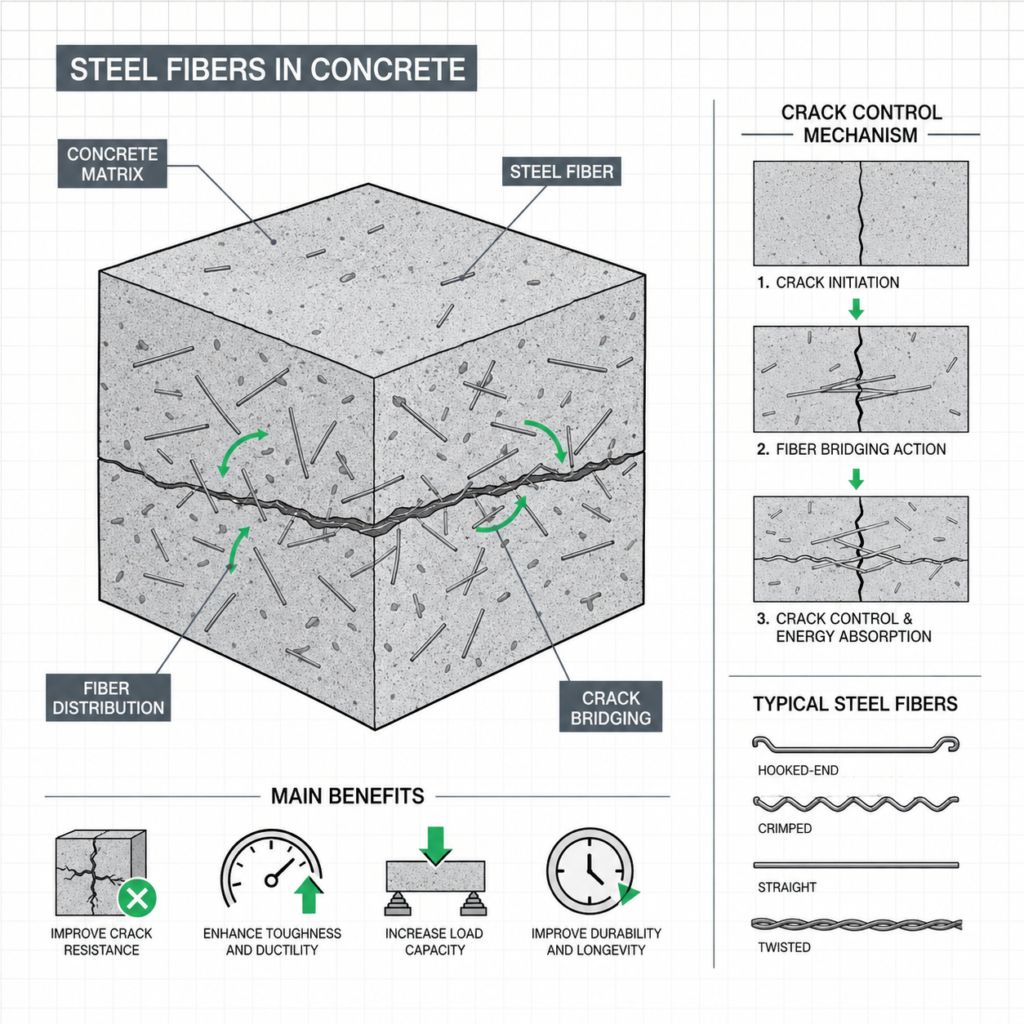
The fibers act as microscopic bridges that help control crack propagation and distribute stresses more evenly within the concrete.
Common Types of Steel Fibers
Several steel fiber designs are available depending on project requirements:
Hooked-End Steel Fibers
Hooked-end fibers provide excellent anchorage within the concrete matrix and are commonly used in industrial flooring and structural applications.
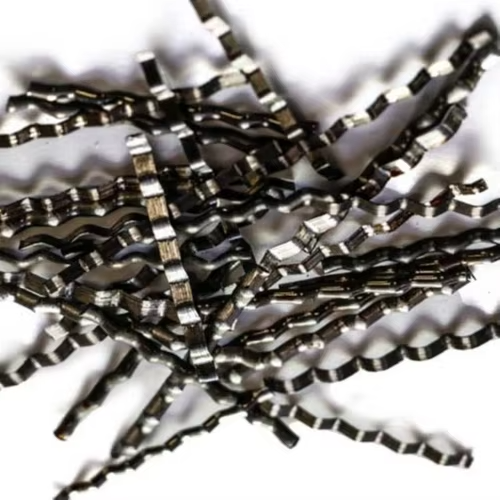
Crimped Steel Fibers
These fibers have a wavy profile that improves bonding performance and crack resistance.
Straight Steel Fibers
Straight fibers are often used in specialized precast applications and high-performance concrete mixes.
Twisted Steel Fibers
Twisted fibers offer exceptional pull-out resistance and energy absorption capabilities, making them suitable for heavy-duty structural applications.
How Steel Fiber Reinforced Concrete Works
When concrete is subjected to loading, shrinkage, temperature changes, or external impacts, microcracks begin to form.
Steel fibers help by:
- Bridging developing cracks
- Redistributing internal stresses
- Preventing crack widening
- Improving post-crack load capacity
- Increasing toughness and ductility
Instead of allowing a crack to rapidly propagate through the concrete, steel fibers hold the cracked sections together and continue transferring loads across the crack plane.
This mechanism significantly improves the overall performance and service life of concrete structures.
Benefits of Steel Fiber Reinforced Concrete
1. Improved Crack Resistance
Cracking is one of the primary causes of concrete deterioration.
Steel fibers effectively control:
- Plastic shrinkage cracking
- Drying shrinkage cracking
- Thermal cracking
- Load-induced cracking
By reducing crack widths, steel fibers help preserve structural integrity and improve long-term durability.
2. Enhanced Toughness and Ductility
Traditional concrete tends to fail suddenly when overloaded.
Steel fiber reinforced concrete behaves differently.
The fibers provide residual strength after cracking, allowing the material to absorb more energy before failure. This improved ductility is especially valuable in seismic zones and dynamic loading environments.
3. Higher Impact Resistance
Structures exposed to heavy loads, vehicle traffic, or impact forces benefit significantly from steel fibers.
Applications include:
- Warehouse floors
- Container terminals
- Airport pavements
- Military facilities
- Industrial plants
Steel fibers absorb impact energy and reduce localized damage.
4. Increased Fatigue Performance
Repeated loading cycles can weaken conventional concrete over time.
Steel fibers improve fatigue resistance by distributing stresses throughout the concrete matrix, making them ideal for transportation infrastructure and industrial flooring.
5. Improved Load-Bearing Capacity
Steel fibers increase the flexural strength and residual load capacity of concrete.
As a result, many projects can reduce or even eliminate traditional reinforcement in certain applications, leading to faster installation and lower labor costs.
6. Better Durability
Reduced cracking means fewer pathways for:
- Water penetration
- Chloride ingress
- Freeze-thaw damage
- Corrosion-causing agents
This enhanced durability extends the lifespan of structures while lowering maintenance costs.
Applications of Steel Fiber Reinforced Concrete
Industrial Floors
Industrial flooring is one of the largest markets for steel fibers.
Benefits include:
- Reduced cracking
- Improved wear resistance
- Higher load capacity
- Faster construction
Warehouses, logistics centers, and manufacturing facilities frequently utilize steel fiber reinforced slabs.
Tunnels and Underground Construction
Steel fibers are widely used in shotcrete tunnel linings because they:
- Improve structural support
- Enhance energy absorption
- Reduce rebound
- Increase construction efficiency
Many modern tunneling projects rely on steel fiber reinforced shotcrete as a primary support system.
Precast Concrete Elements
Steel fibers improve the performance of precast products such as:
- Pipes
- Panels
- Culverts
- Utility structures
The fibers help reduce conventional reinforcement requirements while maintaining structural performance.
Bridge Construction
Bridge decks and infrastructure components benefit from improved durability and crack control, particularly in aggressive environmental conditions.
Mining and Underground Support
Mining operations often use steel fiber reinforced shotcrete for rock stabilization and ground support due to its superior toughness and energy absorption characteristics.
Ports and Marine Structures
Marine environments expose concrete to chlorides and severe loading conditions.
Steel fibers help improve durability and minimize maintenance requirements in ports, docks, and coastal infrastructure.
Steel Fiber Reinforced Concrete vs Traditional Reinforcement
Many project owners ask whether steel fibers can replace conventional reinforcement.
The answer depends on the application.
Advantages of Steel Fibers
- Three-dimensional reinforcement
- Faster installation
- Reduced labor costs
- Improved crack control
- Enhanced toughness
- Better impact resistance
Advantages of Rebar
- Higher tensile load capacity
- Suitable for primary structural reinforcement
- Preferred for heavily reinforced structural elements
In many projects, the most effective solution combines both steel fibers and traditional reinforcement to maximize performance.
Factors Affecting Steel Fiber Performance
Several variables influence the effectiveness of steel fibers in concrete:
Fiber Aspect Ratio
The length-to-diameter ratio affects crack-bridging performance and workability.
Fiber Dosage
Higher fiber content generally increases performance but may affect mixing and placement.
Fiber Geometry
Hooked-end and deformed fibers typically provide better anchorage than straight fibers.
Concrete Quality
Proper mix design and quality control are essential to achieve optimal fiber distribution and performance.
Mixing Procedures
Uniform fiber dispersion is critical. Poor mixing can lead to fiber clumping and reduced effectiveness.
Sustainability Benefits of Steel Fiber Reinforced Concrete
Sustainability is becoming increasingly important in construction.
Steel fibers contribute to environmentally responsible construction by:
- Extending service life
- Reducing maintenance requirements
- Lowering material consumption
- Reducing repair frequency
- Improving lifecycle performance
Longer-lasting structures generally result in lower overall environmental impact compared with conventional construction methods.
Future Trends in Steel Fiber Reinforced Concrete
The global construction industry continues to adopt steel fiber technology due to increasing demands for durability, efficiency, and sustainability.
Emerging trends include:
- Ultra-high-performance concrete (UHPC)
- Automated concrete production
- Smart infrastructure systems
- Large-scale industrial flooring
- Advanced tunneling projects
As construction technologies evolve, steel fibers are expected to play an even larger role in high-performance concrete applications.
Conclusion
Steel Fiber Reinforced Concrete has transformed modern construction by addressing many of the limitations associated with conventional concrete.
Through enhanced crack control, improved toughness, greater impact resistance, and superior durability, steel fibers help create stronger and longer-lasting structures.
From industrial floors and tunnels to bridges and marine infrastructure, steel fibers provide an efficient and cost-effective reinforcement solution for demanding construction environments.
As the industry continues to prioritize durability, sustainability, and lifecycle performance, steel fiber reinforced concrete will remain a key technology shaping the future of infrastructure and construction worldwide.
FAQ
What is steel fiber reinforced concrete?
Steel fiber reinforced concrete is concrete containing dispersed steel fibers that improve crack resistance, toughness, durability, and load-bearing performance.
What are the benefits of steel fibers in concrete?
Steel fibers help control cracking, increase impact resistance, improve durability, and enhance structural performance.
Can steel fibers replace rebar?
In some industrial flooring and precast applications, steel fibers can partially replace traditional reinforcement. Structural projects often use both together.
Where is steel fiber reinforced concrete used?
It is commonly used in industrial floors, tunnels, bridges, ports, precast elements, and mining projects.
Industry Standards and References
ASTM Standards for Fiber-Reinforced Concrete